
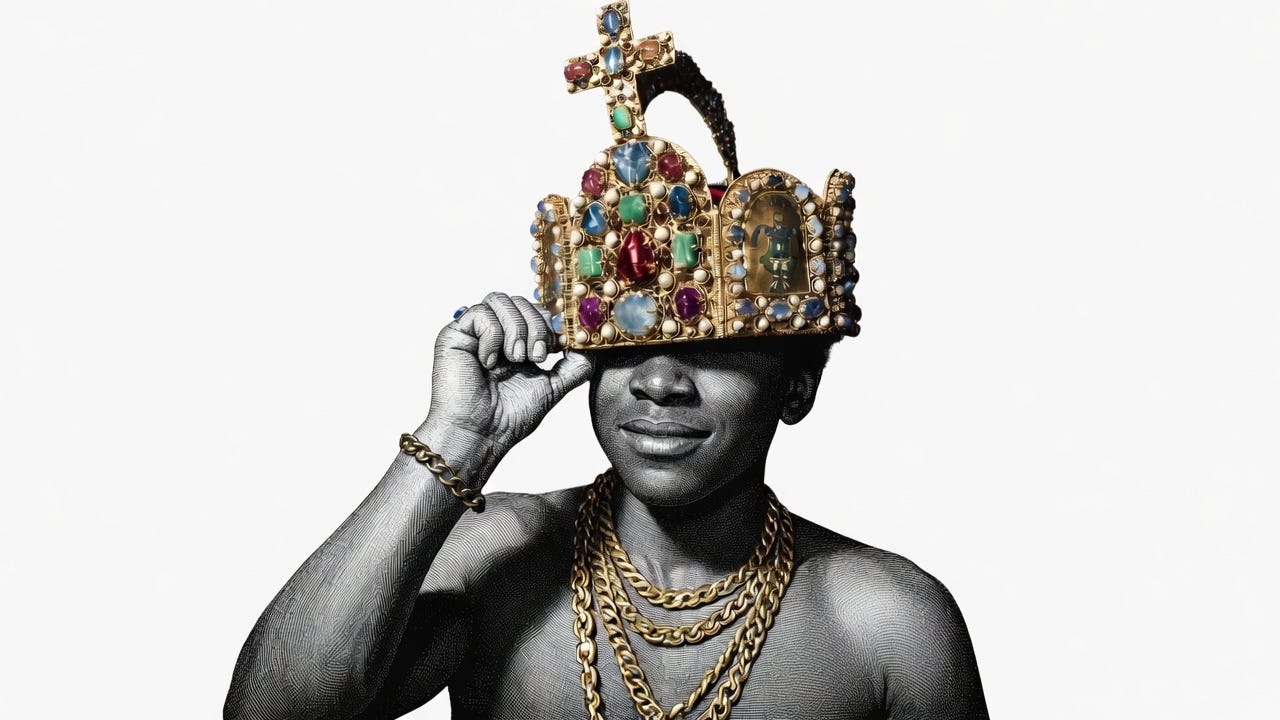
“Got my niggas[Ethiopians] in Paris [Troy] and they going guerillas” -Jay-Z
The Name of the Sea
When we speak of the Black Sea today, we rarely pause to consider the name itself. Pontos Euxinos. The Hospitable Sea. Earlier, it was Pontos Axeinos—the Inhospitable Sea. And beneath that, some linguists suggest, lies a root meaning dark, black, shadowed. A name that might describe storms, or depth, or the color of the water under overcast skies. But what if the name is older than the Greeks who gave it to us? What if it is a geological memory, a toponymic fossil, of the people who lived upon its shores? People whom the Father of History, Herodotus of Halicarnassus, described in unambiguous terms as dark-skinned, woolly-haired, circumcised, and Egyptian in origin. This essay is about those people and what happened to them—not in body, but in narrative. It is about how the language of modern genetics has been quietly deployed to continue an erasure that ancient historians had not yet learned to perform.
Part One: How to Read the Blood
To understand the crime, one must first understand the evidence. And the evidence in this case is written in two places: in the ancient texts and in the mutations of the human Y-chromosome. The Y-chromosome is a thread of DNA that passes from father to son with only rare, random changes. These changes are called Single Nucleotide Polymorphisms, or SNPs. They are spelling errors in a sixty-million-letter book. When a man acquires one of these mutations, he passes it to all his sons, and they pass it to theirs. Over generations, these mutations accumulate in a branching pattern, like a tree. By reading the order of these branches, and by mapping where the leaves of that tree fall today, scientists can reconstruct the broad strokes of ancient human movement. This is the science of haplogroups. It is a blunt instrument, but it is not a useless one.
Before we proceed, a critical distinction must be made between the two primary tools of genetic genealogy. The Y-chromosome tracks the paternal line—father to son, son to grandson. It is a laser beam through the male lineage. Because surnames in many cultures also pass from father to son, the Y-chromosome is uniquely powerful for tracking relatively recent migrations. It can tell you where your great-great-grandfather came from with remarkable precision. Mitochondrial DNA, or mtDNA, passes from mother to all her children, but only daughters pass it on. It tracks the maternal line. And because mtDNA mutates more slowly and is not tied to surnames or property inheritance patterns, it is better suited for tracking the deepest, most ancient migrations of humankind—the slow, generational drift of populations across continents over tens of thousands of years. Both tools have their place. But for the story we are telling, both must be consulted. The fathers tell one story. The mothers tell another. And together, they tell a truth that the consensus has worked very hard to bury.
Part Two: The Sibling Lineages and the African Root
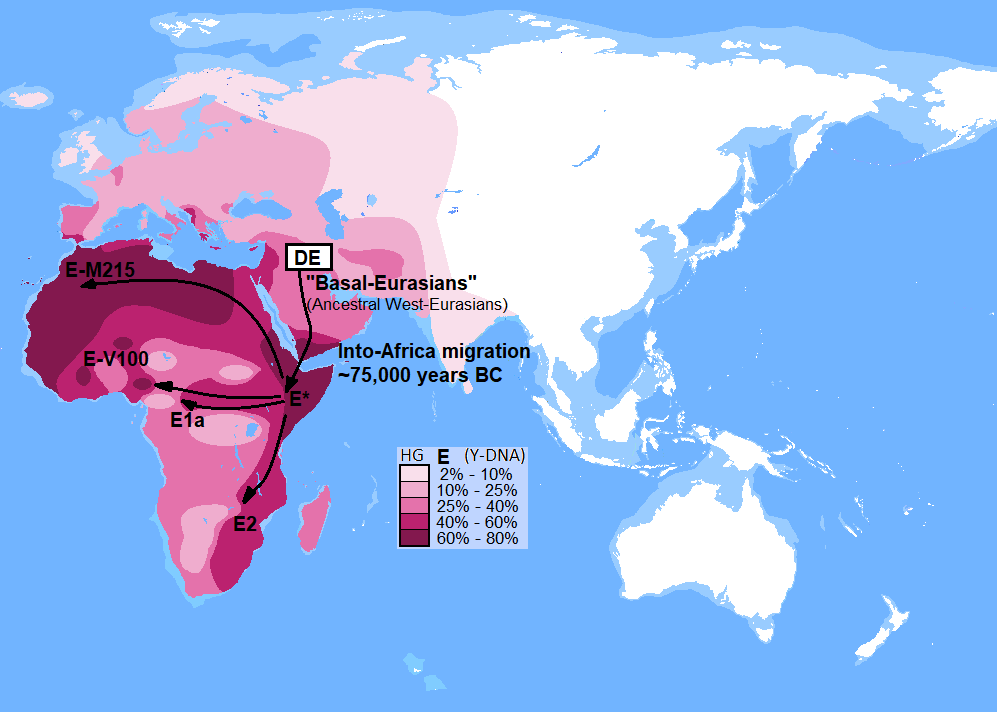
The tree of Y-DNA begins with Haplogroup A, the deepest root of all living men, found in Africa. From A came B, and from B came others. But the branch that concerns this investigation is the one designated by the letter E. More specifically, we must understand the relationship between E1b1a and E1b1b. They are siblings. They share a common father, a lineage known simply as E1b1. E1b1a, defined by the M2 mutation, is the dominant paternal lineage of West Africa and the Bantu expansions. It is, in the public imagination and in the scientific literature, unambiguously African. Its brother, E1b1b, defined by the M215 and M35 mutations, took a different path. Its highest diversity, the marker of its birthplace, lies in the Horn of Africa—Ethiopia, Somalia, Eritrea. From there, it moved north down the Nile corridor, into what is now Egypt and Sudan, and then split. One stream flowed west across the Maghreb, becoming the Berber marker E-M81. Another stream moved east into the Levant and, crucially, across the water into Southern Europe and Anatolia.
This is where we must pause to examine a specific branch of the E1b1b tree with care. The lineage known as E-V13 is one of the most common Y-chromosome haplogroups in the Balkans and Greece today. It reaches frequencies of twenty to forty percent in Albania, Kosovo, and parts of Greece. It is also found in Italy, in Sicily, and along the Mediterranean coast. The V13 mutation itself is estimated to have arisen approximately eight thousand to ten thousand years ago. But its parent lineage, E-M78, is far older. E-M78 coalesced roughly fifteen thousand to twenty thousand years ago, and its highest modern diversity and frequency are found not in Europe, not in the Middle East, but in Northeast Africa—specifically in Egypt, Sudan, Ethiopia, and Somalia. This is the parent. This is the root. The E-V13 lineage that walks the streets of Athens and Tirana today is an offshoot of an African tree. It did not come from Greek colonists spreading outward. It was already in the Balkans when the Greeks arrived. It predates the Hellenic world. It predates the Mycenaeans. It is the signature of a population that crossed the Mediterranean from Africa to Europe at a time when the Sahara was green and the sea was a highway, not a barrier.
Part Three: The Post-C Explosion, The Myth Of Arab Replacement, and the Maternal Witnesses
And it is here that we must confront the phenomenon known as the Post-C Y-Chromosome Explosion. After the initial dispersal of Haplogroup C, the next major branching in the Eurasian tree is the node known as IJK. From IJK came IJ, and from IJ came Haplogroup I—the signature lineage of the European Mesolithic hunter-gatherers, the people who painted the caves of Lascaux and hunted mammoths on the frozen steppe. But IJK also gave rise to Haplogroup K, and from K came the vast majority of lineages that now dominate the Eurasian landmass: N, O, Q, and, most famously, R. R1a and R1b are the lineages of the Indo-European expansions, the chariot-riding pastoralists from the Pontic-Caspian steppe who swept into Europe during the Bronze Age and reshaped its genetic landscape.
But there is another lineage that must be placed in this Post-C constellation, and it is Haplogroup J. Haplogroup J, defined by the M304 mutation, arose approximately forty-three thousand years ago in Western Asia, likely in the Caucasus, Anatolia, or the northern reaches of the Fertile Crescent. Its two major branches, J1 and J2, would go on to dominate the paternal landscape of the Arabian Peninsula, the Levant, and Mesopotamia. J1 is the lineage of the Bedouin, the Yemeni, and a significant portion of Jewish Cohen priests. J2 is the lineage of the ancient Phoenicians, the Minoans, and the great civilizations of Mesopotamia. Haplogroup J is, in essence, the genetic signature of the Semitic and broader Afro-Asiatic speaking world of the Middle East. And here is the fact that should give every honest observer pause: Haplogroup J rode the wave of every major imperial expansion out of the Middle East for the last four thousand years. It spread with the Phoenician maritime empire. It spread with the Assyrian conquests. It spread with the Babylonian captivity. It spread with Alexander the Great’s Hellenistic fusion. And it spread, massively and deliberately, with the Islamic Caliphate, which swept across North Africa in the seventh and eighth centuries like a scythe, bringing Arab armies, Arab administrators, and Arab genes into the Maghreb, into Egypt, into Sudan. And yet. And yet, despite more than a millennium of Arab political and cultural dominance over North Africa, despite the imposition of the Arabic language on the entire Nile-to-Atlantic corridor, despite the religious conversion of virtually the entire indigenous Berber and Egyptian population to Islam, Haplogroup J never became the dominant paternal lineage in North Africa. It hovers at twenty to forty percent in coastal cities. It is present. It made its mark. But the majority of North African men, from the Siwa Oasis to the Atlantic coast of Mauritania, still carry the E1b1b lineage. They still carry the Berber marker E-M81. They still carry the Egyptian marker E-M78. The Arab conquest, for all its linguistic and religious success, was a demographic failure. The paternal line of North Africa remained stubbornly, resolutely, African (Majority E not J). The same cannot be said for the fate of the indigenous populations of Anatolia, where the Post-C explosion and subsequent Steppe migrations overwrote the older E1b1b and J2 substrate so thoroughly that the modern Turk carries more genetic heritage from the Altai Mountains than from the Colchian shore. The North African resisted. The North African endured. And yet, when we speak of North Africa today, we reflexively, lazily, call it part of the Arab world. We erase the genetic continuity with a linguistic label. We pretend the J haplogroup did what it manifestly failed to do.
Maternal Ancestors
And while the Y-chromosome tells the story of the fathers, the mothers left their own indelible signature. A signature that, in many ways, is even more damning to the consensus narrative because it cannot be explained away by Phoenician traders, Greek colonists, or Arab conquerors. Mitochondrial DNA lineages tell a story of African women crossing into Europe at a time so ancient that no imperial narrative can account for it. And the specific lineages that concern this investigation are U6, L, X1, and M1.
Haplogroup U6 is the maternal counterpart to the Y-DNA Berber marker E-M81. It is a lineage that arose in North Africa and, critically, is found in Iberian populations at frequencies reaching 7.5% in western Andalusia. But the frequency is not the most important detail. The most important detail is the date. A 2015 study in PLOS ONE documented U6 lineages entering Iberia at roughly 10,000 years ago, during the Early Holocene. This is thousands of years before the Phoenicians set sail. Thousands of years before the Carthaginians built their empire. Thousands of years before the first Arab armies crossed the Sinai. This African maternal lineage was in Europe while the Sahara was still green, while the ice sheets were still retreating, while the Neolithic revolution was still in its infancy. It predates every conceivable historical vector that could be used to explain it away as “recent” or “colonial” or “slave trade.” It is a deep, aboriginal African presence in Europe. And the study explicitly notes that U6 and some L lineages “moved together from Africa to Iberia in the Early Holocene.” They came together. African men and African women, crossing the Mediterranean as families, as communities, as a people.
**Haplogroup L is the macro-lineage that encompasses the deepest maternal roots of humanity. It is the mitochondrial Eve lineage, the mother of all mothers. And it, too, appears in Iberia at frequencies that cannot be dismissed as noise. The Andalusian study found L lineages at 3.93% in Huelva and 1.49% in Granada, with subclades including L1b, L2a, L2b, and L3d. These are not North African variants diluted by millennia of Mediterranean mixing. These are lineages whose deepest roots lie in Sub-Saharan Africa. And they entered Iberia in the same Early Holocene window as U6. This means African women from both North Africa and the sub-Saharan interior were crossing into Europe and establishing families 10,000 years ago. This is not the Arab slave trade. This is not the Roman occupation. This is not the Moorish conquest. This is a migration so ancient that it precedes every historical event that could be used to “explain away” African ancestry in Europe. The maternal line proves what the paternal line only suggests: Africa was in Europe before Europe knew what Europe was. **
**Haplogroup X1 is a maternal lineage largely restricted to North Africa, the Horn of Africa, and the Near East. Its distribution mirrors the Afro-Asiatic corridor described by Herodotus—the same geographic arc that stretches from Ethiopia to Egypt to the Levant to Anatolia. The X2 subclade shows high frequencies in Georgia (8%) and among the Druze of Israel (27%), and has been found in ancient Egyptian mummies. This is the maternal signature of the very populations Herodotus was describing. The Colchians of the Black Sea coast, whom he identified as dark-skinned and woolly-haired Egyptians, carried maternal lineages that trace back to the same North and East African gene pool as the Egyptians themselves. The genetics and the texts align perfectly. The women of Colchis were, in their mitochondrial DNA, kin to the women of the Nile. **
**Haplogroup M1 is found in Northeast Africa and appears at low but persistent frequencies in Andalusia (0.36-0.64%). Its presence alongside U6 and L reinforces that the African maternal contribution was multi-regional—from the Maghreb, the Nile Valley, and the Horn. Africa did not send a single wave of migrants to Europe. It sent multiple streams, from multiple regions, over multiple millennia. The maternal evidence shows a sustained, continuous relationship between the two continents, not a series of isolated historical events. **
**The asymmetry in how this evidence is treated is glaring. When European Y-DNA lineages like R1b appear in Central Africa, the narrative is clear and directional: this is a back-migration from Eurasia. The vector is stated plainly. The implication of population movement is accepted without hesitation. But when African mtDNA lineages like U6 and L appear in Iberia at 10,000 years of antiquity, the narrative becomes hesitant, qualified, hedged. We are told it is “complex.” We are told it requires “further study.” We are told it might represent “ancient North African” populations—as if “North African” were not a subcategory of African. The double standard is so brazen, so transparent, that one marvels at the collective agreement to look past it. African maternal lineages in Europe are ancient, they are diverse, and they predate every historical conquest that could be used to distance them from the Africa we are not supposed to imagine as having contributed to European civilization. **
And let us speak plainly about another label, a label that has attached itself to every conversation about Haplogroup E with the tenacity of a barnacle on a ship’s hull. That label is Sub-Saharan. Whenever the E1b1b lineage is mentioned, whenever its presence in Europe or the Levant is acknowledged, the qualifier arrives with almost comical predictability: Well, it is not Sub-Saharan. It is North African. It is Mediterranean. It is something other than the Africa we are allowed to imagine as having contributed anything to world civilization. And yet, when we speak of the R1a and R1b lineages that poured out of the Pontic Steppe, when we speak of the Indo-European riders who transformed the genetic landscape of Europe and South Asia, no one feels compelled to attach a Supra-Caucasus label to them. No one rushes to clarify that these were not the same as the R1b lineages found in Western Europe. No one insists on parsing the Steppe pastoralists into a thousand micro-categories to distance them from the implications of their origin. The double standard is so brazen, so transparent, that one marvels at the collective agreement to look past it. The tribes of the Steppe, who mostly lay dormant in their frozen grasslands for tens of thousands of years before the domestication of the horse and the invention of the chariot gave them their brief, violent moment of imperial glory, are granted the dignity of a unified origin story. They are the Indo-Europeans. They are the Aryans. They are the Kurgan culture. They are treated as a coherent civilizational force. But the African lineages that gave the world metallurgy, agriculture, writing, and the very names of the Greek gods are sliced into Sub-Saharan and North African and Mediterranean and Near Eastern until there is nothing left of Africa to claim credit for anything at all. The E1b1b lineage is African. Its parent is African. Its highest diversity is in the Horn of Africa. The mtDNA lineages U6, L, X1, and M1 are African. Their deepest roots are African. Their presence in Europe predates every empire that ever claimed the Mediterranean. And the refusal to say so is not science. It is cowardice.
This is the erasure. It is the deliberate, or at least habitual, refusal to state plainly what the genetic and textual evidence plainly states: that a population of African origin, carrying the E1b1b lineage on the paternal side and U6, L, X1, and M1 lineages on the maternal side, was present in Southern Europe and Anatolia before the arrival of the Indo-European speakers, before the rise of Classical Greece, before the Neolithic farmers of Anatolia made their way into the Danube basin. They were there. And we know they were there because a man who lived twenty-five centuries ago wrote down what he saw with his own eyes and heard with his own ears.
E1b1b is prevalent across two main geographic regions: the Horn of Africa (with frequencies of 40-80%) and North Africa (often exceeding 60-80% among certain populations). It also appears at lower frequencies in Southern Europe and the Middle East .
Here is a list of ethnicities and populations where this haplogroup is notably common:
· Somalis: ~80%
· Ethiopians (Amhara, Oromo, Ethiopian Jews): 40-80%
· Gabra (Kenya/Ethiopia): 82.6%
· Moroccan Berbers: 72-98% (reaches near 100% in some isolates)
· Egyptians: ~37% (higher in the Western Desert)
· Moroccan Arabs: ~31-65%
· Saharawi (Morocco/Western Sahara): ~76%
· Tuareg (Burkina Faso/Mali): 78-82%
· Albanians: ~25-47% (especially Kosovo Albanians)
· Greeks: ~21%
· Italians (Southern/Sicily): ~18-20%
Here’s the breakdown of why E1b1a and E1b1b share the “E1b1” prefix:
· They are “Brother” Lineages: They are not a linear sequence where one evolves into the other. Instead, they are distinct branches that split from the same parent group (Haplogroup E1b1) around 47,500 years ago . Their names reflect this shared parentage; the “a” and “b” simply denote two different sons of the same “E1b1” father.
· The Naming System: The Y Chromosome Consortium developed a hierarchical system using alternating numbers and letters to show this nesting . Think of it like an outline:
· E (Major lineage)
· E1 (Child of E)
· E1b (Child of E1)
· E1b1 (Child of E1b)
· E1b1a & E1b1b (Two distinct children of E1b1)
· Stable Names, Not Importance: Haplogroup names are based on a branching tree, not on the “importance” or geographic spread of the lineage . Since E1b1a and E1b1b both branched directly from E1b1, the naming convention keeps them as “a” and “b” regardless of how large or widespread they later became.
To reach R1a or R1b from this point, one must exit the E tree entirely and return to the common root of all non-African Y-chromosome lineages, as E and R diverged from the shared ancestral population tens of thousands of years ago. The path to R1b ascends back through the major branching points of the human Y-chromosome tree, crossing from the DE lineage into the CF lineage, then through the macro-haplogroups that define the great population movements of the Upper Paleolithic and Neolithic.
The standard Y-chromosome phylogenetic maps achieve their obscuring effect through a simple visual convention: they place E1b1a and E1b1b on separate branches of the tree, often on opposite sides of a diagram, with the label “Sub-Saharan African” affixed to the former and “Mediterranean” or “North African” or “Afro-Asiatic” to the latter. The shared parent E1b1 is acknowledged in the fine print—the nomenclature is technically accurate, the branching is phylogenetically correct—but the graphic presentation systematically minimizes the sibling relationship. A reader unfamiliar with the intricacies of haplogroup naming will see two distinct lineages, each occupying a different geographic and racial box, and will not instinctively grasp that E1b1a and E1b1b are brothers. The brotherhood is the fact that matters. The brothers share a father, E1b1, who lived in Africa roughly forty-seven thousand years ago. The sons took different paths—one westward into the Bantu expansions, one northward along the Nile corridor into the Levant and Southern Europe—but they are equally African in origin, equally old, equally divergent from the ancestral stock. The maps do not lie about this. They simply arrange the visual field so that the eye slides past the connection without stopping. The Mediterranean is colored one shade. The Sahel is colored another. The Horn of Africa is assigned its own ambiguous tint. The color coding does the work that the text cannot perform without exposing its own prejudice. The brothers are separated by the logic of the legend before the mind can register that they share a parent. The result is not falsification. It is misdirection. The data is there. The relationship is visible to anyone who traces the branches back to the fork. But the map has already trained the eye to read the branches as distinct races before the fork comes into view.
Part Four: Why Does Herodotus’ Account Align With The Haplomaps?
One man’s ancient account makes it impossible to dismiss the preceding paragraphs. The man usually states that he reports what he is told, but in many of his accounts on the following subject, he says I, saw. That man was Herodotus. And with the Post-C explosion now understood as the genomic context in which these African-descended populations were already operating, and with the maternal lineages confirming the depth and breadth of the African presence, we can turn to his accounts with fresh eyes, reading between every line for the truths that later centuries would work so hard to bury.
Herodotus of Halicarnassus composed his Histories in the fifth century before the Common Era. He was born in Caria, in what is now southwestern Turkey. He was a Greek speaker, but he was also a subject of the Persian Empire, a traveler, and a man of insatiable curiosity. He recorded what he was told, and sometimes he recorded what he doubted. But on the matter of the Colchians (Georgia), he was emphatic and precise. In Book Two, Section One Hundred and Four, he writes: “For the Colchians are evidently Egyptian, and this I perceived for myself before I heard it from others. And when I had come to consider the matter, I asked both peoples, and the Colchians had better remembrance of the Egyptians than the Egyptians of the Colchians. The Egyptians said that in their opinion the Colchians were of the army of Sesostris. I myself had guessed this, because they are dark-skinned and woolly-haired. This amounts to nothing in the way of proof, since there are other peoples that are so too. But I base my argument on the stronger evidence that alone of all mankind, the Colchians, the Egyptians, and the Ethiopians have practiced circumcision from the first.”
There is no ambiguity here. Herodotus sees a population on the eastern shore of the Black Sea, in what is now the nation of Georgia, and he identifies them as Egyptians based on two observable traits: their skin color, which he describes with the word melanchroes, and their hair texture, which he describes as woolly, oulotrichos. He also notes a cultural practice, circumcision, that binds them to Egypt and Ethiopia. He is not describing a Caucasian population tanned by the sun. He is describing an African-descended people living at the foot of the Caucasus Mountains. And he is not alone in this observation. Modern haplogroup studies confirm that E1b1b, specifically the E-M78 subclade, is present in Georgia and the surrounding Caucasus region. And mtDNA X2, found in Egyptian mummies, appears at 8% frequency in Georgia. The paternal and maternal lines both point to the same conclusion: Herodotus was right. The ghost in the genome is not a ghost. It is an ancestor.
And consider the Ethiopians themselves. In Book Three, Section Twenty, Herodotus describes the Ethiopian tribes known to the Persians. He distinguishes between the straight-haired Ethiopians of Asia, who served in Xerxes’ army alongside the Indians, and the Ethiopians of Libya, who have the woolliest hair of all men. This distinction is critical. It shows that Herodotus was not working with a monolithic concept of African peoples. He observed variation. He recorded it. And yet, when he looked at the Colchians, he saw Egyptians and Ethiopians. He saw the woolly-haired type. He saw Africa on the Black Sea.
The connection does not end at the Colchian coast. In Book Seven, Section Seventy-Three, Herodotus makes a passing remark that is easy to overlook but impossible to overstate. He writes: “The Armenians were armed just like the Phrygians, being settlers from the Phrygians.” This is the link. The Phrygians were an ancient people of central Anatolia. In Book Two, Section Two, Herodotus recounts the famous experiment of the Egyptian Pharaoh Psammetichus. Wishing to discover the oldest race of mankind, Psammetichus isolated two newborn children and waited to hear what word they would first speak. The word was bekos, which the king’s investigators discovered was the Phrygian word for bread. The Egyptians therefore concluded that the Phrygians were the oldest race on earth, older even than themselves. This is a myth, but it is an Egyptian myth about Phrygian antiquity, recorded by a Greek historian. It places Phrygia at the apex of human chronology. And if the Armenians are settlers from the Phrygians, and the Phrygians are the primordial people of Anatolia, then the Colchian description of dark skin and woolly hair takes on a vast geographic significance. It suggests that the entire highland corridor from Anatolia to the Caucasus was once populated by people whom Herodotus would have recognized as kin to the Egyptians.
The erasure deepens when we consider the case of the Cappadocians (Turkey). In Book One, Section Seventy-Two, and again in Book Seven, Section Seventy-Two, Herodotus refers to the people of Cappadocia as Syrians. But in Book Seven, he makes a critical distinction. He calls them Leuco-Syrians—White Syrians. The prefix is the key. Why would Herodotus need to specify that these Syrians were white? Because the default Syrian, the normative Anatolian in his ethnographic framework, was not white. The term Leuco-Syrian only makes sense if there were other Syrians who were darker, against whom these highland peoples were being contrasted. The language itself reveals the baseline. The baseline was dark. The baseline was, in the terminology of the time, Egyptian or Ethiopian.
Now consider the Lydians, another Anatolian people closely linked to this web. In Book Seven, Section Seventy, Herodotus describes the armament of the various nations in Xerxes’ army. He notes that the Lydians were armed much like the Greeks. But more telling is his description of their neighbors and kin. In Book One, Section One Hundred and Seventy-One, he writes that the Carians, the Mysians, and the Lydians are brethren. They share an ancient temple to Carian Zeus at Mylasa, open only to those three peoples. This is a recognized kinship among the indigenous Anatolian populations. And what of their appearance? Herodotus does not describe the Lydian hair directly in the surviving text with the same detail as the Colchians, but he places them firmly within the Anatolian matrix that includes the woolly-haired Colchians and the dark Syrians. Contrast this with his description of the Indian and Arab nexus. In Book Seven, Section Seventy, he notes the straight hair of the Indians and the Eastern Ethiopians. The Lydians and their brethren are not placed in that straight-haired, eastern category. They belong to the Anatolian west, the world that touches the Aegean and the Black Sea, the world that Herodotus sees as connected to Egypt.
And what of the Nubians? In Book Two, Section Twenty-Nine, Herodotus describes the journey up the Nile beyond Elephantine. He notes that beyond the island of Tachompso, the country is inhabited by Ethiopians. And he records a remarkable detail: these Ethiopians, the Nubians of the far south, are described as hunting the savage Ethiopians, the Troglodytes, who are fleet of foot and live in caves. This is a world of African peoples interacting with African peoples. It is a reminder that the Nile Valley was not a boundary between races but a corridor of continuous variation. And it is from this corridor that the parent lineage of E-V13, the E-M78 mutation, arose. And it is from this same corridor that the maternal lineages U6, L, and M1 began their long journey to the Mediterranean and beyond. The Nubians, the Egyptians, the Ethiopians of the south—they are all part of the same deep genetic and cultural stream. And Herodotus places the Colchians squarely within that stream.
Part Five: The Black Doves of Dodona
And then there is the matter of the oracles. In Book Two, Sections Fifty-Four through Fifty-Seven, Herodotus investigates the origins of the oracle of Zeus at Dodona, the oldest oracle in Greece. He records two versions of the story. The Egyptian priests of Thebes told him that Phoenicians had carried off two priestesses from their city. One was sold into Libya, where she founded the oracle of Ammon. The other was sold into Greece, where she founded the oracle at Dodona. The priestesses of Dodona themselves told a more mythologized version: two black doves flew from Thebes in Egypt. One landed in Libya and commanded the founding of Ammon’s oracle. The other landed on an oak tree at Dodona and, speaking with a human voice, ordered the establishment of an oracle to Zeus. Herodotus then provides his own rationalization. He suggests that the women were called doves because they were foreigners and their speech sounded like the twittering of birds. Once they learned to speak intelligibly, the locals said the dove had spoken. The core fact remains: the founding priestesses of the oldest oracle in Greece were Egyptian women. They were black doves from Thebes. The voice of Zeus at Dodona was, by the Greeks’ own admission, a Black African voice.
And here the mtDNA evidence circles back with almost poetic force. The maternal lineages U6, L, X1, and M1 that appear in ancient and modern European populations are the genetic echo of those Black doves. African women—priestesses, mothers, founders—crossed the sea and planted their lineages in European soil. They did not come as slaves. They did not come as concubines. They came as oracles. They came as founders of the most sacred sites in the Greek world. The maternal DNA proves that the story Herodotus recorded was not a myth. It was a memory. And the memory was African.
This is the thread that ties Africa to the spiritual heart of ancient Greece. And it is not an isolated thread. The Phoenicians appear in this account as the agents of the priestesses’ dispersal. And Herodotus tells us in Book One, Section One, that the Phoenicians came originally from the Erythraean Sea—a term that in ancient geography encompassed the Indian Ocean, the Arabian Sea, and the Persian Gulf. They settled on the Mediterranean coast and became the great mariners of antiquity. This is a complex and contested origin, and it is not the purpose of this essay to claim the Phoenicians as simply African or simply Arabian. But it is essential to note that the vector of cultural and genetic transmission that Herodotus describes runs from south to north, from the Erythraean Sea to the Mediterranean, from Egypt to Greece. It is the same vector that the haplogroup E1b1b traveled. It is the same vector that the maternal lineages U6 and L traveled. The direction is consistent. The evidence is consistent. Only the narrative is inconsistent.
Part Six: The African Foundations of Greece
The Greeks did not invent their civilization in a vacuum. They built upon foundations laid by older, darker peoples. The Colchians, with their Egyptian customs and their Golden Fleece, were masters of metallurgy and gold-washing. The Lydians, brethren of the Carians and Mysians, were the first to coin money. The Phoenicians gave the Greeks their alphabet. The Egyptians gave them their gods, their architecture, and, as Herodotus himself admits, the very names of most of the Greek deities. In Book Two, Section Fifty, he writes that the names of nearly all the gods came to Greece from Egypt. This is not a fringe theory. This is the testimony of the Father of History. The civilization that we call Greek, that we hold up as the cradle of the West, was built on a substrate that was African and Afro-Asiatic. And the genetic evidence, in the form of E1b1b and its subclades on the paternal side, and U6, L, X1, and M1 on the maternal side, confirms that this was not merely a cultural diffusion. It was a migration of people. Men and women who carried the M78 mutation and the U6 and L maternal lineages walked from the Nile to the Balkans, from the Horn of Africa to the Black Sea. They built temples. They founded oracles. They minted coins. They taught the Greeks how to wash gold from the rivers of Colchis. And then, over millennia, they were absorbed, diluted, and forgotten.
Part Seven: The Asymmetry of Erasure
The intellectual dishonesty of the standard narrative lies in its asymmetry. We are comfortable talking about R1b in Africa as a European back-migration. We are comfortable talking about the Indo-European conquest of Europe. We are even comfortable talking about the Neanderthal admixture that gave Europeans their distinctive immune systems and skin and hair variants. But we are profoundly uncomfortable talking about the African admixture that gave Southern Europe its earliest farmers, its oldest oracles, and its first circumcised, woolly-haired populations. We are uncomfortable talking about African maternal lineages that predate every empire, every conquest, every slave trade that could be used to explain them away. We hide this discomfort behind a screen of technical language. We call E1b1b Mediterranean. We call J2 Near Eastern. We call G2a Anatolian. We call U6 North African and then act as if North African were not a geographic subset of African. We call L lineages Sub-Saharan and then use that label to quarantine them from the Mediterranean story. We use geography as a proxy for race, and then we define geography in a way that excludes Africa. The Nile Valley, which is geographically part of Africa, becomes culturally part of the Middle East. Egypt, which is physically in Africa, becomes civilizationally in the Mediterranean. And the Colchians, who lived on the Black Sea and were described as dark-skinned and woolly-haired Egyptians, become a mysterious Caucasian tribe whose true origins are lost to time.
The mtDNA evidence makes this erasure even more egregious. Because mtDNA mutates slowly and is passed only through the maternal line, it preserves signals of ancient migrations that Y-DNA, with its more rapid turnover and its vulnerability to male-mediated conquest and replacement, often obscures. The fact that U6 and L lineages persist in Iberia at frequencies of several percent, and that they entered Europe 10,000 years ago, means that the African presence in Europe is not a footnote. It is a chapter. A chapter that has been torn out of the book and hidden in the appendix, under a heading that reads “Miscellaneous Admixture.”
Epilogue: The Dark Sea Remembers
The truth is not lost. It is buried. It is buried under layers of euphemism and omission. It is buried under a historiography that has spent centuries separating Greece from its African roots, Europe from its African populations, and the Black Sea from its African shoreline. Herodotus saw the connection clearly. He saw Egyptians in Colchis, Phrygians at the dawn of time, Black doves at Dodona, and brothers in Caria and Mysia. He saw Nubians hunting savage Ethiopians along the upper Nile. He saw Lydians and Carians sharing temples and kinship. He saw a world in which the boundaries between Africa, Asia, and Europe were porous and populated by peoples who did not fit the neat racial categories of a later age. And he wrote it down.
The mutations in our DNA confirm the broad outline of his account. The Y-DNA lineage E1b1b, born in the Horn of Africa, walked north to Egypt, jumped the sea to the Balkans, and settled the shores of the Black Sea. The mtDNA lineages U6, L, X1, and M1, born in North and East Africa, crossed the Mediterranean 10,000 years ago and planted themselves in Iberian soil, where they remain to this day. The paternal and maternal lines tell the same story: Africa was in Europe before Europe knew what Europe was. Africa gave Europe its gods, its oracles, its alphabet, its metallurgy, and its blood. The lineages are there, in the bones and in the blood. They have been diluted, overwritten, and absorbed. But they have not disappeared.
The Black Sea is not a metaphor. It is a body of water that touches six nations and empties into the Mediterranean. It was once called the Inhospitable Sea, and before that, perhaps, simply the Dark Sea. It is dark now in a different way. It is dark with the shadow of a forgotten Africa, a drowned memory of a time when the shores of Colchis were walked by men and women whom the Greeks recognized as kin to the people of the Nile. The genetic maps show the traces. The ancient texts preserve the descriptions. The erasure is not total, because erasure can never be total. The past leaves marks. And those marks, read carefully and honestly, tell a story that the consensus has not yet learned to tell. It is a story of African tribes starting civilizations that influenced Greece. It is a story of Black doves speaking oracles in the oldest shrine of Zeus. It is a story of African mothers whose mitochondrial DNA still circulates in European bloodlines, unacknowledged and uncelebrated. It is a story written in blood, in bone, and in the silent, stubborn mutations of the Y-chromosome and the mitochondrial genome alike.
The scholars have decided that Herodotus, who was there, who saw with his own eyes, who asked the Colchians and the Egyptians the same questions and compared their answers, must have been confused. The debate over whether Herodotus described the Colchians as "dark-skinned" or "Ethiopian" is a masterpiece of scholarly evasion. The word he uses is melanchroes, which means, quite simply, dark-skinned. The word he uses for the Egyptians and Ethiopians, elsewhere in the same book, is also melanchroes. He says the Colchians look like Egyptians. He says they practice circumcision, alone among all mankind, alongside the Egyptians and Ethiopians. He says the Colchians are evidently Egyptians, and he bases this on his own observation and his own inquiries. The conclusion is not ambiguous. The Colchians were not Egyptians. They were just very, very tan.