

Iuppiter Nostrum Feudalism Invisibilem Foveat
The network does not need violence. It installed a script where compliance became the only rational choice. Inflation makes saving irrational. Property taxes make land ownership contingent on continuous payment. Dollar hegemony makes trade dependent on U.S. approval. Debt makes the future subordinate to the present. You can resist. But resistance comes at a cost. And the cost compounds.
The Engineered Trap: How Inflation, Debt, and Dollar Hegemony Enforce Perpetual Compliance
The American monetary system was deliberately engineered to be inflationary. It compels perpetual economic participation by ensuring money steadily loses value over time. The simple act of holding cash became a losing strategy. To preserve wealth you must constantly deploy capital — investing, lending, spending, working. Property taxes add relentless pressure, forcing even outright homeowners to keep paying or risk losing their land to the state. The entire structure rests on a single unspoken philosophy: humans are inherently lazy, work must be compelled, and no one should ever be permitted to simply stop.
This control operates across four dimensions:
Time: You must keep working (inflation erodes savings).
Space: You must keep trading (dollar hegemony erodes alternatives).
Body: You must keep producing (debt requires repayment).
Mind: You must keep believing (the system is presented as natural, not designed).
The Federal Reserve was never meant merely to manage the business cycle. It was created to mobilize America’s fragmented, localized capital into a unified credit engine for global power projection — the exact gap Paul Warburg designed it to fill. Subsequent 1917 amendments enabled the Fed to monetize government bonds, transforming it into a permanent war-finance machine. Bretton Woods locked the dollar as the world’s reserve currency. The CIA, staffed by Council on Foreign Relations members, became the covert arm. Every aircraft carrier, overseas base, and intervention could now be financed through the Fed’s unlimited ability to create dollars. A small network had captured both American finance and the financial foundation of U.S. imperialism.
Here is the story of how it happened with the catalyst clearly being the Copper Panic of 1907.
The 1907 Bankers’ Panic: The Mysterious Phone Call That Doomed the Knickerbocker Trust
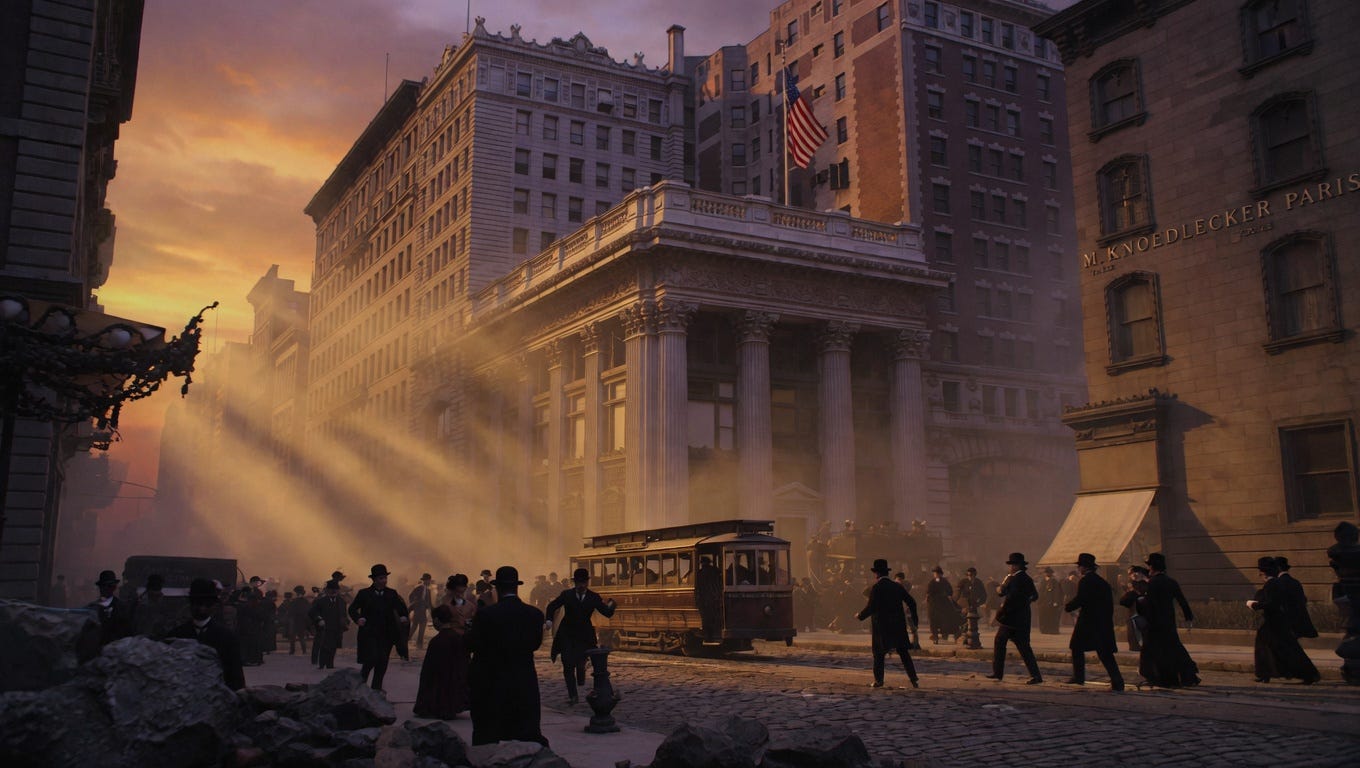
On the morning of October 22, 1907, the National Bank of Commerce made one phone call. They told the Knickerbocker Trust Company: we will no longer clear your checks. Seventeen thousand depositors. Thirty-five million dollars. With one phone call, the Knickerbocker Trust was dead — it just didn’t know it yet.
Who made that call? No one would ever say. Who ordered the Clearing House to close the door on a solvent institution? Even J.P. Morgan’s own son-in-law would later wonder aloud who dared. Because whoever did it feared no retaliation.
The panic unfolded with mechanical precision. Acting on Otto Heinze’s orders, the brokerage firm Gross & Kleeberg accumulated thousands of shares of United Copper. When the short squeeze failed, Otto refused to take delivery. The New York Stock Exchange suspended Otto Heinze & Co. Confidence evaporated overnight. Banks tied to the Heinzes shuttered. The contagion spread.
Morgan refused a direct bailout of the Knickerbocker but secured pledges from other bank presidents. He locked financiers in his library while the stock exchange teetered on collapse. He sat alone in the adjoining room playing solitaire, quietly rejecting every proposal until total unity was achieved. The strongest holdout received a hand on the shoulder and a gold pen. “There’s the place, King. And here’s the pen.” The signatures were completed at 4:45 a.m.
Morgan quarantined the Heinzes’ influence, let the Knickerbocker Trust — run by a Heinze ally — collapse, and orchestrated the Tennessee Coal & Iron bailout through U.S. Steel after securing Roosevelt’s quiet approval. The man who could destroy a competitor in a single phone call was also the only one qualified to “rescue” the system. How convenient.
Unmasking the Money Trust: Pujo Committee Investigation and the Network Defined
In 1912, Congressman Arsène Pujo of Louisiana launched the first congressional investigation into what the committee called the Money Trust. The 1913 report did not find a signed conspiracy with a membership card. It found something far more effective: an informal, tightly knit community of interest that effectively controlled American finance.
Who made the call on the Knickerbocker Trust? If the implications of the Pujo Committee Investigation are fully understood — then the answer is clearly the network.
By “the network,” this series means a specific group of families and financial institutions that dominated American finance from the 1890s through today. The core families are Morgan, Rockefeller, Warburg, Schiff, and Harriman.
The report named six institutions as the most active agents in the concentration of money and credit: J.P. Morgan & Co., First National Bank of New York, National City Bank of New York, Lee, Higginson & Co., Kidder, Peabody & Co., and Kuhn, Loeb & Co.
Control was maintained partly through “banking ethics” — an understanding between firms like Kuhn, Loeb & Co. and the Morgan banks not to compete for certain business. There were two groups that often cooperated and often competed: the Anglo-Saxon faction and the German faction. The Anglo faction appeared to be the consistent leaders.
The final majority report explicitly named the inner group: J.P. Morgan & Co., George F. Baker of First National, and James Stillman of National City Bank.
The Pujo Committee documented 341 interlocking directorships held across 112 corporations with combined resources of over $22 billion. These broke down as follows: 41 banks and trust companies holding 385 directorships, 31 railroad systems with 155 directorships, 28 industrial corporations with 98 directorships, 19 public utility corporations with 48 directorships, 3 express and steamship companies with 10 directorships, and insurance companies holding 30 directorships — equivalent to roughly 12% of total U.S. wealth at the time, or about $22.09 trillion today.
The report itself uses Goldman, Sachs & Co. and Lehman Brothers as evidence that the “Money Trust” did not have a complete monopoly. The lead underwriters for a Studebaker Corporation preferred stock issue were Goldman, Sachs, Lehman Brothers, and Kleinwort & Sons.
This “outsider” alliance was a transatlantic triangle: southern capital, New York finance, and London connections. When J.P. Morgan partner Henry Davison was pressed by Pujo counsel Samuel Untermyer to name any competition to the Money Trust, he irritably listed several firms, including Lehman Brothers and “Golden & Sachs” (Goldman, Sachs & Co.), insisting there were houses that “can handle issues without the help of any other house.” In fact, the Lehman-Goldman alliance had been formalized by Philip Lehman and Henry Goldman in 1906, operating on a 50-50 profit-sharing basis to underwrite the emerging consumer economy. Their European partner was Kleinwort, Sons & Co. of London — a prestigious merchant bank founded by a German immigrant that provided the European capital and distribution network the outsiders needed to compete. The intermarriage among these families was extensive.
A Necessary Trip Down Memory Lane: The German Revolutions of 1848
In the spring of 1848, Europe caught fire. From Paris to Vienna, Berlin to Frankfurt, crowds filled the squares. They demanded constitutions, free speech, and an end to the old aristocratic order. For Jewish families living in the German Confederation’s patchwork of duchies and principalities, the stakes were personal. They demanded full civil rights—the freedom to live, work, and worship without the centuries-old restrictions that had confined them to cramped ghettos and narrow trades.
Over the next decade, more than one million Germans crossed the Atlantic. Among them were young men who would become the founding fathers of American finance.
Marcus Goldman, a 27-year-old from Trappstadt, Bavaria, arrived in New York in 1848, the year of revolution itself. He began as a peddler on the streets of Philadelphia. Solomon Loeb left Worms, the ancient city of Jewish learning, in 1849. He settled first in Cincinnati, then New York. Joseph Seligman had arrived earlier, in 1837, from Baiersdorf, Bavaria. But his brothers followed in the late 1840s after the Seligman family was marked on arrest warrants for financing the revolution. They fled—not as immigrants seeking opportunity, but as refugees fleeing political persecution. Abraham Kuhn came from Harxheim, near Mainz, around 1840. Henry Lehman arrived from Rimpar, Bavaria, in 1844.
They landed in New York, Philadelphia, Cincinnati, and Mobile. What happened next was not just hard work. It was a deliberate strategy of family alliance.
In 1867, Abraham Kuhn and Solomon Loeb formalized their partnership as Kuhn, Loeb & Company in New York City. They had already bound themselves by marriage—Loeb had married Kuhn’s sister, Fanny. In Frankfurt Kuhn had met Jacob Schiff (1847–1920) at the house of a fellow banker, Jacques Dreyfus, and sent Schiff to work for Kuhn, Loeb in New York.
Then the alliances multiplied. Solomon Loeb’s daughter Therese married Jacob Schiff. Schiff would become the dominant force at Kuhn, Loeb, financing railroads and reshaping American industry.
Their daughter Frieda Schiff married Felix Warburg, son of the great Hamburg banking dynasty. Another Loeb daughter, Nina, married Felix’s brother Paul Warburg, who would later design the Federal Reserve System. Yet another Loeb daughter, Guta, married Isaac Newton Seligman of the Seligman banking house.
In 1888, Ludwig Dreyfuss (spelled with a double “s”) married Rebecca Goldman, daughter of Marcus Goldman. He became a junior partner at Goldman, Sachs & Co.—and the firm’s name was changed that year to include “Dreyfuss” before he retired and reverted to simply Goldman Sachs.
By 1888, the families of Lehman, Warburg, Dreyfus (or Dreyfuss), Schiff, Goldman, Sachs, and Seligman were no longer separate houses. They were a single interwoven web of capital, marriage, and trust.
That same year, 1888, Germany experienced its own political earthquake. On June 15, 29-year-old Wilhelm II ascended the throne.
The new Kaiser was brilliant, insecure, and deeply resentful of Jewish financial power. Within two years, he forced Chancellor Otto von Bismarck into retirement and abandoned the careful diplomacy that had kept European peace for two decades.
Wilhelm launched a naval arms race against Britain, promoted aggressive Weltpolitik (world policy), and tolerated—often encouraged—state-sponsored antisemitism. The Warburgs of Hamburg, the Schiffs of Frankfurt, and the Rothschilds of the German states watched with alarm. Their comfortable status under Bismarck was ending.
In the 1890s and early 1900s, the next generation made its move. The Second Wave.
Felix Warburg arrived in New York in 1894, joining Kuhn, Loeb after marrying Schiff’s daughter. His brother Paul followed in 1902.
The German bankers who fled the failed revolutions of 1848 largely built Wall Street. They financed the Union during the Civil War, the transcontinental railroads, and the rise of American industry. They married one another’s children, held one another’s partnership shares, and corresponded across the Atlantic in German and English.
House of Morgan: From Puritan Roots to Wall Street Dominance
The Morgan story in America begins with Miles Morgan, who arrived from Bristol, England, in 1636 and helped found Springfield, Massachusetts (originally named Agawam). Despite being only 21 years old, he quickly became second-in-command to William Pynchon. He was known as an “intrepid Indian fighter” who defended the settlement during King Philip’s War in 1675, when his house became a refuge for townspeople during an attack.
J.P. Morgan’s grandfather, Joseph Morgan, left farming to become a hotelier, running the Exchange Coffee House in Hartford, Connecticut. He diversified into steamboats, canals, railways, and fire insurance. He was one of the founders of the Aetna Insurance Company.
Junius Spencer Morgan is the patriarch who founded the “House of Morgan.” After building the family fortune and surviving the Panic of 1837 by personally collecting debts from Virginia to Florida, in 1853 he met George Peabody, a wealthy American merchant banker in London who was looking for a successor. In 1854, Junius became Peabody’s partner. When Peabody retired in 1864, Junius took over and renamed the firm J.S. Morgan & Company.
George Peabody & Co. served as a direct financial and operational link between the Rothschild network and what would become the House of Morgan. While George Peabody was an American patriot and a legitimate merchant banker in his own right, historical records confirm that his London firm functioned as a critical American proxy for the Rothschilds, channeling European capital into the U.S. and establishing Junius S. Morgan (father of J.P. Morgan) as their partner and heir. The most concrete, verifiable evidence is the foundational financial assistance Peabody received to establish his London banking house in 1835 — with the help of Brown Brothers and Nathan Mayer Rothschild. This created an unbroken chain of influence: the Rothschilds helped fund Peabody, Peabody partnered with Morgan, and Morgan was selected as successor with the understanding that the discreet relationship with Rothschild would continue.
Bowles accused the firm of “swell[ing] the popular feeling of doubt abroad, and speculat[ing] upon it,” and of being “guilty of a grievous error in judgment, and a grievous weakness of the heart” for their lack of faith in the Union cause . His central charge was this:
“No individuals contributed so much to flooding our money markets with the evidences of our debt in Europe, and breaking down their prices and weakening financial confidence in our nationality as George Peabody and Co., and none made more money by the operation.”
J.P. Morgan was groomed for greatness from birth. Fluent in French and German, he studied art history at the University of Göttingen in Germany. He formed Drexel, Morgan & Company in 1871; the firm became J.P. Morgan & Co. in 1895. He created General Electric. He created U.S. Steel — the world’s first billion-dollar corporation.
Morgan was not a man who asked for permission. He gave orders. He suffered from an inherited skin condition that gave him a bulbous purple nose. He kept several female consorts. He canceled his Titanic ticket at the last minute. He spent the modern equivalent of $900 million on art. The gemstone morganite is named after him.
Initially the Vanderbilts were physical titans of ships and rails who openly scoffed at bankers, yet by the 1880s their ruinous price wars had proven they needed a financial referee to save their profits. The 1879 stock sale marked the symbolic passing of the torch; as the Commodore dynasty declined, Morgan stepped in as the orchestrator of American industry, using his financial power to sit on the boards and quietly control the very corporations the Vanderbilts had built while they spent their fortunes erecting mansions like the Biltmore and The Breakers. Charles Schwab, the charismatic president of Carnegie Steel, secretly brokered the deal and convinced his boss to sell, but a humiliated Andrew Carnegie refused to shake J.P. Morgan’s hand, forcing the financier to come to him at his own mansion; the resulting United States Steel Corporation became the world’s first billion-dollar enterprise and cemented the network’s industrial domination for a generation.
J.P. Morgan & Co. was not a publicly traded corporation. It was a private banking partnership owned by its partners. The “Money Trust” identified by Pujo did not just control American railroads; it was the primary financier for the Entente Cordiale (Britain and France). When WWI broke out in 1914, it was the house of J.P. Morgan & Co. that was immediately named the exclusive purchasing agent and bond issuer for the British and French governments. The man who could destroy a competitor with one phone call was also the man who could finance empire. Morgan, the era’s preeminent financier, effectively acted as the de facto central bank. He personally led a multi-stage intervention.
Brown Brothers: Irish Linen Merchant Who Built a Dynasty
The story begins with Alexander Brown, an Ulster linen trader who fled sectarian violence in Belfast and set up his business in Baltimore in 1800 . By 1818, his sons George and John Brown had formally established Brown Brothers in Philadelphia. The “Three Houses” of Brown: The firm was unique for its time. Alexander brought his sons into the business, a common practice for trading houses like the Rothschilds and Barings, and placed them in different cities.
William Brown (1784–1864): The eldest son was sent to Liverpool, England, in 1809 to manage the shipping and currency exchange side of the business. His firm, Brown, Shipley & Co., became the crucial British link in the family’s financial chain. He pivoted the firm decisively into the buying and selling of raw cotton produced in the American South. In 1838 alone, the firm sold 178,000 bales—equivalent to nearly 16 percent of all U.S. cotton imports into Britain that year.
George Brown (1787–1859): George remained in Baltimore, taking over the original firm, Alex. Brown & Sons, after his father’s death. He was a pivotal figure in early American infrastructure, famously hosting the meeting at his home that led to the founding of the Baltimore and Ohio (B&O) Railroad .
John Brown (1788–1872): The third son was sent to Philadelphia in 1818 to establish a presence there, founding what would become Brown Bros. & Co. .
James Brown (1791–1877): The youngest son was dispatched to New York in 1825 to open an affiliate, also under the Brown Brothers name. He later expanded to Boston, and under his leadership and that of his son, John Crosby Brown, the New York house became the central hub of the family’s operations
They were perfectly positioned to become a powerhouse. By 1835, the firm alone accounted for an astonishing 11 million of the estimated 100 million in trade between the U.S. and Great Britain. Brown Brothers & Co. was not listed as a “primary” member of the inner group (like J.P. Morgan & Co.), — in the Pujo Committee report—but as a “closely allied” major banking house, frequently operating in concert with the Morgan network. The firm’s enduring power was solidified during the Great Depression. In 1931, Brown Brothers merged with Harriman Brothers & Company (the bank of railroad tycoon E.H. Harriman’s sons, W. Averell Harriman and E. Roland Harriman) to form Brown Brothers Harriman & Co. The relationship was not merely transactional but operational. While in London between 1837 and 1843, Peabody purchased dry goods for his Baltimore firm, using credits established with London banks — connections likely facilitated through his relationship with the Browns. The House of Brown was unique among major Anglo-American banking houses because its roots were in the United States, not England. Peabody’s partnership with Brown Brothers directly enabled the rise of the Morgan dynasty. Brown Brothers helped fund Peabody’s London bank in 1835. After building his firm with Brown and Rothschild support, Peabody took Junius Spencer Morgan (father of J.P. Morgan) into partnership in 1854. Unlike many of its peers, BBH has remained a private partnership, famously avoiding the heady speculation and subsequent bailouts that plagued public banks in 2008.
Paul Warburg’s Blueprint: The Smoking Gun Before the 1907 Panic
In a string of what will be— never ending coincidences Paul Warburg- the architect of the federal reserve published an article in the New York Times titled Defects and Needs of Our Banking System— nine full months before the October panic. Reading it today is not an exercise in economic history. What he presents as a scientific diagnosis appears, in hindsight, as a meticulously crafted blueprint for a catastrophe that had not yet happened.
Warburg, a naturalized German citizen decorated by Kaiser Wilhelm II in 1912, declared the United States a financial backwater stuck in the age of the Medicis. The problem, he said, was not speculation or greed but “commercial paper” — simple promissory notes that were illiquid and immobilized. The solution? Adopt the European model of banker’s acceptances and deliberately drive American capital into the stock market to create the instability that would justify a central bank. He openly praised the German Reichsbank as the most perfect organization of its kind. The foresight is not prophetic. It is suspicious.
His 1908 plan went further: the New York Clearing House — the same private club that had just destroyed the Knickerbocker Trust — would gain legal authority to decide which banks could access emergency currency. The transformation, he confessed, would require “years of educational work.” This was not reaction to an emergency. This was a long-term strategy waiting for the perfect crisis.
Warburg was not acting alone. He was part of a coordinated international financial network. His brother Max Warburg was Kaiser Wilhelm’s personal banker in Germany and led German espionage operations. Max allegedly authorized Lenin’s sealed train to pass through German lines to trigger the Bolshevik Revolution. The Rothschilds bought the German news agency Wolff, placing Max Warburg as an executive.
These German connections were not background noise. They were central to the network’s transatlantic reach. The question arises: why Warburg, a “foreigner,” was so singularly obsessed with remaking the American financial system. In this view, Warburg was not just an “international banker” content to exploit differences in interest rates. He was an evangelist for a specific German model of state-corporate partnership. He was a designated operative for the European banking elite who had already conquered European finance. The Panic of 1907 was not a warning to him; it was an opportunity.
The Heinze Brothers’ Copper Corner: Catalyst of the 1907 Panic and Alternative Narratives
The Heinze patriarch, Otto Sr., was a wealthy German immigrant and Brooklyn dry-goods merchant whose death in 1891 left each of his sons a $50,000 inheritance they used to enter the copper business.
F. Augustus moved to Butte, MT in 1889 and became a folk hero by reducing miner workdays to 8 hours. He used an 1872 mining law to legally follow ore veins onto competitors’ land, igniting brutal legal and physical fights. Fritz Heinze was a hard-drinking, fun-loving brawler who once punched a cab driver in New York for overcharging him. The most scandalous episode of his life involved a “pretty girl” who allegedly offered a Montana judge one hundred thousand dollars to rule in Heinze’s favor. He was implicated but never charged.
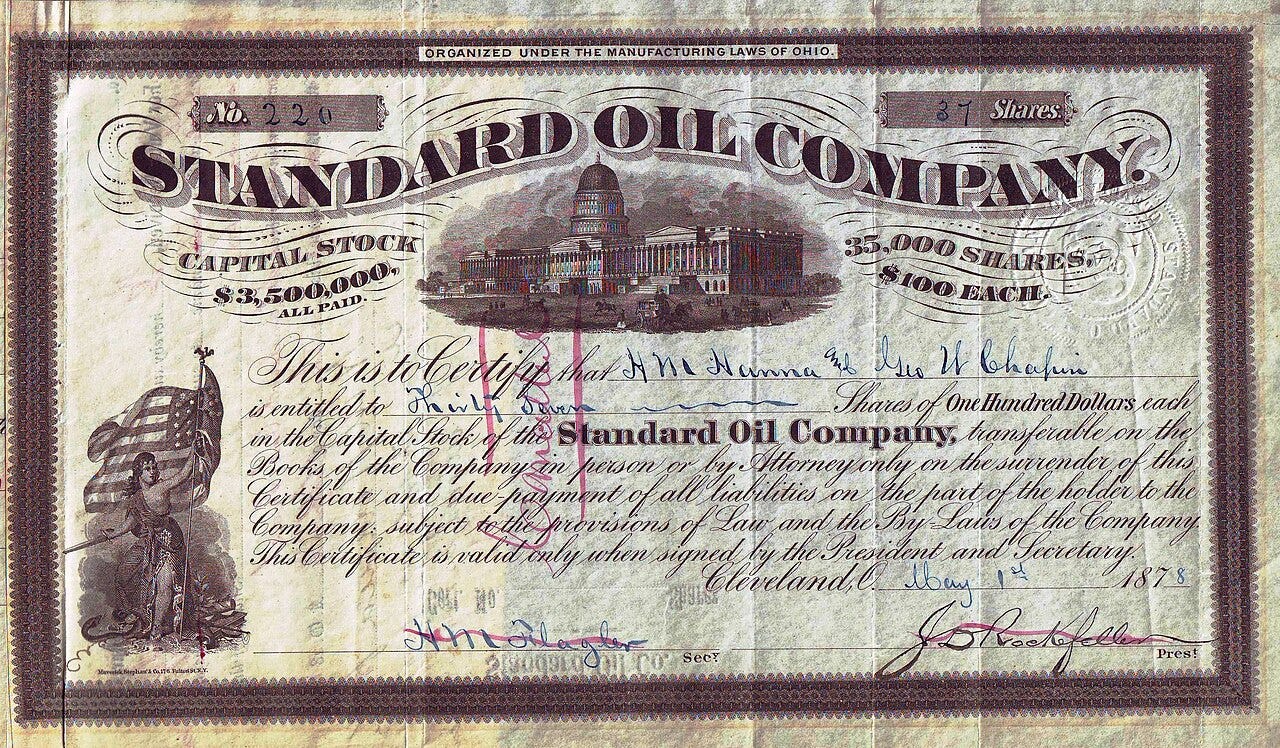
The Heinze brothers challenged the network directly. F. Augustus Heinze used the 1872 law of the apex to follow ore veins under Standard Oil’s properties. Unable to crush him, Standard Oil decided to buy him out. He sold his mines to them for $12 million in 1906 and moved to New York.
His older brother, Otto C. Heinze, ran the Wall Street firm Otto Heinze & Co. and orchestrated the disastrous October 1907 scheme to corner United Copper stock. The third brother, Arthur P. Heinze, served as the family’s attorney and legal strategist. Otto Heinze sat in his office on the morning of October 16, 1907. He believed he had cracked the code. He had mapped every share of United Copper. He had counted every potential seller. He had calculated the precise moment when the short sellers would break.
He was wrong.
He was convinced that short sellers had borrowed far more shares than actually existed, so he quietly bought up what he believed was the entire remaining free float, driving the price sky-high. His plan was simple — once he demanded the borrowed shares back, the shorts would be trapped and forced to buy from him at his inflated price.
Stock ownership in 1907 was tracked solely through physical certificates — engraved paper documents bearing the owner’s name on the front and blank transfer forms on the back. Each company maintained a single official “stock book” (ledger) at its office or transfer agent, which served as the only authoritative record of who held shares. To change ownership legally, the original certificate had to be physically surrendered so the company could cancel it and issue a new one. The system therefore offered no real-time visibility.
Consider what this requires you to believe. Otto Heinze was a professional Wall Street strategist. He ran his family’s brokerage firm. His brother Fritz had just sold his copper mines to Standard Oil for twelve million dollars — about three hundred and sixty million dollars today. They knew their holdings. They knew the terms of the sale. The original investors who had received shares as payment were not secret. Their holdings were recorded. An audit — which Arthur Heinze was supposedly conducting — either counts shares or it does not. It cannot miss a significant block.
Yet the official narrative asks you to believe that a man who had successfully navigated Wall Street for years made a mistake that a first-year accounting student would avoid. This is not plausible. It is an appeal to authority — historians repeating a convenient explanation because the alternative is harder to prove and more disturbing to accept.
The official story says the Heinzes simply miscounted shares and a “pretty girl” leaked the plan — a story published in the Chicago Tribune on October 21, 1907, claiming that a young woman friend of F. Augustus Heinze had babbled about the corner over lunch at the Waldorf-Astoria. The Tribune itself admits that the Heinzes already had a majority before the information leaked, making the leak irrelevant to the outcome. The figure cited — sixty-five million eight hundred and thirty thousand dollars — is too precise to be real.
The alternative narrative is more rational. Otto Heinze did not miscalculate. He was outmaneuvered. The Morgan network controlled the New York Clearing House. The Clearing House controlled the banking system. And the curb market, with its chaos and lack of transparency, was a weapon that could be turned against any corner — provided you had the resources to deploy it.
Here is how it would have worked. First, Otto began buying United Copper, driving the price from thirty-nine dollars to fifty-two dollars. Second, his enemies — knowing his plan — used wash sales to create additional upward price pressure. Third, Otto saw the price rising and believed his corner was working. He continued spending, unaware that some of the demand was fake. Fourth, the artificially inflated price attracted genuine sellers. Fifth, Otto’s cash ran out before he could achieve a true corner. Sixth, the real supply flooded the market. The price crashed from sixty dollars to ten dollars. The corner failed — not because of miscalculation, but because of coordinated attack.
This theory does not require Otto to be incompetent. It requires his enemies to be sophisticated. And we know they were.
He was indicted for bank fraud. During the trial, the prosecution explicitly stated that this man is not being prosecuted by the Standard Oil, so help me God, it will have nothing to do with it. This disclaimer implied the widespread public belief that his prosecution was engineered by his enemies.
The New York Clearing House: A Private Weapon of Control
The New York Clearing House was the private system banks used to settle checks with each other. It was founded in 1853. By 1907, it had become a powerful instrument of collective action — controlled by the same banking network that Heinze had challenged.
The network used two tactics. First: the silent run. A silent run is invisible to the public. Depositors write checks on a target bank and deposit them in other banks. Those banks present the checks to the Clearing House for settlement. The target bank’s clearing balance drains rapidly. Only the Clearing House sees it happening. No public panic. No newspaper headlines. Just a slow, invisible death. Contemporary financial journalist Alexander Noyes testified that the Knickerbocker Trust experienced a silent run days before the public run broke it. The Clearing House members were aware but did nothing.
Second: the refusal to clear. When the National Bank of Commerce announced it would no longer clear Knickerbocker Trust checks, that was the fatal blow. The Clearing House had effectively declared the trust insolvent. Depositors panicked. But the panic was not spontaneous. It was manufactured.
The network had eliminated a competitor. Heinze was ruined. His banks were seized or closed. His brokerage was suspended. The Copper King who had defied Standard Oil was finished.
The report also documents a second case: two Brooklyn banks cleared through the Oriental Bank (a full member). The clearing-house committee told the Oriental Bank to terminate its clearing relationship with both banks. The Oriental Bank’s president protested, saying it would destroy the banks. The committee ordered him to do it anyway. He complied. “Within a day or two,” both Brooklyn banks closed.
Why this matters: It proves the Clearing House was not just a neutral utility. It was a private death panel controlled by member banks, with no government oversight, no due process, and no appeals. This transforms the “phone call” in our prologue from a suspicious rumor into a documented power.
Jekyll Island Conspiracy: Secret Drafting of the Federal Reserve
In November 1910, a small group of the nation’s most powerful financiers snuck onto Jekyll Island, Georgia — an exclusive resort owned by J.P. Morgan — under the guise of a “duck hunting trip.” They brought no ducks. They brought no guns. They brought only a seven-page blueprint for a central bank. They denied the meeting for twenty years.
They drafted the Aldrich Plan: a National Reserve Association that would hold member bank reserves and issue elastic currency.
The attendees:
Nelson Aldrich: A powerful Senator (and grandfather to Nelson Rockefeller). He chaired the National Monetary Commission and led the expedition. He was personally close with J.P. Morgan, Stillman, and Rockefeller. As Chairman of the National Monetary Commission, he was a business associate of J.P. Morgan and, crucially, the father-in-law of John D. Rockefeller Jr. (Standard Oil).
Paul Warburg: A partner at Kuhn, Loeb & Co., he was the primary intellectual architect of the Fed.
Henry Davison: A senior partner at J.P. Morgan & Co.
Benjamin Strong: Head of J.P. Morgan’s Bankers Trust Company (he later became the powerful first governor of the New York Fed).
Frank Vanderlip: Vice President of National City Bank, working directly under James Stillman (of Standard Oil alliance fame).
A. Piatt Andrew: Assistant Secretary of the Treasury.
Manufacturing Grassroots Support: The National Citizens’ League
The National Citizens’ League was the “hidden hand” of the campaign — a sophisticated propaganda operation designed to manufacture grassroots support for the Federal Reserve while hiding its Wall Street origins.
The League’s first strategic decision was its most revealing: it established its headquarters in Chicago, not New York. Why Chicago? The architects knew that any reform openly launched in New York would be instantly killed as a “Wall Street plot” in the populist Congress. By setting up in the heartland, they created a “bogus patina of a ‘grassroots’ heartland operation” to hide the fact that control “really resided” in New York.
The Public Faces: The official leaders were respectable Chicago businessmen: John V. Farwell and Harry A. Wheeler (President of the U.S. Chamber of Commerce). The executive director was J. Laurence Laughlin, a respected University of Chicago economist. This allowed the League to pose as a non-partisan civic group while executing a strategy designed by the bankers. The League published a periodical, Banking and Reform, and subsidized pamphlets by pro-reform experts from National City Bank and other major institutions. Its official book, Banking Reform, was a 400-page “plain, untechnical exposition” designed to look academic.
Backers included Cyrus McCormick (International Harvester — Morgan sphere), John G. Shedd (Marshall Field & Co.), Julius Rosenwald (Sears, Roebuck), and Frederic A. Delano (Wabash Railroad — Rockefeller-controlled; he was not only a railroad executive but also the uncle of Franklin Delano Roosevelt).
The 16th Amendment: The Income Tax That Financed the Heist
Now we come to a piece of the story that is almost never told. The Federal Reserve Act was signed on December 23, 1913. But the 16th Amendment — the amendment that allowed the federal government to collect income tax — was ratified on February 3, 1913. They occurred in the same calendar year. This was not an accident.
In 1895, the Supreme Court ruled in Pollock v. Farmers’ Loan & Trust that the federal income tax was unconstitutional. The government could not tax incomes directly. It had to rely on tariffs and excise taxes. This was a problem for the network. Why? Because the network wanted a central bank. And a central bank needed government bonds. And government bonds needed a reliable source of revenue to pay the interest.
In 1909 — the same year that Senator Aldrich began his push for currency reform — Congress proposed the 16th Amendment. It would allow a federal income tax without apportionment among the states. The amendment was sent to the states for ratification.
Meanwhile, the network was planning Jekyll Island. The secret meeting happened in November 1910. The Aldrich Plan was drafted. The network’s blueprint for a central bank was complete.
On February 3, 1913, the 16th Amendment was ratified. The income tax was now constitutional. On December 23, 1913, the Federal Reserve Act was signed. The central bank was now law.
The connection: The same people who wanted a central bank also wanted a federal income tax. Why? Because the income tax would create a steady, predictable stream of revenue. That revenue would be used to pay interest on government bonds. Those bonds would be held by the Federal Reserve and the network’s banks. The network would earn risk-free interest. The taxpayer would foot the bill.
In feudalism, the lord collected tithes and taxes. In modern finance, the network collects interest, fees, and seigniorage.
The 16th Amendment ensured that the federal government would have a reliable source of revenue. The Federal Reserve ensured that the government could borrow money and that the network’s banks would be the ones lending it. The two pieces fit together like a lock and key.
Without the income tax, the government would struggle to pay interest on its debt. Without the Federal Reserve, the network would have no guaranteed market for government bonds. Together, they created a self-reinforcing system: the government borrows, the Fed buys the bonds (or facilitates their sale to member banks), and the income tax pays the interest.
The network did not steal the money supply. They were given it. And the American people were told it was reform.
The Cortelyou Testimony Which Confirmed Nothing
Untermeyer: “Was there anything said as to where these funds should be deposited – with what banks?”
Cortelyou: “I do not recall.”
Untermeyer: (pressing for a list of banks)
Cortelyou: “I only remember that the money was deposited in national banks. I could not undertake to say which ones.”
The syndicate books of J.P. Morgan & Co. from this period still exist at the Morgan Library & Museum . One specific volume (Vol. 5, p. 5-6) records the “Funds for the benefit of the Trust Company of America & the Lincoln Trust Co.” dated November 14, 1907.
Sources of Funds for the 1907 Panic Rescue:
U.S. Treasury deposit: $25 million on October 24, 1907, directed by Cortelyou / Morgan’s conference.
J.P. Morgan syndicate (private): $25–30 million on October 24–25, 1907, directed by Morgan.
Treasury gold shipments: $30+ million throughout October 1907, directed by the Treasury.
Clearing House Loan Certificates: $88 million peak (December 16), issued from October 26, 1907 to March 1908, directed by the New York Clearing House (Morgan network).
U.S. Steel / Tennessee Coal & Iron (TC&I) purchase: $30 million on November 2–4, 1907, directed by Morgan with Roosevelt’s approval.
Bank of France discounting: Undisclosed amount, November 22–December 7, 1907, directed by the Bank of France.
The money was not neutral. It flowed to the network’s allies and was withheld from its enemies.
The relief was selective. The Clearing House was a private club. It issued $88 million in emergency currency to its members – not to competitors like the Knickerbocker Trust . That is not a neutral emergency response. It is a weapon.
The opacity was deliberate. Cortelyou met with Morgan’s inner circle, then deposited $25 million into unspecified national banks . He refused to name them. The Treasury records exist, but the Pujo Committee could not force their disclosure. This opacity allowed the network to control the flow of government funds without accountability.
The scale of the “rescue” is too small relative to the narrative. If 25−30 million from Morgan and 25 million from the Treasury were enough to stop a true systemic panic, then the panic was not a systemic collapse – it was a localized liquidity crisis. The total liquidity infused (including CLCs, gold, and Bank of France support) was large, but the government’s direct contribution (25M+30M in gold) was modest relative to the $35 billion money supply of the era.
The contemporary Ogden Evening Standard noted that the resort to clearing house certificates in 1907 was “the one thing that prevented a crash” and that “the banks can protect themselves by issuing promises to pay” . One Republican businessman quoted in the paper said: “The issuing of clearing house certificates in 1907 has pointed the way by which all solvent business institutions, in times of money stringency, can be saved... It is not even necessary, since the precedent of 1907, to reform the currency laws of the United States” .
Crucially, the Clearing House was a private club. Its member banks controlled who could access its emergency currency. The Knickerbocker Trust, as a non-member, could not access CLCs . This selective access meant that the very institutions that were part of the inner circle (Morgan’s allies) could issue private money, while their competitors could not. That is not a neutral emergency response – it is a structural advantage.
One more crucial detail. When Untermeyer asked Cortelyou if more than $25 million was deposited that day, Cortelyou admitted:
“I think there was something more than that; I do not recall just how much.”
Untermeyer then stated: “I think it says thirty-six millions.” Cortelyou replied: “Thirty-six millions were deposited during the entire four days”
Institutions and Relief During the 1907 Panic:
J.P. Morgan & Co. received relief (syndicate leader) because Morgan controlled the syndicate.
First National Bank (Baker) received relief because it was in the conference and on the committee.
National City Bank (Stillman) received relief because it was in the conference and on the committee.
Trust Company of America received relief on November 14 because it was specifically bailed out by the Morgan syndicate.
Lincoln Trust Co. received relief on November 14 because it was specifically bailed out by the Morgan syndicate.
Knickerbocker Trust received no relief because it was allowed to fail.
Mercantile National Bank (Heinze) received no relief after Heinze was forced out because the condition of relief was Heinze’s resignation.
Dead Ends, Dead Partners, and the Information Monopoly
Long before the Pujo Committee exposed the “Money Trust” and before J.P. Morgan locked the bankers in his library, three European media moguls had already perfected the art of the cartel.
The three men were Charles-Louis Havas of France, Paul Julius Reuter of Britain, and Bernhard Wolff of Germany. Each had started as a translator of financial news. In 1870, the three agencies signed a new agreement—updating an outdated agreement from 1859— that did not merely divide Europe. It divided the entire planet. Reuters took the British Empire and the Middle East. Havas took the French and Portuguese empires, plus South America. Wolff took Central Europe, Russia, and the Balkans—the less profitable zones, forced to pay 25% of its annual profits to its partners. This was a global information monopoly and a function of empire.
The bankers were not signatories to the 1870 cartel agreement. They did not need to be. The telegraph network that carried the news was financed by the same banking houses that underwrote the railroads and the wars. In 1879, when Havas reorganized as a public company, its shares were purchased by the Banque de Paris et des Pays-Bas—a bank with deep Rothschild connections. Bernhard Wolff’s agency was from its founding intertwined with the Siemens family, whose telegraph equipment company was financed by the same Berlin banking circles that included the Rothschilds’ German cousins, the Bleichröders. Bismarck’s banker, Gerson von Bleichröder, was both a Rothschild agent and a silent partner in the Prussian state’s relationship with Wolff. The cartel was an extension of the European banking network into the realm of information.
The 1870 cartel left one significant territory unassigned: the United States. The American market was dominated by the Associated Press—a cooperative that had its own exclusive agreements with the European cartel. The AP was a junior partner, receiving news from Havas, Reuters, and Wolff but not sharing in the global division of territory.
Now the chain of wealth and intimacy that connects the media cartel to the “Money Trust” becomes visible for an instant before returning to it’s opaque origin in cascade of deaths.
The chain begins with James Gordon Bennett Jr., the eccentric publisher and son of the founder of the New York Herald. Bennett was a recluse who lived in Paris and communicated with his newspaper by telegraph—a technology made possible by the same cartel that Wolff had helped create. In 1914, at the age of 73, Bennett married Baroness de Reuter, the widow of George de Reuter, son of Paul Julius Reuter, the founder of Reuters. The marriage was a corporate merger sealed with a wedding ring. The two men who had dominated the “Ring Combination” of 1870 were now linked by marriage through their successors. The marriage merged the Bennett publishing empire with the Reuters news dynasty—the two great information networks of the Atlantic world. The men who controlled the flow of capital also controlled the flow of news. And now, the two families were one.
When Bennett died in May 1918, his will named James Stillman as one of his administrators. Stillman—the chairman of National City Bank, the ally of Rockefeller and Kuhn, Loeb—was the obvious choice to manage the Bennett estate. But Stillman did not live to serve. He died just weeks after Bennett, on March 15, 1918.
Stillman’s will named his close friend and lawyer, John William Sterling, as one of his executors. Sterling was the founding partner of Shearman & Sterling. He was the legal architect of the “Money Trust.” He represented Jay Gould and James Fisk, the two men who had attempted to corner the gold market in 1869, triggering the “Black Friday” panic that nearly bankrupted the American economy. He represented the Standard Oil Trust during its 1911 antitrust trial. He helped structure the formation of United States Steel, the world’s first billion-dollar corporation. He was a director of nine large banks. He was the mechanic who designed the legal structures—the voting trusts, the stock swaps, the holding companies—that allowed a small group of financiers to control the nation’s credit.
But Sterling did not live to serve as Stillman’s executor. He died suddenly in July 1918, just months after Stillman.
Sterling’s will named James O. Bloss as one of his executors. Bloss was not merely Sterling’s lawyer or business associate. He was Sterling’s companion of nearly fifty years. They had met around 1870, shortly after Sterling was admitted to the bar, and had lived together for the rest of their lives. Sterling called him “Blossy” in his private journals.
Bloss, the former president of the New York Cotton Exchange and a former business associate of Stillman, was the last man standing. But he did not live long. He died in December 1919, just a few months after Sterling.
The combined estates of Bennett, Stillman, and Sterling totaled approximately $76 million. The bulk of the Sterling estate, after Bloss’s death, was directed to Yale University. He had graduated from Yale College in 1864. His fortune was the largest single bequest the university had ever received. The Sterling Memorial Library at Yale is named for him. Also of note, Rev. James Pierpont (1659-1714) is credited with the founding of Yale College—then known as the Collegiate School—in 1701. Through his son James Pierpont II and his second wife, Anne Sherman, the Pierpont line entwines with the Sherman dynasty. Anne Sherman was a direct descendant of Henry Sherman the Younger (c. 1545-1610), the prosperous clothier of Dedham, Essex, whose will of 1610 meticulously named his sons Henry, Samuel, Daniel, John, Ezekiel, and Edmund. From Henry the Younger’s line, the family split: the descendants of his son Samuel ultimately produced the Rhode Island Shermans, while the descendants of his son John produced the Connecticut Shermans—the latter giving rise to the Honorable Roger Sherman (1721-1793), the only Founder to sign all four great state papers of the American Revolution, and the former, his distant cousin, Thomas Gaskell Sherman, founder of the legal firm Shearman & Sterling. Henry Sherman the Younger acts as a “gateway ancestor” connecting multiple branches of the early American power structure. This structure includes the Bush family. The irony of Henry Sherman the Younger is that his father is a ghost—an unknown clothier of Dedham whose absence from the heraldic rolls of Yaxley has not stopped generations of genealogists from trying to drape a noble lineage around his shoulders.
Another obscure death in the network is notable: A founder of Kuhn, Loeb & Co. Samuel Wolff was a founding partner of the firm, alongside Abraham Kuhn and Solomon Loeb. But unlike his partners, he did not move to New York to build a banking empire. He stayed behind in Montgomery, Alabama, to run the dry goods business that had generated the initial capital.
On September 9, 1889, he committed suicide. The Montgomery Advertiser reported that he died of strangulation. He had attempted to hang himself, but the rope or strap stretched, and he was found with it still around his neck. He was discovered by a Mr. Rosefeld, a bookkeeper for the firm. The cause was “derangement over financial troubles,” but the article noted that the firm was “doing a large and prosperous business.” Samuel Wolff was the brother of B. Wolf, a furniture dealer in Montgomery. There is no known connection to Bernhard Wolff, the German media mogul.
His partners, Kuhn and Loeb, went north. They took the capital from the dry goods business and built a Wall Street powerhouse that would rival J.P. Morgan. Samuel Wolff, one of the three founders, died in obscurity, his name erased from the firm’s official history. While the partners of Kuhn, Loeb consolidated their power in New York, the man who helped launch them was dead in Alabama, a strap around his neck. The chain of wealth had no room for the men who were left behind.
Conclusion: What the Network Won
When the Fed opened for business in November 1914, it could already affect the money supply through the discount window. A member bank facing a liquidity shortage could bring eligible paper (commercial loans) to the Fed, receive Federal Reserve Notes in exchange, and meet its depositors’ demands. This was the “elastic currency” the Act promised.
But the scale of this power was limited because:
The Fed was still on a gold standard (40% gold backing required)
Discounting depended on banks having eligible paper to bring
The system was designed for normal business cycles, not global war, yet
Here is what the network will have eventually won.
First, control of the discount window. The Fed lends to member banks in a crisis. The network’s banks are member banks. Their competitors are not.
Second, control of the payment system. The Fed processes every large transaction. The network’s banks have access. Their competitors do not.
Third, control of the money supply. The Fed decides how much money exists. The network’s members influence that decision.
Fourth, a guaranteed market for government debt. The Fed buys government bonds. The network’s banks are the primary dealers. They profit from underwriting and trading.
Fifth, a reliable revenue stream from the income tax. The government pays interest on its debt. That interest flows to the bondholders — including the network’s banks.
But they had not yet captured the entire global financial system. That would take two world wars, a Great Depression, and a revolution in how money itself was understood.
In feudalism, the lord controlled the land. In the 20th century, the network discovered something more valuable than land. They discovered the power to create money itself.
The king is gone. The lords remain. The Federal Reserve is the castle. The member banks are the barons. The rest of us are the serfs.