

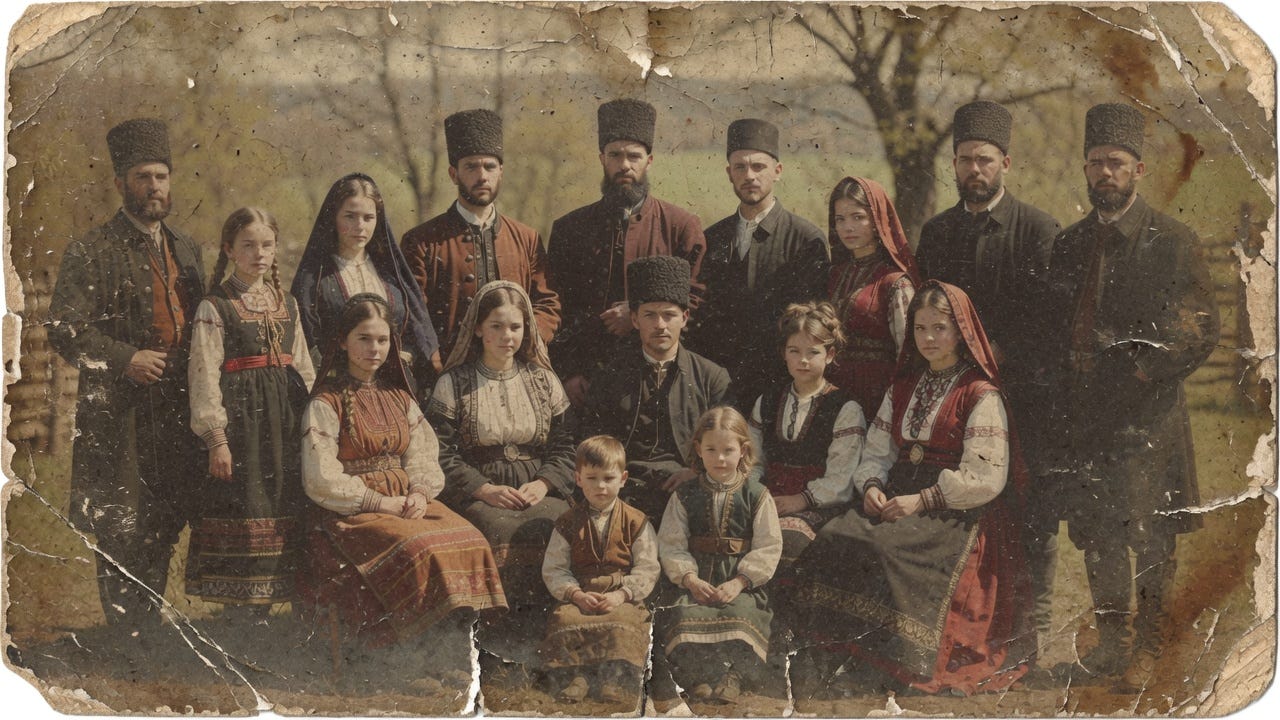
The Ashkenazi Jews of Eastern Europe—Poland, Lithuania, Ukraine, Belarus, the Pale of Settlement (Western Russia)—carry in their name the memory of Ashkenaz, the Scythian ancestor. They carry in their law the matrilineal principle encoded by the rabbis after the Temple’s fall, congruent with the gender patterns of the Thracians, the Illyrians, and the steppe. The descendants of this genealogy now inhabit the lands between the Vistula and the Dnieper, between the Baltic and the Black Sea. They speak Yiddish, a Germanic language written in Hebrew script, with Slavic and Turkic loanwords—a linguistic fossil of the recombination that produced them. They speak Yiddish, a Germanic language written in Hebrew script, with Slavic and Turkic loanwords—a linguistic fossil of the recombination that produced them. And the descendants, scattered across the Pale of Settlement and beyond, carry in their blood and their law the memory of a genealogy that stretches back to the Caucasus, to the steppe, to the temple at Ascalon where the Enarei received their sacred affliction, and to the dark-skinned Colchians whom Herodotus recognized as kin to the people of the Nile.
And with these characteristics we can trace the influences that created this group through history with five additional tent-poles as a reference:
Solomon’s Temple, built around 950 BCE, was a royal chapel attached to the palace, operated by the Zadokite priesthood.
In 597 and 586 BCE, Nebuchadnezzar II of Babylon destroyed Jerusalem and deported the Judahite elite in two waves.
Cyrus the Great conquered Babylon in 539 BCE and issued his decree allowing the Jews to return, the “return” was not a mass migration but the dispatch of a Persian-trained elite to govern a temple-state.
The destruction of the Second Temple in 70 CE
The establishment of Matrilineality by Talmudic/Mishnah tradition in contrast to the patrileanility of Torah/Old Testament
Disclaimer: By tracing this group, the author means the influences that are the hallmarkers of the ‘Elite’ stratum who shape adminstrative systems and not the common man who has little or no influence on shaping characteristic customs, behavorial norms, or enforcing policy. It must also be understood that the ‘Elites’ often construct parrellel ideaologies, religions, symbolism, and social mores that contradict the meanings taught in the moral instruction of the common man of any population. For a deeper exploration on that see my article, The Death Merchants of Venice.
The genealogy traces a persistent institutional logic that repeatedly dissolves individual and familial bonds in favor of group cohesion, and in this it shares deep structural affinities with the communist project as it has been historically realized. Both traditions emerged from environments of scarcity and mobility, where survival depended not on the accumulation of private wealth or the continuity of a lineage but on the discipline of a collective that could move, fight, and extract as a unit. The sublimation of the family into the war-band or the party cell, the partial liberation of women from reproductive sequestration into economic and even military roles, the reduction of mate-guarding in favor of a communal claim on the loyalties of the young— regarding societal based gender utility in sex and in war—these are not superficial parallels. They are adaptive responses to the same fundamental problem: how to hold a group together when the material basis for individual inheritance is absent or has been deliberately abolished. The king who wore the lion-skin was also the king who could be ritually slain. The party chairman who purged the old guard was himself vulnerable to the next purge. The system preserved the elite stratum but devoured the individual elite, because the survival of the group required that no person become indispensable.
UNDERSTANDING POPULATION MIGRATIONS, INTEGRATIONS, AND REPLACEMENTS
The standard model of civilizational change, the one taught in schools and repeated in textbooks, imagines a world of clean breaks. One people arrives. Another is conquered, scattered, extinguished. A fresh start unfolds on virgin ground. Mesopotamia gives way to Babylon, Babylon to Persia, Persia to Greece, Greece to Rome. The torch is passed. The story is linear. The story is simple. The story is wrong.
What the archaeological and genetic records tell us, with increasing clarity and undeniable force, is that populations do not vanish when empires fall. They persist. They endure. They absorb. What changes is not the substance of the people but the identity of the ruling stratum—the thin layer of elites who impose their language, their gods, and their institutions upon the deeper, older, more numerous substrate beneath them.
The various cultures that combined, generation after generation, to create the ethnicities we now call Greek, Roman, Jewish, Slavic, and Ashkenazi did not emerge in isolation. They overlapped. They interpenetrated. They borrowed and lent and stole and merged. There is no definitive racial distinction to be drawn between them, no pure stock, no unmixed lineage stretching back to a mythical dawn. The genetic record is a mosaic. The archaeological record is a palimpsest. Every population is a composite, and every composite contains elements that the standard narrative would prefer to keep separate. And yet. Each particular culture, in the course of its transmission through time, bore certain features that were emphasized, repeated, and ritualized in its continuation. These features were not arbitrary. They were the markers of identity, the signals of belonging, the passwords that distinguished insider from outsider. A way of burying the dead. A way of counting descent. A way of organizing the warrior band. A way of minting coinage and sanctifying prostitution in the same breath. These features, passed down through generations, gave the racial construct a certain tangibility—not a biological reality, but a cultural one, a continuity of form that persisted even as the genetic material shifted and mixed beneath it.
This stands in contrast to the linear model that is presented in education today. The linear model cannot account for the persistence of substrate populations beneath elite replacements. It cannot account for the recurrence of the same institutional forms—the Männerbund, the matrilineal line, the sacred coinage, the ritualized gender subversion—across cultures separated by millennia and continents.
Throw away your standard misconceptions of linearity and clean-sweep replacement from your Rockefeller-education camps.
THE FRAMEWORK TO UNDERSTANDING
Stratum 1, the Substrate, is the foundational population.
Stratum 2, the Overlay, they arrive not as settlers but as conquerors, and they install themselves as the ruling stratum over the substrate populations they encounter.
Recombination is the process by which these two strata fuse. When Stratum 2 overruns Stratum 1, the result is not replacement but synthesis. The languages shift. But the underlying patterns—in gender roles, in economic extraction, in the commodification of persons—persist across multiple iterations.
Even this framework, for all its explanatory reach, still flattens a deeper truth: every major cosmopolitan society, every ancient cultural center worth the name, was never a single people but a crowded harbor of overlapping diasporas. The Western habit of mind that insists on purity—pure origins, clean transmissions, a torch passed unaltered from one civilization to the next—is a mnemonic device that has outlived its usefulness. It serves memory but starves understanding. When simple handoffs of culture become the assumed baseline of discussion, the assumption itself becomes the impediment, a quiet refusal to acknowledge that the harbor was always full of ships from every shore, and that the torch, if it ever existed, was lit from a hundred different fires.
REFERENCE OF CULTURAL TIMELINE
Yamnaya—Canaanite—Hurro-Urartian—Minoan (c. 3300 BCE – 586 BCE)
Thracian—Phrygian—Lydian—Mycenaean (c. 1600 BCE – 546 BCE)
Dorian—Illyrian—Cimmerian—Scythian—Agathyrsi (c. 1200 BCE – 300 CE)
Etruscan—Veneti—Slavic—Khazar (c. 800 BCE – 1240 CE)
TRACING THE EXODUS BY MEMETIC MILESTONES OF IDENTITY
Out of Africa:
The deep substrate emerges from the Horn of Africa and the Nile Valley, spreading north and west during the Green Sahara period, roughly ten thousand years ago. These populations cross the Mediterranean and settle Iberia, the Balkans, Anatolia, and the Colchian shore of the Black Sea. Herodotus, writing in the fifth century BCE, will encounter their descendants on the eastern shore of the Black Sea and describe them as dark-skinned and woolly-haired, practicing circumcision from the first, alone among all mankind alongside the Egyptians and Ethiopians. He concludes, without ambiguity, that the Colchians (Modern Georgia) are Egyptians.
Steppe In the Name of Love:
By 3000 BCE, the Caucasus has become an incubator for overlapping waves: proto-Persians, Phoenicians, Celts, steppe tribes, and the Hurro-Urartian peoples who preserve the ancient metallurgical priesthoods.The first great steppe wave begins with the Yamnaya horizon around 3300 BCE on the Pontic-Caspian steppe. These are the first fully mobile pastoralists.In Northern and Central Europe, the Corded Ware culture effects near-total population replacement. In the Mediterranean—Greece, Anatolia, the Aegean—steppe migrants arrive as a thin elite stratum, contributing only four to fifteen percent to the genetic ancestry of Mycenaean populations. They install themselves as a ruling warrior caste over the existing Colchian-Phrygian-Pelasgian substrate.
Moses of the Caucus and Mesopotamia:
The Akkadian Empire, forged by Sargon of Akkad around 2334 BCE through the conquest of the Sumerian city-states, was the first multi-ethnic empire in recorded history, and though it collapsed within two centuries under Gutian pressure, its Semitic language became the diplomatic lingua franca of the Near East for over a thousand years, its administrative template shaped the succeeding Babylonian and Assyrian empires.The Sargon birth legend is known from a Neo-Assyrian tablet discovered in the library of Ashurbanipal at Nineveh, dated to the seventh century BCE, though the story it preserves is considerably older. Sargon of Akkad lived around 2300 BCE, and the legend was likely composed during the Akkadian period or shortly thereafter, perhaps around 2200 to 2000 BCE, when the empire he founded was still a living memory. The extant text is a copy of a copy, the latest link in a chain of transmission that stretched across a thousand years. The story Sargon tells about himself is this. His mother was a priestess, possibly a temple woman of the goddess Ishtar. His father he never knew. She conceived him in secret, in a city on the Euphrates, and when he was born she placed him in a basket of reeds, sealed it with bitumen, and set him adrift on the river. The river carried him to a gardener named Akki, who drew him from the water and raised him as his own son. Akki trained him in the work of the garden, but Ishtar loved the boy and elevated him. He became the cupbearer to the king of Kish, and from that position he rose to overthrow his master and conquer the known world. The parallels with the biblical story of Moses are too specific and too sequential to be coincidence. An infant of threatened or obscure birth. A basket of reeds sealed with bitumen. A river. A rescue. A rise from obscurity to leadership. The Moses story, as it appears in Exodus, was composed during the Babylonian Exile in the sixth century BCE, a thousand years after the Sargon legend was first told. The Israelite scribes who wrote Exodus had access to Mesopotamian literature. They were living in Babylon. The libraries were open to them. They took the story and gave it to Moses. The basket on the Nile is the basket on the Euphrates, transposed. The priestess mother becomes a Levite woman. The gardener becomes an Egyptian princess. The city of Akkad becomes the land of Goshen. The legend was not stolen. It was inherited. The Israelites, like every people of the ancient Near East, drew from a common cultural reservoir. The Sargon legend is the oldest known version of a story that would echo through the millennia—the abandoned infant who rises to rule, the child of the river who remakes the world.
Werewolves of Anatolia:
Around 1200 BCE, the systems collapse destroys the Mycenaean palaces, the Hittite Empire, and the Canaanite city-states. The Sea Peoples—Sherden, Denyen, Peleset, Tjeker—are the military arm of the elite diaspora, warrior bands whose names will reappear as place-names across the Mediterranean. Out of this vacuum emerged the Dorians, one of the four major Greek ethnic groups, distinguished by their Doric dialect and their characteristic social institutions. They originated in the mountainous regions of northwestern Greece—Macedonia and Epirus—and migrated south into the Peloponnese. Their “invasion” was mythologized as the Return of the Herakleidai, a divine homecoming in which the descendants of Heracles reclaimed their rightful inheritance. West Greek-speaking warrior clans, the Heraclids and their Dorian allies, overrun the Mycenaean Peloponnese. The myth of the Return of the Herakleidai is the ideological software patch: a violent conquest renamed as a divine homecoming, a gift—dōron—of land granted by the gods to a chosen lineage. The etymology is revealing. Dōron means gift. Doru means spear-shaft. The Dorians are simultaneously the people of the gift and the people of the spear. Around 1200 BCE, the systems collapse destroys the Mycenaean palaces, the Hittite Empire, and the Canaanite city-states.
The Sea Peoples—Sherden, Denyen, Peleset, Tjeker—are the military arm of the elite diaspora, warrior bands whose names will reappear as place-names across the Mediterranean. The Dorian “invasion” that follows is an elite replacement. West Greek-speaking warrior clans, the Heraclids and their Dorian allies, overrun the Mycenaean Peloponnese. The Dorian cities formed a commercial-maritime network stretching from Corinth to Syracuse to the Hexapolis in Asia Minor. This network would later become the spine of Paul’s missionary journeys. The myth of the Return of the Herakleidai is the ideological software patch: a violent conquest renamed as a divine homecoming, a gift—dōron—of land granted by the gods to a chosen lineage. The etymology is revealing. Dōron means gift. Doru means spear-shaft. The Dorians are simultaneously the people of the gift and the people of the spear. The Dorian social structure that emerges from this recombination is distinctive. Dorian women had greater freedom and economic power than women of other Greek ethnicities. Unlike other Hellenic women, Dorian women could own property, manage their husbands’ estates, and delegate many domestic tasks to slaves. Spartan men were removed from their families at age seven and subjected to the agoge, a brutal training regimen designed to produce obedient warriors. They lived in all-male residences until the age of thirty, regardless of marital status. Institutionalized pederasty between adult warriors and adolescent boys was a mechanism of elite bonding and socialization.
This created a structural paradox. The Spartan state was the most militarized in Greece. Yet Spartan women controlled the household economy, owned land, and exerted influence that shocked other Greeks. The paradox is resolved when we understand it as a system where the prolonged absence of warrior males necessitates that women become the stable, continuous element of the household. Property is managed by women. Inheritance flows through women in practice, even if formal legal structures remain patrilineal. The woman is the fixed point; the man is the transient warrior. Along the Black Sea coast, the Getae—the most Hellenized branch of this continuum—established a kingdom centered at Helis by the fourth century BCE under King Cothelas. It was Cothelas who made a marriage alliance that would alter the course of Mediterranean history: he gave his daughter Meda to Philip II of Macedon, the conqueror of Greece and father of Alexander the Great.
Phrygian Liberty Cap:
The Thracians, Dacians, and Getae were not separate peoples but overlapping waves sharing a common spiritual technology: the wolf-warrior initiation. Young men underwent a ritual death and rebirth, living as outlaws—as wolves—for a year, taking what they needed. The Dacian name itself derives from the Phrygian daos, meaning wolf. Head-taking was their sacrament. Trophy display was their proof of membership. The Agathyrsi, a Scythic people, migrated into Thracian territory in the eighth and seventh centuries BCE and were absorbed, contributing their steppe traditions to the synthesis. The Getic kingdom of Cothelas emerged by the fourth century BCE. Herodotus recorded that the Thracians “sell their children and let their maidens commerce with whatever men they please.” This was not promiscuity. It was a system where female sexual autonomy coexisted with the commodification of children. The woman chose her partners; the children she produced were alienable. In such a system, maternity is certain while paternity is not. The child belongs to the mother’s line because the mother’s identity is the only verifiable fact.
The Phrygians themselves emerged around 1200 BCE in the wake of the great Bronze Age collapse, inhabiting central Anatolia. They were associated with the goddess Cybele, whose sacred black stone, said to have fallen from heaven, was housed at Pessinus. The Phrygian cap—a soft, pointed hat—would later be worn by the god Mithras in Roman mystery cults and, millennia afterward, be adopted as the “liberty cap” of the French Revolution. Herodotus, writing in the fifth century BCE, records that the Armenians were “settlers from the Phrygians”—a connection that links them to the people whom the Egyptians, in the famous experiment of Pharaoh Psammetichus, considered the oldest race on earth. Herodotus, writing in the fifth century BCE, records that the Armenians were “settlers from the Phrygians.”
Coinage and Sacred Prostitution:
Lydia, in western Anatolia, sat at the crossroads of steppe and Aegean. The Mermnad dynasty ruled from Sardis. The Lydians were the first to mint coinage around 600 BCE. Herodotus, our primary source, notes that they were also the first to systematize temple prostitution as a source of revenue. The daughters of common people earned their dowries through sacred sex work, and the silver they earned funded the king’s tomb. This is not coincidence. Coinage and commodified sexuality emerge together as mechanisms for extracting surplus from the population. The temple prostitute’s body is exchanged for silver that builds the king’s monument. The merchant’s goods are exchanged for coins that fund the king’s army. The state inserts itself into every transaction, skimming a portion for the oligarchy. The Lydians capital at Sardis became the crucial bridge between the steppe world and the Mediterranean.
The Lydians interacted extensively with the Ionian Greeks of the coast and with the Scythians of the steppe; in the seventh century BCE, the Thracian Treres tribe, allied with the Cimmerians, even sacked Sardis itself. The Lydians interacted extensively with the Scythians, the Thracians, and the Ionian Greeks. They were the cultural bridge between the steppe and the Aegean, the translators of the ancient Steppe concept of sacralized gold into standardized, state-guaranteed tokens of value. The Lydians—ruled by the Mermnad dynasty—Gyges, Ardys, Alyattes, and the famously wealthy King Croesus, whose name became a byword for wealth, was overthrown by Cyrus the Great of Persia in 546 BCE. The Lydian elite was absorbed into the Persian imperial system, carrying their financial technologies with them. Herodotus also recounted the legendary tradition that a group of Maeonian/Lydian colonists, led by Lydus’s brother Tyrrhenus, fled the region after a severe famine and sailed to Italy, where they became the ancestors of the Etruscans.
13th Legion:
Meanwhile, in Italy, the Etruscans—a non-Indo-European people likely of Anatolian origin, per Herodotus’s account of the Tyrrhenian migration—had organized a League of Twelve cities, ruled by a closed aristocracy that monopolized religious knowledge and political office. Their religion, centered on haruspicy and lightning divination, shows clear Anatolian and Mesopotamian roots. They imported the cult of Cybele and her castrated Galli priests. They urbanized the Latin villages that would become Rome. When the Tarquin kings were expelled around 509 BCE, the Etruscan elite was absorbed into the Roman Patriciate. The Aemilii Paulli, carrying the Sabine war-name Mamercus derived from Mamers the Oscan Mars, conquered Illyria and Macedon across four generations, systematically pacifying the territory that would become the Venetian hinterland. The Servilii Caepiones intermarried with the Caecilii Metelli, allies of Macedonicus. Servilia Caepionis—lover of Caesar, mother of Brutus, half-sister of Cato—was the matrilineal node where the Aemilii, Servilii, Porcii Catones, and Junii Bruti converged. Brutus’s assassination of Caesar in 44 BCE was a ritual of sovereignty renewal: the king must die so the republic may live. The Delos slave market, in the Hellenistic period, could process tens of thousands of human beings daily.
The Roman Republic perfected this system. Conquest flooded Italy with captives. The publicani, the tax-farming corporations, extracted surplus from the provinces. The denarius became the standard currency of the Mediterranean. The Roman aristocracy’s wealth was measured not only in land but in the number of human chattels they owned. The commodification of persons was the steppe logic of portable wealth, systematized and scaled to imperial dimensions.
The First Temple:
Solomon’s Temple, built around 950 BCE, was a royal chapel attached to the palace and operated by the Zadokite priesthood. The population at large worshipped at local high places, the bamot. The prophets—Elijah, Amos, Hosea, Isaiah—were the voice of a purist Yahwist faction demanding exclusive worship of the sky-god and condemning the syncretic practices of the substrate.In 597 BCE, Nebuchadnezzar II of Babylon captured Jerusalem and deported the elite: the royal family, the nobility, the military commanders, and skilled craftsmen—roughly ten thousand people. A second deportation followed the destruction of the Temple in 586 BCE. The Babylonians, like the steppe empires before them, practiced targeted deportation of elites. This was a decapitation, not a population replacement.
The Judahite elite in Babylon underwent a profound transformation. King Jehoiachin was maintained at the royal court, receiving rations confirmed by archaeological tablets. The Zadokite priests had access to Babylonian temple-scribe complexes, where they encountered Mesopotamian creation myths, flood narratives, law codes, and priestly-divinatory technologies. The Priestly source of the Torah was composed in Babylon. It is a hybrid document: the memory of a Judahite past reorganized using the intellectual categories of Mesopotamian priestly science.
From Israelites to Jews:
In 539 BCE, Cyrus the Great conquered Babylon. His policy of repatriating captive elites and funding the restoration of their temples was standard Achaemenid statecraft, confirmed by the Cyrus Cylinder. He issued a decree allowing the Jews to return, providing royal funding and returning the looted Temple vessels. Cyrus is called “the Lord’s anointed”—Messiah—in the Book of Isaiah, an unprecedented title for a non-Israelite. The decree was not singular benevolence. It was the Persian imperial model: create a network of dependent, grateful client-temple-states on the frontiers of the empire, staffed by elites whose legitimacy depended entirely on Persian support.
The Second Temple and the Matrilineal Shift:
The return was not a mass migration. It was the dispatch of a Persian-backed elite—Zerubbabel, a Davidic prince, and Joshua, a Zadokite high priest—to re-establish a temple-state. The returning golah community encountered the “people of the land,” the Am ha-Aretz, the Stratum 1 population that had never left, had continued to worship Yahweh at local shrines, and had intermarried with neighboring peoples. The conflict between the returning purists and the local syncretists defines the Second Temple period. The Second Temple was completed around 516 BCE. Ezra’s reform around 458 BCE—the mass divorce of foreign wives, the public reading of the Torah, the reimposition of purity laws—was the imposition of a newly rigid, Exile-forged orthodoxy upon a resistant local population. The “holy seed” ideology created a closed, endogamous community defined by adherence to the Torah. The foreign wives were often simply Stratum 1 women whose families had never been part of the pre-Exilic elite’s marriage network. Ezra’s reform was an act of elite boundary-policing.
The Pharisees emerged as a lay scribal movement, distinct from the Sadducean priestly aristocracy. They believed in resurrection, angels, and the authority of both written and oral Torah. They developed the synagogue as a local institution of worship and study, making Torah accessible outside the Temple. They were popular with the common people and were also the Jewish movement most engaged with Hellenistic culture, operating in the diaspora cities—Alexandria, Ephesus, the Dorian Hexapolis—where they interacted with Greek philosophy, Roman law, and the gender patterns of the Dorian and Illyrian populations.
Aliyah or Haj:
Among the Scythians, a hereditary class of diviners called the Enarei—the “effeminates”—wore women’s clothing, performed women’s work, and wielded immense ritual power. They alone could diagnose royal illness, and their divinations could sentence men to death. Herodotus explicitly traces their condition to the sack of the temple of Aphrodite Urania at Ascalon, on the Levantine coast. The Scythians who plundered the goddess’s temple were afflicted with the “female sickness,” and their descendants inherited it. This is a crucial detail for the genealogy we are tracing. The Enarei did not develop their shamanic gender-subversive tradition in isolation on the steppe. They journeyed to the Levantine coast, to the ancient temple of the goddess, and there they received—or were cursed with, depending on the telling—their sacred affliction. The vector of transmission runs from the steppe to the Levant and back again. The priestly-shamanic tradition of the Enarei is a recombination of steppe warrior culture with the ancient goddess cults of the Canaanite-Levantine coast, the very region where the Israelites would later emerge. This is the same Ascalon whose temple the Philistines—the Peleset, the Sea Peoples—would later control. The Enarei are the living proof that the steppe and the Levant were not separate worlds but nodes in a continuous circuit of sacred and genetic exchange, a circuit that predates the Israelite monarchy by centuries.
The Etymology of Ashkenaz:
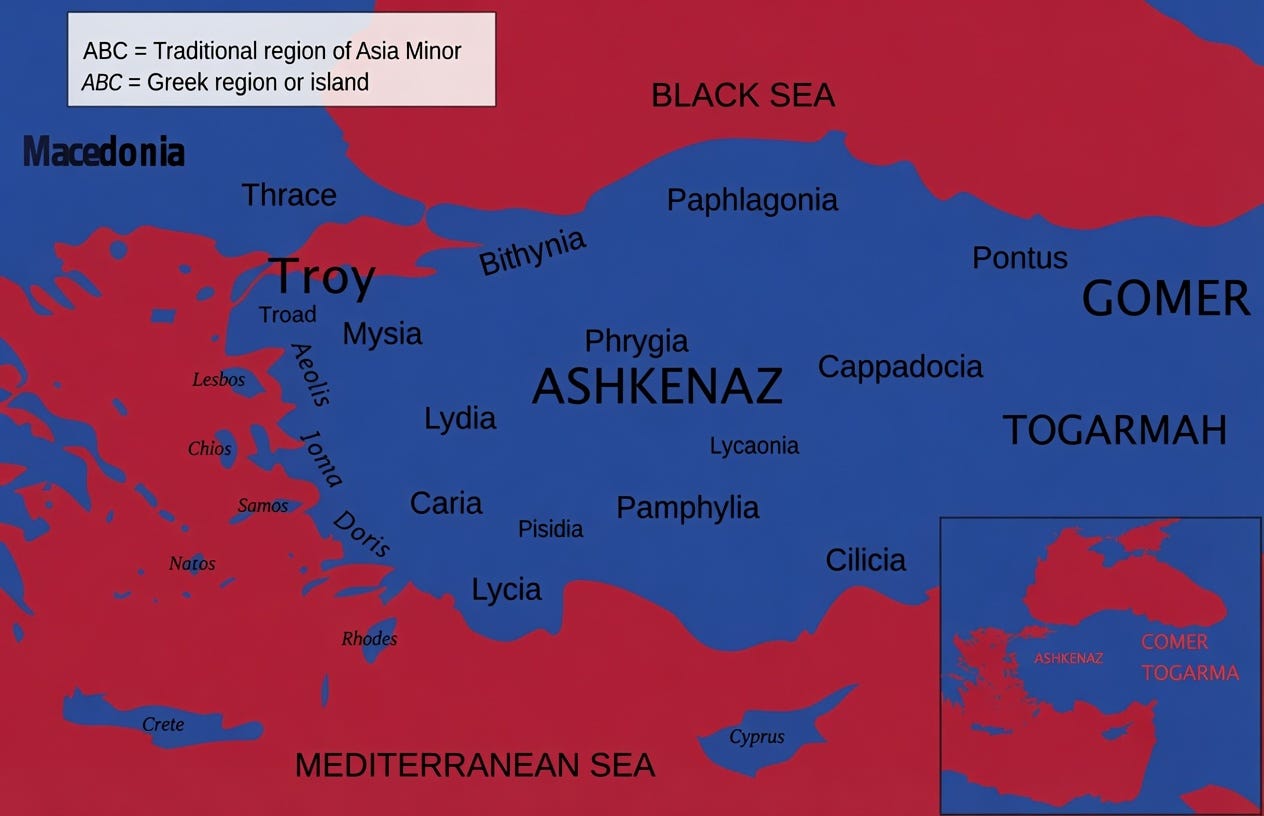
The name Ashkenaz appears in the Hebrew Bible as the first son of Gomer, a Japhetic patriarch in the Table of Nations (Genesis 10:3). In rabbinic literature, the descendants of Ashkenaz were first associated with the Scythian cultures—the same Scythians who merged with the Thracians to form the Dacian wolf-cult, the same Scythians whose name was given to the Persian satrapy of Skudra, the same Scythians among whom the Enarei served as the hereditary diviners afflicted with the female sickness after their voyage to the Levantine coast. Only later, from the eleventh century CE onward, was the name Ashkenaz associated with Germany and northern Europe. The shift in meaning encodes a migration: the descendants of the Scythian-identified peoples had moved westward, and the name followed them. The Ashkenazi Jews, who would come to dwell in the Rhineland and then in Poland-Lithuania, carried a name that originally meant Scythian. Their very ethnonym is a geographical cipher pointing back to the steppe. The Slavs, among whom the Ashkenazi Jews dwelled for a millennium, share a linguistic root with the Armorican Veneti of the Atlantic coast. The Gaulish Aremorica means “place in front of the sea.” The Slavic Po-mor-jane—the inhabitants of Pomerania—means “those in front of the sea.” The Gaulish and Slavic peoples, seemingly separated by half a continent, share a linguistic DNA that points to a common maritime orientation. Even earlier than the Scythian expansion, the Cimmerians—a mysterious steppe people who may have been related to the Thracians or the Scythians—had swept through Anatolia around the eighth and seventh centuries BCE. Allied with the Thracian Treres tribe and the Lycians, they attacked Lydia and captured Sardis.
The Cimmerians were a steppe people who appear in Assyrian records as the Gimirri around the eighth century BCE. They swept through Anatolia, allied with the Thracian Treres tribe, and attacked Lydia, capturing the capital Sardis in the seventh century BCE. The Assyrian name Gimirri is the earliest recorded form of their ethnonym. In the Hebrew Bible, the Table of Nations in Genesis 10 lists the descendants of Noah’s sons. Japheth, the third son, has a son named Gomer—spelled Gomer in Hebrew, consisting of the consonants g-m-r. This is the same consonantal root as the Assyrian Gimirri. The biblical Gomer is listed as the father of Ashkenaz, Riphath, and Togarmah. The sequence is telling. Ashkenaz, as we have traced, was associated in later rabbinic literature with the Scythians and eventually with the Jewish communities of Germany and Eastern Europe. The genealogy in Genesis places Gomer one generation before Ashkenaz—the Cimmerians as the parent population, the Scythians as the offshoot. It entered Greek as Kimmerioi in Herodotus and other classical sources. The Cimmerians themselves were absorbed into the populations of Anatolia and the steppe, but their name survived in the biblical genealogy, where Gomer became the father of Ashkenaz—the ancestral figure whose name would eventually be applied to the Jewish communities of the Rhineland and Eastern Europe. Their name may connect to the biblical Gomer, who appears in the Table of Nations as the father of Ashkenaz. The Cimmerians represent one of the earliest documented steppe incursions into the Anatolian-Levantine zone.
The Scythians themselves dominated the Pontic steppe from roughly 800 BCE to 300 CE. They were the archetypal steppe confederation, documented in vivid detail by Herodotus in the fourth book of his Histories. Their society was rigidly stratified: the Royal Scythians regarded the other Scythians as their slaves, extracting tribute and military service. Among them lived the Enarei, a hereditary class of “effeminate” diviners who wore women’s clothing, performed women’s work, and wielded immense ritual power. Herodotus traces their condition to the sack of the temple of Aphrodite Urania at Ascalon on the Levantine coast—a crucial detail that demonstrates the continuous circuit of movement and exchange between the Pontic steppe and the Near East. The Scythian ethnonym was given to the Persian satrapy of Skudra, and it is the ultimate linguistic root of the name Ashkenaz.
The destruction of the Second Temple:
The destruction by Rome in 70 CE annihilated the Sadducean priesthood and scattered the Jerusalem church. The Pharisaic survivors became the rabbis who reconstructed Judaism as a diasporic religion. In this crucible, the Mishnah codified matrilineal descent around 200 CE: the child of a Jewish woman is Jewish, the child of a non-Jewish woman is not. This was a radical inversion of biblical patrilineality, congruent with the gender patterns of the Thraco-Illyrian-Dorian populations among whom the Pharisees had operated for centuries. The Sadducean priesthood was annihilated. The Pharisees survived, becoming the rabbis who reconstructed Judaism as a diasporic religion of the book. It was in this crucible that the matrilineal principle was codified. The Mishnah, compiled around 200 CE, established in Kiddushin 3:12 that the child of a Jewish woman and a non-Jewish man is Jewish; the child of a non-Jewish woman and a Jewish man is not. This was a radical inversion of biblical patrilineality, where descent, inheritance, tribal affiliation, and priestly status had all flowed through the father.
The structural logic is compelling. The destruction of the Temple destroyed the institutional basis of patrilineal priestly identity. Without the Temple, there were no sacrifices for Kohanim to perform, no tithes for Levites to collect, and no throne for a Davidic heir to claim. The patrilineal categories became vestigial. In a world of exile, expulsion, and uncertainty, the mother became the only verifiable anchor of identity. The mother was always known. The mother’s status was stable regardless of political upheaval. The household replaced the Temple. The matrilineal line replaced the patrilineal priesthood. This shift was congruent with the gender patterns of the Thraco-Illyrian-Venetic populations with whom the Pharisees had interacted for centuries in the Hellenistic diaspora—the same pattern Herodotus had documented among the Thracians, where female sexual autonomy and the commodification of children made maternity the only certain anchor of identity. The rabbis, whether consciously or not, adopted the gender logic of the warrior societies that surrounded them and encoded it into Jewish law.
The Adriatic Veneti, an Illyrian-related people who had controlled the amber trade from the Baltic to the Mediterranean since the first millennium BCE, provided the demographic and cultural substrate for Venice. When the Western Roman Empire collapsed, their elite fled to the lagoons and built a republic that would last a thousand years. The Armorican Veneti of Brittany closed the Atlantic circuit, their solid-oak ships with iron chains and leather sails withstanding Atlantic storms. The Vistula Veneti, recorded by Tacitus, became the Slavs. All three derive from the Proto-Indo-European root wen-, encoding the bond of the Männerbund: kinship by initiation, alliance by oath. The Slavic word for themselves—Slověne, “people of the word”—derives from slovo, speech, contrasting with němьcь, the mute foreigner, the term for Germans. The Slavic Pomeranians—Po-mor-jane, “those in front of the sea”—share the exact linguistic construction with Gaulish Aremorica, “place in front of the sea,” demonstrating the ancient maritime orientation encoded in their language.
The Khazar Conversion:
The Khazar Khaganate was a Turkic steppe empire that controlled the trade routes between the Islamic Caliphate, Byzantium, and the emerging Rus’ states between the seventh and tenth centuries CE. Its elite converted to Judaism in the eighth or ninth century. The reasons for the conversion remain debated—a strategic choice to maintain independence between the Christian and Muslim empires, a genuine religious transformation, or both. What matters for our genealogy is the structural fact: a Stratum 2 Turkic steppe warrior elite, direct heirs of the Scythian and Hunnic traditions, adopted Judaism as their court religion. The Khazar elite carried the ancient steppe gender patterns into their adopted faith. The Papaeus pole—the sky-father, the warrior chieftain—and the Baba pole—the chthonic grandmother, the matrilineal line—were encoded in the steppe operating system. The Enarei tradition of the gender-subversive shaman-priest, acquired through the voyage to the Levantine temple of the goddess, was part of this inheritance. When the Khazar elite converted to Judaism, they brought this template with them. Simultaneously, a network of Jewish merchants known as the Radhanites dominated the trade routes between Western Europe and China from the sixth to tenth centuries CE. Their name is of uncertain origin—possibly from a region in Khorasan, or from the Rhône Valley, or from a Persian term. They spoke multiple languages—Arabic, Persian, Greek, Frankish, Slavic—and maintained complex credit instruments called suftaja, a precursor to the bill of exchange. Their trade routes precisely traced the old Silk Road and the steppe corridor. They were under the direct protection of the Carolingian and Abbasid courts. They represented a trans-imperial commercial elite whose networks had survived the fall of Rome by operating across civilizational boundaries.
Suftaja:
The suftaja was an early medieval credit instrument used by Jewish merchants, particularly the Radhanites, to transfer value across the vast distances of the Eurasian trade network without the physical movement of coin. The term derives from an Arabic root and referred to a letter of credit or bill of exchange—a written order from one merchant to another, often in a distant city, instructing the recipient to pay a specified sum to a named third party. The Radhanites were a network of Jewish merchants who, from roughly the sixth to the tenth centuries CE, dominated the overland and maritime trade routes connecting Western Europe to China. Their name is of uncertain origin—possibly derived from a district in Khorasan, the Rhône Valley, or a Persian term for “those who know the way”—but their operations are documented in the ninth-century Book of Routes and Kingdoms by the Persian geographer ibn Khordadbeh, who described them as speaking Arabic, Persian, Greek, Frankish, Slavic, and Andalusian, and as trading in slaves, furs, textiles, spices, perfumes, and precious metals across the entire breadth of the known world. They moved along four principal routes: one by sea from France to the Levant, another by sea to Egypt and then overland to the Red Sea and beyond, a third overland through the Caucasus and Central Asia, and a fourth along the Danube and across the Pontic steppe.
Their commercial advantage rested on several factors: their multilingualism, which allowed them to operate across linguistic boundaries that stymied competitors; their use of credit instruments like the suftaja, which freed them from the risks of transporting specie; their ability to draw on a diaspora network of co-religionists who provided lodging, credit, and market intelligence in every major trading city; and the protection extended to them by both Carolingian and Abbasid authorities, who valued the luxury goods and tax revenues they generated. When the Khazar Khaganate collapsed around 1000 CE, the Radhanite networks provided the commercial infrastructure into which displaced Khazar elite lineages integrated, and their financial techniques—letters of credit, bills of exchange, the systematic arbitrage of price differentials across markets—were absorbed into the Italian merchant banking houses that would later dominate European commerce. They are the missing link in the economic history of the West, the bridge between the ancient trade networks of the Silk Road and the commercial revolution of the High Middle Ages, and their disappearance from the historical record after the tenth century is one of the quiet mysteries that the standard narrative has never adequately explained.
Baba Yaga:
When the Khazar Khaganate collapsed in the late tenth century under the pressure of Kievan Rus’ expansion, its elite did not vanish. They dispersed into the existing Jewish communities of Eastern Europe, the Rhineland, and the Islamic world. The Kievan Rus’ themselves were a Stratum 2 elite—Norse Varangians who had established themselves as the ruling caste over Slavic Stratum 1 populations along the Dnieper and Volga rivers. Their capital, Kiev, was a multi-ethnic emporium with a significant Jewish and Khazar quarter. The Ashkenazi Jewish community emerged from this triple recombination.
First, the Khazar steppe warriors, Turkic-speaking, carrying the ancient sky-father and earth-mother binary into their Judaism. Second, the Radhanite merchant-scholars, multilingual, trans-imperial, masters of credit instruments and long-distance trade. Third, the Slavic-Venetic substrate populations of Eastern Europe, with their own ancient matrifocal traditions, their Pomeranian maritime orientation, and their linguistic connection to the Armorican Veneti of the Atlantic coast. The matrilineal principle, already encoded in the Mishnah after the destruction of the Second Temple, was reinforced by this triple fusion.
The Khazar steppe pattern—the Baba pole, the chthonic grandmother as the fixed point of identity—converged with the Radhanite commercial pattern—the diasporic network that required portable identity across state boundaries—and the Slavic-Venetic pattern—the ancient matrifocal traditions of the Baltic-Adriatic circuit. The result was a community whose defining criterion of membership was the mother’s line. The Ashkenazi economic niche—tax-farming, estate management, tavern-keeping, and banking for the Polish szlachta nobility—was the structural consequence of this recombination. A diasporic commercial and administrative class, literate in Hebrew and Aramaic, maintaining credit networks across state boundaries, served a landowning warrior aristocracy in a zone that had been the western terminus of the Pontic slave-trading network for a millennium. The word “slave” itself derives from “Slav” because of the volume of Slavic captives traded through Venetian, Radhanite, and Khazar routes into the Mediterranean and Islamic worlds.
GENETIC CONFIRMATION OF A SLAVO-IRANIAN ORIGIN (ERAN ELHAIK)
The genealogy traced in the preceding paragraphs—a lineage running from the Scythian steppe through the Cimmerian-Gomer-Ashkenaz axis, through the Khazar conversion, the Radhanite trade networks, and the Slavic-Venetic substrate—was assembled from textual inference, linguistic reconstruction, propography, and historical pattern recognition. The evidence was there, in Herodotus and the Table of Nations, in the etymology of Yiddish and the geography of the Silk Roads. But it was assembled without recourse to modern genetics, a narrative built from the available sources and the logic of their connections. The author had not yet searched for genetic confirmation when the broad contours of this genealogy were first laid down as earlier versions of it already existed in his writing. This author’s note is included only to demonstrate how the seriousness of modern science is frequently betrayed by the political constructions it is surrounded by. In fact, I confess that the summary of the following study has only been appended here —not merely as support but also as demonstrated contempt— by adding a layer of complexity— for the type of nay-sayer who will respond with scientific tropes and other forms of institutionally educated constructions of argument meant to deflect, obscure, and deny but in an exceedingly authoritative tone.
In a 2016 study published in Genome Biology and Evolution, an international team led by Eran Elhaik analyzed the genomes of 393 Ashkenazic Jews—both Yiddish speakers and non-Yiddish speakers—and compared them with over 600 non-Jewish genomes from across Eurasia (Das et al., 2016). Using a biogeographical tool called Geographic Population Structure, the researchers traced the origins of Ashkenazic Jews not to Germany or the Rhineland, but to a cluster of primeval villages in northeastern Turkey, along the southern coast of the Black Sea, adjacent to the ancient borders of the Khazar Empire. Four villages in particular—İşkenaz, Eşkenez, Aşhanas, and Aschuz—bear names that may derive from “Ashkenaz” itself. All four sit along major trade routes that once formed the spine of the Silk Road.
The genetic distances told the same story. Ashkenazic Jews were significantly closer to Turks, Armenians, Georgians, Iranians, and southern Caucasians than to Germans or Middle Eastern populations. Simulated “native” populations of Khazars were closer to Ashkenazic Jews than any other group save the Ashkenazim themselves. Not a single individual was positioned in Germany. The most common Y-chromosome haplogroups among the Ashkenazim were J1a, E1b1b, J2a, R1a, and R1b—lineages that dominate the region between the Black and Caspian Seas, including Turkey, Iran, and the Caucasus. The mitochondrial DNA showed greater diversity, with haplogroups common in Africa (L2), the Near East (J), Europe (H), North Eurasia (T, U), and Northeast Eurasia (X), reflecting a diffuse maternal origin consistent with the proselytization of diverse populations. A small but consistent sub-Saharan African component, approximately two percent, was present across the Ashkenazic genomes, in agreement with earlier findings and consistent with the deep African substrate that Herodotus documented among the Colchians and that the E1b1b lineage traces through Anatolia and the Levant. The R1a lineage found in Ashkenazic Jews is predominantly the R1a-Z93 subclade, which is associated with Iranian and Central Asian populations, consistent with the Irano-Turko-Slavic hypothesis.
The authors concluded that Ashkenazic Jews “probably originated during the first millennium when Iranian Jews Judaized Greco-Roman, Turk, Iranian, southern Caucasus, and Slavic populations inhabiting the lands of Ashkenaz in Turkey” (Das et al., 2016, p. 1132). Yiddish, they argued, was created by “Slavo-Iranian Jewish merchants plying the Silk Roads between Germany, North Africa, and China” as a cryptic trade language, later undergoing relexification by adopting German-like vocabulary while retaining its Slavic and Iranian grammatical core.
The implications for the genealogy we have traced are profound. The name “Ashkenaz,” which the study confirms is the biblical Hebrew rendering of the Assyrian aškūza—the Scythians—was not arbitrarily chosen. It was a self-designation, a memory preserved in the very ethnonym of the people. The Scythian circuit of sacred exchange, the Enarei voyage to the Levantine temple, the Cimmerian-Gomer connection in the Table of Nations, the Khazar conversion, the Radhanite commercial networks, the Slavic-Venetic matrifocal substrate—all of these streams, which the historical and linguistic evidence had suggested converged in the Ashkenazi synthesis, are now legible in the genome. The genetic record confirms what the textual record implies: the Ashkenazi Jews are the product of a Slavo-Iranian-Turkic fusion that occurred in the lands between the Black and Caspian Seas, and their name encodes the entire history in a single word.
ON TALKING HEADS AND BOTTLENECKS
The consensus would deploy the bottleneck argument as its primary instrument of refutation, and it would do so with the quiet authority of a method that presents its own assumptions as settled fact. The argument runs as follows: Ashkenazi Jewish genomes show strong evidence of a severe population bottleneck during the medieval period, reducing the effective breeding population to perhaps a few hundred individuals. This bottleneck, combined with subsequent rapid expansion, is sufficient to explain the genetic distinctiveness of the Ashkenazi population without invoking any particular geographical origin or admixture event. The genetic signatures that the genealogical model attributes to a Slavo-Iranian-Turkic fusion in the lands between the Black and Caspian Seas are, in the consensus reading, simply the result of genetic drift acting on a small founder population. The similarities to Turks, Armenians, and Caucasians are dismissed as shared ancestral components from a much deeper Neolithic or Bronze Age past, predating the formation of any of the historical populations in question by thousands of years. The E1b1b, J1a, J2a, and R1a lineages are reinterpreted as part of the general Near Eastern and Mediterranean gene pool, not as evidence of a specific Khazar or Scythian contribution. The bottleneck, in this framing, is not merely an alternative explanation. It is a solvent that dissolves every connection the genealogy asserts, reducing them all to the generic background noise of Eurasian population history.
The scientific rebuttal to this consensus position does not deny the bottleneck. It denies that the bottleneck explains what the consensus claims it explains. A bottleneck reduces genetic diversity. It does not create affinities with specific populations. Genetic drift is random. It can shift allele frequencies, but it cannot systematically pull an entire genome toward the genetic signatures of Turks, Armenians, and southern Caucasians while simultaneously pushing it away from Germans and Middle Eastern populations. If drift were the primary force, the resulting genetic distances would be chaotic—some loci closer to one population, some to another, with no consistent pattern. What the Elhaik study and related work demonstrate is not chaos. It is a systematic and statistically significant skew toward populations inhabiting the region between the Black and Caspian Seas. This skew is precisely what a model of admixture in that region would predict, and it is precisely what a model of random drift would not predict. The bottleneck can explain why Ashkenazi Jews are genetically distinct. It cannot explain why that distinctiveness takes the specific shape of affinity with Irano-Turkic-Caucasian populations rather than, say, affinity with Berbers or Finns or any other randomly chosen group. The direction of the skew is the evidence. The bottleneck is silent on the direction.
A second weakness in the bottleneck argument concerns timing. The admixture events that produced the Ashkenazi genetic signature are dated by multiple methods to the first millennium CE, roughly between 700 and 1200 CE. This is precisely the period when the Khazar Khaganate existed, when the Radhanite trade networks operated, and when the Silk Road corridor between the Black and Caspian Seas was a major zone of population movement and cultural exchange. The bottleneck, by contrast, is typically dated to a slightly later period, the thirteenth to fourteenth centuries, and is attributed to persecution, expulsion, and the founder effects of small migrating communities. But a bottleneck that occurs after an admixture event does not erase the admixture. It may amplify some of its effects through drift, but the underlying affinities created by the admixture persist. The consensus tends to treat the bottleneck as if it overwrote earlier population history, as if the founding of small Ashkenazi communities in the Rhineland erased any prior genetic connections to other regions. This is not how population genetics works. A small founder population carries within it the genetic legacy of the larger population from which it was drawn. If that larger population had affinities with the Caucasus and the steppe, those affinities will be preserved, in diluted form, in the founder group. The bottleneck cannot explain them away. It can only redistribute them.
The deepest scientific flaw in the consensus position is its reliance on an implicit model of pristine origins that it would never state openly. The bottleneck argument is deployed to protect the Rhineland hypothesis, which posits a migration from Judea to Rome to the Rhineland, followed by a demographic miracle in Eastern Europe. But the Rhineland hypothesis requires that the Ashkenazi population be fundamentally derived from a Judaean source, with only minor admixture from local European populations. The genetic data do not support this. Ashkenazi Jews are closer to Turks, Iranians, and Caucasians than they are to Palestinians, Bedouins, or other populations that would represent the putative Judaean source. This is not a matter of interpretation. It is a measurement. The consensus has responded by “Middle Easternizing” the data—by redefining the Middle East to include Anatolia and the Caucasus, by treating any similarity to Near Eastern populations as evidence of a Judaean origin, by collapsing the distinction between a Bronze Age shared ancestry and a first-millennium admixture event. The bottleneck is the mathematical fig leaf over this logical gap. It allows the consensus to say: the patterns are real, but they are meaningless, because drift can produce anything. But drift cannot produce a systematic, directional affinity with a specific geographical region. Only admixture can do that. The bottleneck does not refute the genealogy. It distracts from it. And the distraction, as always, serves the needs of the institution that deploys it.
CONCLUSION IN THIRD PERSON
Reading between the lines of this text— the deeper argument is structural and epistemological. What is being relayed is not merely that the Ashkenazi Jews emerged from a particular set of historical recombinations, but that the standard narrative of Jewish origins—and by extension, the standard narrative of Western civilization—has been deliberately constructed to obscure a reality that is visible to anyone who looks at the evidence without the filter of institutional authority.
The pattern is visible to the unaided eye, but the institutions that could validate the pattern are structurally committed to obscuring it, because the pattern implicates the elite stratum that those institutions serve. What the author ultimately intends to relay is that identity is not a biological inheritance but a political construction maintained by an administrative elite that has, across millennia, learned to wear whatever mask the local population requires. The Ashkenazi Jews, in this reading, are neither a pure race nor a random mixture. They are the product of a specific, traceable sequence of elite recombinations, each one leaving its mark in law, language, and custom. The matrilineal principle, the credit instrument, the cryptic trade language, the portable god—these are not accidents of history. They are technologies of survival developed by a stratum that has been displaced and reinstalled so many times that it has perfected the art of cultural camouflage. The author is not celebrating or mocking this. He is pointing at it. And he is doing so in a tone that suggests the reader has been trained not to see it, and that the training itself is the mechanism of the ongoing deception.