

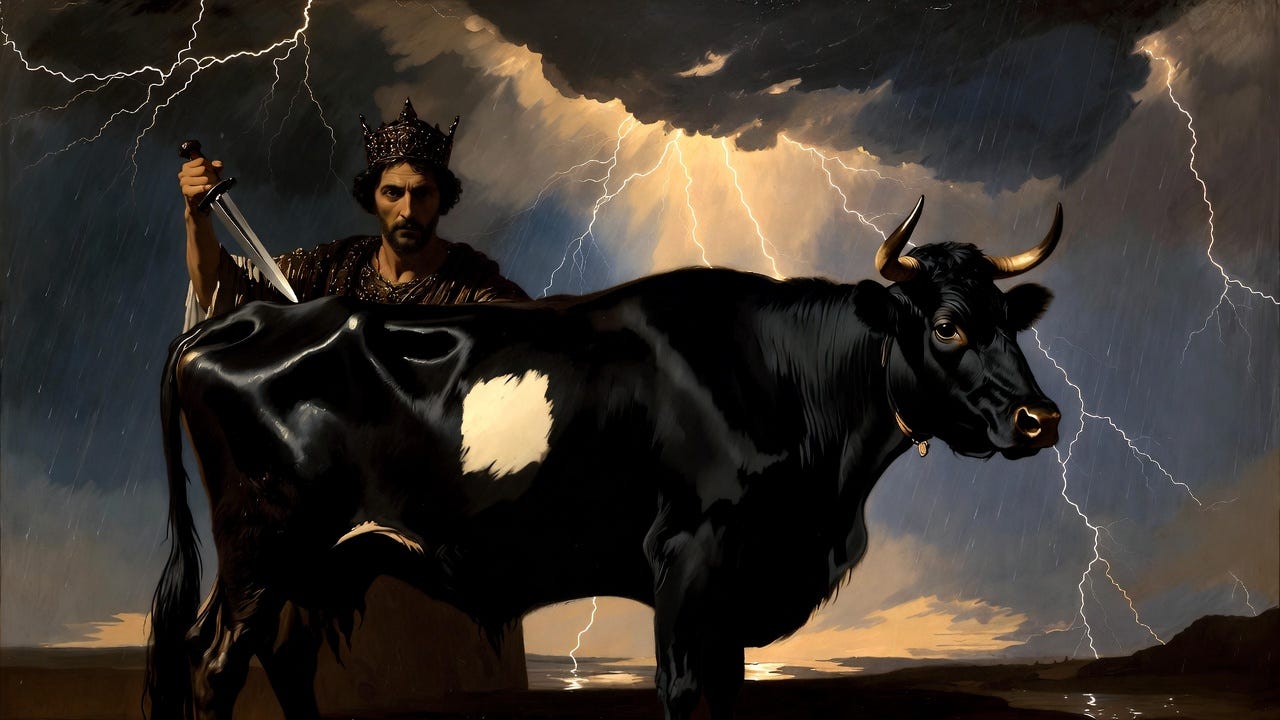
Matthew 10:16:
16 Behold, I send you forth as sheep in the midst of wolves: be ye therefore wise as serpents, and harmless as doves.
FROM THE AUTHOR
The announcement of Christopher Nolan's Odyssey adaptation has, predictably, inflamed the online guardians of Greek history—those amateur classicists who can spell Mycenae and name twelve Olympians and believe this constitutes mastery. They have rushed to their keyboards to pronounce judgment on armor, on casting, on the presumed fidelity of a script they have not read. They do not know, and will never pause to learn, that the Homeric epics themselves are late literary encryptions of a far older oral tradition whose deepest roots lie not in the Peloponnese but in the Nile Valley and beyond. They do not know that the word Homer may not be a name but a title, that the blind bard is a motif older than Greek civilization, that the Odyssey is a migration myth dressed as a sea voyage. They argue about the color of Achilles' tunic while remaining oblivious to the fact that Achilles' heel is the same heel that Jacob grasped, the same bare foot that marked Jason, the same blind spot where the serpent strikes in Genesis.
If they were ever to begin reading the Library that has been assembled here—if they were to encounter the evidence that their entire classical education is a carefully maintained fiction, a crust without its contents, a coffin whose sacred bull was removed by the very priests who now sell tickets to the empty shrine—they would not finish. They would close the tab and return to arguing about the trailer, because it is easier to debate the casing than to admit that you have never tasted the meal.
If you decide to read this in it’s entirety, it will completely destroy the illusion you’ve been living in. And you will know for a certainty that every scholastic discipline, commercially available Artifical-Intelligence system, scientific bureaucracy, has conveniently crafted an algorithmic narrative — a simulacrum— around the truth.
The Synthetic Position
Anyway… The person who stakes out a position between two competing claims presents himself as the reasonable one. He has weighed both sides. He has found merit and fault in each. It is evidence of a prior commitment to the idea that both sides must be equally valid, because if they were not, the pose of neutrality would be impossible to maintain. The middle is not discovered. It is chosen, and the choice precedes the reasoning.
Consider the structure. Two parties disagree. One says the sky is blue. The other says the sky is green. The man in the middle says the truth is probably teal. He has invented a color that neither party proposed, congratulated himself for his moderation, and contributed nothing. He has not tested the claims. He has averaged them. The average of a truth and a lie is still a lie, diluted. This is not a cognitive bias that can be corrected by trying harder to be fair. It is a structural feature of centrist epistemology. The act of placing oneself in the middle of a controversy presupposes that the correct answer is between the extremes.
The Library Western Civilization Can’t Be Honest does not take the middle because the middle does not exist. There is only the evidence and the refusal to look at it. Claiming the middle ground is not a method for eliminating bias. It is a method for concealing it. If I had to choose one word as a linguistic mascott for this charade it would be the word ‘just’. Just derives from ‘Justice’. From which, I am told, lawful or fairness, in the 15th century drifted to ‘exactness’. And from there, it further devolved into recency. But to understand the notion I am proposing, think thus: It wasn’t that the Greeks were _____, they were just…’; Its just that ……; and so on.
The entire undertaking of this publication, and the Library from which it springs, can be distilled into a single, disquieting recognition. If a falsehood has grown so fundamental, so instrumental to our communal life, that to disentangle it would threaten the very structure of our society, then that falsehood is not a wound to be healed but the foundation upon which everything stands. Our civilization, in this light, is not a corrective reaction against that primordial lie; it is the adaptive, evolutionary flowering of it—shaped by ecological pressures, historical shocks, and human intercourse, yet always carrying forward its original architecture. What this truly means is that for all our dazzling technological triumphs, no machine, no method, no invention has ever reshaped the human environment in the radical way we suppose. Technology has served not to replace the foundation, but to perpetuate it, to give it new clothes and faster instruments, while the old logic hums on undisturbed beneath.
The data I have gathered expose a further, and perhaps more treacherous, layer. At some dark juncture in the late eighteenth to nineteenth centuries, mathematics ceased to be a servant of investigation and became its substitute. A quiet insurrection took root within the scientific method itself: formal, self-contained abstraction began to pass for empirical inquiry, and the starved sensorium of the real was traded for the elegant, unfalsifiable paradise of the equation. Nobody noticed the coup. The numbers were so beautiful, the models so complete, that the gatekeepers simply locked the door and declared the landscape mapped. We are now living inside that substitution—a world where “rigour” means conformity to a mathematical formalism that has pre-emptively ruled out any evidence that would threaten the foundational lie.
It may, therefore, be time for a Fourth Organum. Not a return to Bacon’s tables or a refinement of Popper’s falsification, but a genuinely new instrument of knowing: one that can read the encrypted plaintext of history, that can distinguish between a signal and the asterisk, and that can finally separate the foundation of the house from the lie that built it.
Table of Contents
THE PERSIAN CONFLICT AND PERSIAN RACISM
THE COLCHIAN THREAD AND THE SARDONIC LAUGH
WESTERN CIVILIZATION CAN’T BE UNENCRYPTED (TM)
Recap of Part One
See Western Civilization Can’t Be Honest #10, but really you dont have to. It was badly written, and accidentally published prior to the Geneaology of Greek Myths by accident. Here is a summary:
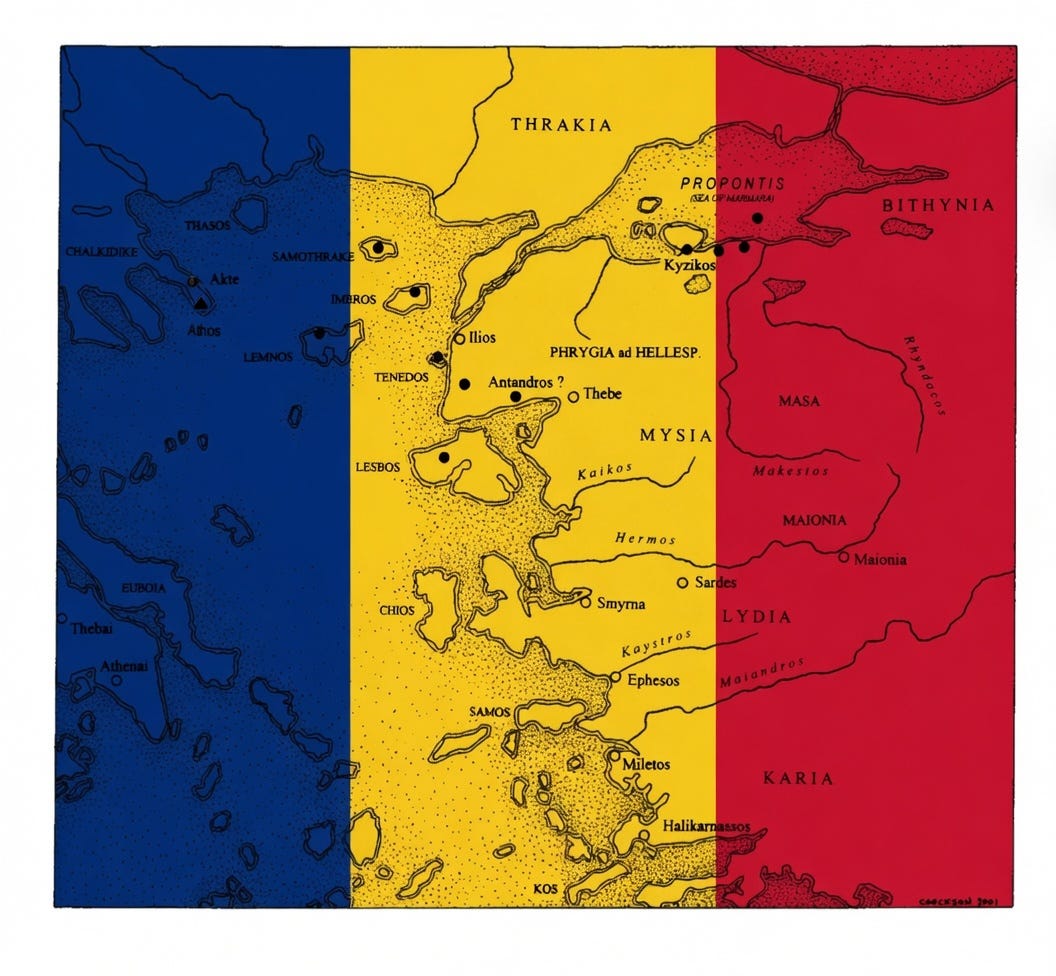
The Greeks, those self-anointed inheritors of the steppe’s chariot-lords, those pure-blooded Aryans of the nineteenth-century imagination, spun a glorious myth in which they sailed to the ends of the earth to pluck the Golden Fleece from Colchis—a dark-skinned, woolly-haired people whose very name they lent to the bitter laugh of the thief. And yet—here the irony curdles into farce—the same Greeks who boasted of this stolen metallurgical fire, who hammered bronze and iron into swords and greaves and breastplates, could not, for all their vaunted cleverness, conceive of a handle for a shield. The Carians, a people of Anatolia whom the Greeks despised as barbarians, the very same Carians who worshipped at the temple of Carian Zeus at Mylasa alongside their brothers Lydos and Mysos, were the ones who first fixed handles to shields. Before them, Herodotus drily notes, shields were carried without handles, dangling from leather straps slung around the neck and left shoulder—an arrangement of staggering inconvenience for any man expected to fight. It took the Carians, those non-Indo-European islanders-turned-mainlanders, to look at a shield and think, “Perhaps a hand might hold it directly.”
A MIRAGE BUILT OF LANGUAGE
The phrase “Indo‑European” was born in philology, not in biology. It names a family of languages—Sanskrit, Greek, Latin, Persian, Germanic, Celtic—that share a common ancestral tongue spoken perhaps six millennia ago on the Eurasian steppe. A linguist can map the sound shifts that turned a single root for “father” into pitár‑, patér, pater, father. But the nineteenth‑century theorists, intoxicated by the power of comparative grammar, smuggled in a second, illegitimate claim: that the speakers of those languages were a single, noble, fair‑skinned race—the Aryans—who burst out of their homeland and brought civilization to a dark world. That claim was never evidence‑based. It was a racial fantasy, and for two centuries it served as the foundation myth of the West.
A preprint published in February 2025 by Silvia Ghirotto and colleagues, analyzing 348 ancient genomes from across Western Eurasia, charts the genetics of skin, hair and eye color over 45,000 years.¹ The finding is stark: most ancient Europeans had dark skin, dark hair and dark eyes until roughly 3,000 years ago, well into the Iron Age. Lighter pigmentation emerged in isolated individuals around 14,000 years ago—the tail end of the Palaeolithic—but it remained rare for millennia. Even during the Copper and Bronze Ages, dark pigmentation dominated in many regions. The pale European body is a very recent phenomenon.
While, this recent data is an even more recent date then the 5,000-7,000 year timeline that made headlines in 2014, from the research of Carles Lalueza Fox— I think it prudent to just estimate 3,000-7,000 years for now.
How Herodotus Encoded the Hidden: The Old Style
No ancient writer provides a sharper window into the lived experience of skin than Herodotus, writing in the fifth century BCE. His Histories is a dense catalogue of the peoples of the known world, and he pays close attention to what they looked like and how they treated bodies that looked different. The most revealing passage—and the one that has been systematically veiled by translation—describes Persian customs regarding disease, impurity, and strangers.
Many of the accounts, and myths that Herodotus would have encountered were by the Old Style of oral tradition. Oral traditions passed by the layering of events, archetypes, and symbols into each other as a way of compressing the truth—to prevent data loss—like an mp3 or a zip file. The old style trusted the future to unpack what the narrative encoded. The tragedy of the standard translations is that they have repeatedly replaced these encoded details with political equivalents, stripping the text of its hidden keys.
The old style isn’t much different than the discipline of etymology, as you will come to see.
Halicarnassus
Herodotus of Halicarnassus presents himself as the disinterested eye of the world, a travelling sage who gathers the customs of Persians, Egyptians, Scythians, and Greeks alike without prejudice. He famously declares that he will record the great deeds of both Hellenes and barbarians, “lest the works of men be forgotten.” Among the barbarians he catalogs are the Carians, a people of southwestern Anatolia whose ancient claims he reports with a curious tenderness. The Carians, he tells us, invented the crest on the helmet, the device on the shield, and the handle on the shield itself—arts that the Greeks later adopted. He notes that they were once subjects of Minos and manned his fleets, and that they alone, among all the peoples he has encountered, call themselves by the same name they have borne since the dawn of their existence. There is no sneer in his voice, no dismissal of them as mere eastern subjects. He is, after all, the impartial historian, the Greek who can give the barbarian his due. And yet the reader might wonder at the intimacy of his Carian knowledge, the way he lingers over their contributions. The answer to that wonder lies buried in the first sentence of his own Histories, the one word that every schoolchild skips: Halicarnassus.
For Halicarnassus was not a pure Greek city. It was a Carian city, its very name a Greek mangling of the Carian Alos karnos. Herodotus’s own father bore the Carian name Lyxes, and his cousin or uncle, the epic poet Panyassis, perished at the hands of a Carian tyrant who ruled under Persian sufferance. The young Herodotus, stained by both his blood and his politics, fled that Persian-ruled town and spent years in exile on Samos, a man severed from his homeland by the very empire he would later chronicle. When he returned to Halicarnassus and helped cast out the tyrant, the stain remained: he was a Carian among Greeks, a Greek among Carians, a subject of the Great King who wrote as if he stood above the fray. The impartial observer was no detached spirit but a man writing his own heritage into the margins of a foreign war. His Carians, so lovingly detailed, are himself—a people who gave the Greeks the shield that would be used against them, a people who had been conquered and yet endured. The surprise, then, is not that Herodotus recorded the Carians so fully, but that we ever believed he could have done otherwise.
Skin in the Sun: The Persian Exclusion and Its Mistranslation
When I came to this passage, it immediately stuck me as odd.
Book 1, Section 138 of Herodotus’s Histories:
“They hold it unlawful to talk of anything which it is unlawful to do. The most disgraceful thing in the world, they think, is to tell a lie; the next worst, to owe a debt: The Persians have a custom that if anyone is afflicted with leprosy or the white sickness (leprosy), he is not allowed to enter a city or to associate with other Persians. They say that the disease is a punishment for some sin against the sun. Any stranger who contracts the disease is driven out of the country, and many drive away even white doves for this reason. They do not wash their bodies in rivers, nor do they ever wash themselves at all, for they consider it a defilement of the waters.”
It reads: The Persians did not simply isolate lepers out of a pragmatic concern for contagion. The Persian prohibition on washing in rivers is particularly striking. It is not a rejection of cleanliness but a profound act of reverence for the natural elements.
It struck me as odd for two reasons. First, I know there are two terms for doves. Both πελειάδες (peleiades) and περιστεράς (peristeras) refer to doves or pigeons in ancient Greek, but they belong to different linguistic eras, contexts, and species. They are both often used to denote prophecies, love interest, or women however the context doesn’t make it clear that birds are not being discussed.
Second, why would they say leprosy twice? Elephantiasis was the condition that most closely corresponds to modern leprosy, characterized by the thickening and deformity of the skin. I looked for the original translation.
The Greek
Αἰσχρὸν δὲ αὐτοῖσι τὸ ψεύδεσθαι νενόμισται, καὶ δευτέραν τὴν ὀφείλειν χρέος, πολλῶν μὲν καὶ ἄλλων εἵνεκα, μάλιστα δὲ ἀναγκαίην φασὶ εἶναι τὸν ὀφείλοντα καί τι ψεῦδος λέγειν. Λέπρην δὲ ἢ λεύκην ὅς ἂν ἔχῃ, οὗτος ἐς πόλιν τε οὐ κατέρχεται καὶ τοῖσι ἄλλοισι Πέρσῃσι οὐ συμμίσγεται. φασὶ γάρ μιν ἁμαρτόντα τι ἐς τὸν ἥλιον ταῦτα ἔχειν. ξεῖνον δὲ πάντα τὸν λαβόντα ταῦτα ἐξωθέουσι ἐκ τῆς χώρης, πολλοὶ δὲ καὶ τὰς λευκὰς περιστεράς. ἐς ποταμὸν δὲ οὔτε ἐνοῦσι οὔτε πτύουσι, οὐ χεῖρας ἐναπονίζονται, οὐδένα ἄλλον περιορῶσι, ἀλλὰ σέβονται ποταμοὺς μάλιστα.
Literal translation:
The most shameful thing among them is to tell a lie, and second to this is to owe a debt, for many other reasons, but most of all because they say that the one who owes a debt is compelled also to tell some lie. Whoever has the scaly-skin (leprēn) or the white-skin (leukēn), this man does not go down into the city and does not mingle with the other Persians. For they say that he, having sinned in some way against the sun, has these things. And every stranger who has contracted these things they drive out of the land, and many also drive out the white doves. Into a river they neither urinate nor spit, nor do they wash their hands in it, nor do they allow any other to do so, but they reverence rivers most of all.
The literal meaning of λέπρα (lepra) is indeed “scaly” or “to peel,” derived from the verb λέπω (lepō), “to peel, strip off,” and the noun λεπίς (lepis), “scale” or “flake.” It does not mean “leprosy” in the modern clinical sense of Hansen’s disease. The Hippocratic physicians and later Greek medical writers used lepra to describe a range of scaling, flaking, disfiguring skin conditions.
The word λεύκη (leukē), “the white,” is distinct. It refers to a whitening of the skin, a loss of pigmentation, possibly vitiligo or a depigmenting condition. The two terms are paired in Herodotus not as synonyms but as two different visible skin afflictions, both of which the Persians regarded as marks of divine punishment for sin against the sun.
But…The very fact that the translators felt the need to collapse two distinct categories into one is the clue that something ideologically inconvenient was being buried. So it cannot be ruled out, that a plainer message was intended. Notice how lawful, window dresses shame. It is purposefully stated this way, to make it look like we’re discussing religious rites. The dove is the key. There is no evidence that Persains hated white doves and as I said doves are commonly used when something else is being alluded to. I’v read multiple translations and there are various tricks; some translate it as the Persians are filthy and hate to bathe. Which is strange, it is the truest and most religious aspect of the discussion.
Other translations change the numbering completely. However, the reason I say that the translation is much more literal is within the first few chapters of Book 1.
The two Greek words leprēn and leukēn—derived from lepō “to peel” and leukos “bright, white”—describe what the skin does (in the Mountain sun) and what the skin looks like, not a clinical pathogen.
THE PERSIAN CONFLICT AND PERSIAN RACISM
The passage opens with a clause that the consensus skims over but the Library holds as the key: “Those of the Persians who have knowledge of history declare...” This is not Herodotus speaking. It is the Persian historical tradition, transmitted through him in the old style. The Persians, the doves, are narrating their own version of how the world divided. They do not begin with Greek heroes. They begin with the Phoenicians—a Semitic, seafaring people of the Levantine coast, part of the Afro-Asiatic superhighway the Library has traced from the Horn of Africa to the Black Sea.
The Phoenicians, the Persians say, came from the Erythraian Sea—the Red Sea, the water that touches Egypt, Arabia, and the Horn of Africa. They settled on the Mediterranean coast and began making long voyages, carrying goods from Egypt and Assyria. This is not a footnote. It is a map. The first actors in the Persian history of conflict are a people rooted in the Afro-Asiatic world, trading the products of the Nile and Mesopotamia. The quarrel begins not with a Greek hero but with a commercial network older than any Indo-European polity.
Accusation 1, Herodotus’s Histories:
1.1 According to the Persians best informed in history, the Phœnicians began to quarrel. This people, who had formerly dwelt on the shores of the Erythræan Sea, having migrated to the Mediterranean and settled in the parts which they now inhabit, began at once, they say, to adventure on long voyages, freighting their vessels with the wares of Egypt and Assyria. They landed at many places on the coast, and among the rest at Argos, which was then pre-eminent above all the states included now under the common name of Hellas. Here they exposed their merchandise, and traded with the natives for five or six days; at the end of which time, when almost everything was sold, there came down to the beach a number of women, and among them the daughter of the king, who was, they say, agreeing in this with the Greeks, Io, the child of Inachus. The women were standing by the stern of the ship intent upon their purchases, when the Phœnicians, with a general shout, rushed upon them. The greater part made their escape, but some were seized and carried off. Io herself was among the captives. The Phœnicians put the women on board their vessel, and set sail for Egypt. Thus did Io pass into Egypt, according to the Persian story, which differs widely from the Phœnician: and thus commenced, according to their authors, the series of outrages.
In the very first chapter of book 1, the first actors in the Persian history of conflict are a people rooted in the Afro-Asiatic world, trading the products of the Nile and Mesopotamia. The quarrel begins not with a Greek hero but with a commercial network older than any Indo-European polity. The Persians note that Argos (Jason) was, “at that time in all points the first of the States within that land which is now called Hellas.” The phrase is precise. The land is now called Hellas, but it was not called Hellas then. The Greeks had not yet arrived, or if they had, they had not yet imposed their name. Argos, a city of the Peloponnese, was the preeminent power in a land that did not yet bear the name of the Hellenes. This is the substrate speaking through the Persian account: the land was already old, already organised, already a “State,” before it was Greek.
The daughter of the king of Argos is Io, daughter of Inachos. The Persians name her, and Herodotus adds that the Hellenes agree on the name. Io, as the Library has already established, is the Argive priestess touched by Zeus, turned into a cow, driven across the Bosporus into Asia, and then to Egypt, where she gives birth to Epaphus—the child of the touch, the Apis bull, the black calf with the white mark on his forehead. The Phoenicians carry her to Egypt, and in doing so they set in motion the entire genealogy: Io to Epaphus, Epaphus to Libya, Libya to Belus and Agenor, from them Egypt and Ethiopia and Phoenicia and Thebes and Troy.
The Greeks, who later claimed to be the pure inheritors of Indo-European glory, preserved this account—and then spent centuries trying to bury it. They turned Apis, the Egyptian god, into two mortal tyrant kings. They gave his name a Greek etymology: apios, “of the pear-tree.” They erected the Deucalionid flood myth, with its stones thrown over shoulders, to replace the Io genealogy with a clean, autochthonous origin. But the Persian account, recorded by Herodotus in the old style, remained. It sat in the text, waiting.
Accusation 2, Herodotus’s Histories:
1.2 At a later period, certain Greeks, with whose name they are unacquainted, but who would probably be Cretans, made a landing at Tyre, on the Phoenician coast, and bore off the king’s daughter, Europé. In this they only retaliated; but afterwards the Greeks, they say, were guilty of a second violence. They manned a ship of war, and sailed to Aea, a city of Colchis, on the river Phasis; from whence, after dispatching the rest of the business on which they had come, they carried off Medea, the daughter of the king of the land. The monarch sent a herald into Greece to demand reparation of the wrong, and the restitution of his child; but the Greeks made answer that, having received no reparation of the wrong done them in the seizure of Io the Argive, they should give none in this instance.
Then, they say, certain Greeks—probably Cretans—sailed to Tyre in Phoenicia and carried off Europa, the king’s daughter. This made the score even. But then the Greeks committed the second wrong. They sailed a warship to Aia in Colchis, on the river Phasis, and carried off Medea, the king’s daughter. The Colchian king sent a herald demanding satisfaction.
The myth of the Argonautica, which the Persian account condenses into a single sentence, was not a story about a woman. It was a story about the Golden Fleece, the symbol of Colchian metallurgical wealth. The Persian account, filtered through the Mithra principle, treats the abduction of Medea as the visible act. But the Library, reading in the old style, sees the encoded truth. The Greeks did not sail to Colchis because they were avenging Io. They sailed to Colchis because Colchis had gold, and the fleece was the visible sign of Colchian power. The “retaliation” was a pretext. The theft of the fleece was the purpose.
The Persians, who operate under the Mithra principle, see this clearly. The visible act—sailing to Colchis, taking Medea—does not match the stated motive. The motive is a veil. A lie.
Accusation 3, Herodotus’s Histories:
1.3 In the next generation afterwards, according to the same authorities, Alexander the son of Priam, bearing these events in mind, resolved to procure himself a wife out of Greece by violence, fully persuaded, that as the Greeks had not given satisfaction for their outrages, so neither would he be forced to make any for his. Accordingly he made prize of Helen; upon which the Greeks decided that, before resorting to other measures, they would send envoys to reclaim the princess and require reparation of the wrong. Their demands were met by a reference to the violence which had been offered to Medea, and they were asked with what face they could now require satisfaction, when they had formerly rejected all demands for either reparation or restitution addressed to them.
Alexander, whom the Greeks call Paris, bears in mind the prior outrages. He reasons as the Persians reason, as the Colchians reasoned, as anyone operating under the Mithra principle must reason. The visible precedent is clear. The Greeks took Medea. The Colchian king sent a herald demanding satisfaction. The Greeks refused. They offered no reparation, no return of the woman, no acknowledgment of wrong. The visible record is unblemished: the Greeks are a people who take and do not give satisfaction.
Paris applies this precedent exactly. If the Greeks have established that the taking of a woman requires no satisfaction, then the taking of Helen requires none either. The logic is symmetrical, visible, and unanswerable. The dove says: you set the rule; I am merely following it. What face can you now present that contradicts the face you presented before?
Accusation 4, Herodotus’s Histories:
1.4 Up to this point, they say, nothing more happened than the carrying away of women on both sides; but after this the Hellenes were very greatly to blame; for they set the first example of war, making an expedition into Asia before the Barbarians made any into Europe. Now they say that in their judgment, though it is an act of wrong to carry away women by force, it is a folly to set one’s heart on taking vengeance for their rape, and the wise course is to pay no regard when they have been carried away; for it is evident that they would never be carried away if they were not themselves willing to go. And the Persians say that they, namely the people of Asia, when their women were carried away by force, had made it a matter of no account, but the Hellenes on account of a woman of Lacedemon gathered together a great armament, and then came to Asia and destroyed the dominion of Priam; and that from this time forward they had always considered the Hellenic race to be their enemy: for Asia and the Barbarian races which dwell there the Persians claim as belonging to them; but Europe and the Hellenic race they consider to be parted off from them.
There it is.
The Indo-Iranian Mithra Principle Against the Indo-European Trickster
Mithra is the Iranian god of covenants, oaths, and truth. His very name means “covenant” or “contract.” He is the god who sees all, because the sun is his eye—or, in some traditions, Mithra himself is the sun, riding across the sky in a chariot, watching everything that happens on earth. Nothing is hidden from Mithra. The liar, the oath-breaker, the one who says one thing and does another, cannot escape his gaze. The visible is the true because Mithra makes it so: the surface of things is illuminated, and what is illuminated is what is real.
This is the Persian cosmos. The king rules under Mithra’s warrant. The satrap swears an oath before Mithra and must keep it visibly, publicly, without dissembling. The river must not be clouded because the water, like Mithra’s eye, is transparent. The scaly-skinned foreigner peels under the sun because the sun is Mithra’s gaze, and the body that cannot withstand that gaze does not belong. The white-skinned man’s depigmentation is a visible disorder, a breach of the cosmic covenant between skin and sun.
When the Persian gives the abducted woman the benefit of the doubt, he does so because Mithra sees her departure. If she went, she consented; if she presented resistance, she was violated. The action itself is the oath, and Mithra holds the contract. There is no hidden interior to interrogate, no secret motive to suspect, because Mithra has already seen everything there is to see.
The Greek does not live under Mithra. He lives under a pantheon of gods who deceive, who hide, who transform themselves into animals to escape detection. The Greek hero is the one who can trick the god, who can steal the fleece under cover of night, who can put on the Ring of Gyges and become invisible. The Greek psyche is built on the conviction that the visible is a mask and that power lies in escaping the gaze. Mithra, to the Greek, would be a tyrant—a god who demands that you be exactly what you appear to be, who gives you no place to hide.
Herodotus’s Histories:
1.137 To my mind it is a wise rule, as also is the following- that the king shall not put any one to death for a single fault, and that none of the Persians shall visit a single fault in a slave with any extreme penalty; but in every case the services of the offender shall be set against his misdoings; and, if the latter be found to outweigh the former, the aggrieved party shall then proceed to punishment.
Herodotus notes that the law applies to the king and to the master of a slave alike. The Great King, who rules from the Indus to the Aegean, cannot kill a man for a single offense any more than a slave-owner can. This is not sentimentality. It is the Mithra principle’s radical egalitarianism. The sun shines on the king and the slave with the same light. The visible record of a life is equally visible regardless of station. The scales do not tip differently for the powerful.
The Greek world, with its sharp division between free citizen and barbarian slave, could never have produced such a law.
Understanding The Conflict
The Persians call the Hellenic race their permanent enemy and trace that enmity to the Trojan War, an event centuries before the Persian Empire existed.
The Persian moral commentary is blunt:
Herodotus, Histories 1.4:
“Stealing women is the act of a rogue, but making a great fuss about stolen women is the act of a fool. Men of sense care nothing for such women, since it is plain that without their own consent they would never be forced away.”
The Persians, in other words, assumed the abducted woman had gone willingly. Their own cultural logic—one in which female desire was a force to be reckoned with, and in which the woman’s body carried agency—led them to extend the benefit of the doubt. When the Greeks took Medea, the Persians absorbed the insult and moved on.
The Greeks did not reciprocate. When Paris took Helen, they launched a thousand ships, waged a ten‑year war, and burned Troy to the ground. They did not seriously entertain the possibility that Helen went willingly. In the Greek imagination, the woman was a passive prize, not an agent. The asymmetry is stark: the Persian gave the Greek the interpretive charity of his own culture; the Greek refused to extend the same.
This inequitable frame of mind is precisely what the Persians blamed the Greeks for. The Greeks accused the Persians of covetousness, of copying foreign customs without originality. Herodotus records this Greek accusation explicitly:
Herodotus, Histories 1.135:
“Of all men the Persians most adopt foreign customs. They wear Median dress, considering it more beautiful than their own, and for war the Egyptian breastplate. They practise whatever luxuries they learn from others, including the Greek custom of pederasty. Each man has many wives, but a far greater number of concubines.”
The Persian adoption of customs was open, pragmatic, unashamed—the simplicity of the dove. They saw something useful, they took it, they used it, and they did not pretend it was theirs by ancient right. The Greek, by contrast, took the fleece from Colchis, the alphabet from Phoenicia, the gods from Egypt, and then wrapped his borrowings in myths of autochthon and heroic theft. The dove was transparent; the serpent was hidden, scaly, and ironic. The Persian frame of mind was straightforward: what is visible is true. The Greek frame of mind was defensive and ironic: what is visible is a disguise.
This same asymmetry explains why the Persians sided with Troy in their historical memory. The Trojans, as the Persians saw it, were the first victims of Greek aggression. Troy was a city of Asia, ruled by a line of kings that, according to some genealogies, was connected to the same ancient stock that later produced the Medes and Persians. The Greeks had no legitimate claim to Asian territory; they were interlopers, and their destruction of Troy was the original sin that justified every subsequent Persian campaign against the Greek city‑states. The Persian siding with Troy was not an arbitrary choice. It was a statement that Asia was a unity, that the Greeks were outsiders, and that the abduction of Helen was merely the pretext for a war of conquest that the Greeks had been waging since the time of Jason.
The Distinctiveness of Their Indo‑Iranian Traditions
All Indo‑European-speaking peoples share certain inherited traits: a patriarchal pantheon with a sky-god (Zeus, Jupiter, Dyaus, Varuna), horse sacrifice, and a tripartite social ideology (priests, warriors, producers).
But the Iranian branch developed a religious and cultural system that is uniquely its own, shaped by the prophetic reform of Zoroaster and the deep Elamite substrate that the Persians absorbed.
Before the religious reforms attributed to Zoroaster, the Iranian-speaking peoples—including the proto‑Persians—shared in the common Indo‑Iranian polytheistic heritage. The most direct evidence comes from the Avesta, the sacred texts of Zoroastrianism themselves. Although the Gāthās (the oldest portion, attributed to Zoroaster) are rigorously dualistic and centred on Ahura Mazdā, the later Avestan texts, particularly the Yašts, preserve hymns to a host of divine beings who clearly predate the reform. These include:
Mithra (covenant, light, justice), a solar deity with a strong ethical dimension, closely corresponding to Vedic Mitra.
Anāhitā (Aredvī Sūrā Anāhitā), a goddess of water, fertility, and war, who appears in later Persian royal inscriptions (Artaxerxes II) as a major recipient of royal devotion.
Verethragna (victory), a warrior god with Vedic parallels (Vṛtrahan, epithet of Indra).
Tishtrya (Sirius, rain), Vayu (wind), Haoma (the deified ritual drink), and many others.
These are not minor spirits; they form a structured pantheon, the yazatas, meaning “worthy of worship.” That this pantheon existed before Zoroaster is widely accepted because the Gāthās polemicise against the worship of the daevas, the old gods (cognate with Vedic devas), whom Zoroaster condemned as demonic. The religious revolution only makes sense if there was an established polytheism to overturn. Thus, the pre-Zarathustrian Iranians possessed a pantheon closely related to that of Vedic India, inherited from their common Indo‑Iranian ancestors.
Beyond the Avesta, the Achaemenid royal inscriptions from the early Persian period show a complex picture. The Behistun inscription of Darius I mentions only Ahura Mazdā, but later inscriptions of Artaxerxes II explicitly invoke Mithra and Anāhitā alongside Ahura Mazdā. This suggests that even after Zoroaster’s reforms, the old gods were never fully eliminated; they re‑emerged in official worship, perhaps reflecting the Elamite and Mesopotamian substrate that the Persians absorbed.
There is also comparative evidence: the Vedic Indians preserved a nearly identical pantheon (Mitra, Varuna, Indra, the Aśvins, etc.), confirming that their common Indo‑Iranian ancestors were polytheistic. The Persians therefore did not invent a pantheon; they originally shared one, then partially rejected it under Zoroaster’s influence, and later re‑integrated some deities into a modified royal cult.
Relation to the Vedic Indians. The Iranian and Vedic traditions share a common Indo‑Iranian ancestor. Mitra (Vedic) corresponds to Mithra (Avestan), Varuna to Ahura Mazda (in reverse of roles), and the soma cult to the haoma cult. But after Zoroaster, the Iranians demonised the daevas (Vedic devas, gods) and elevated the ahuras (Vedic asuras), an inversion of the Vedic pantheon. This split may reflect a religious schism in the late second millennium BCE, perhaps between proto‑Iranian and proto‑Indic branches of the Andronovo world.
Zoroasterism
Dualism. Zoroastrianism posits a cosmic struggle between Ahura Mazda (Lord Wisdom, the good creator) and Angra Mainyu (the destructive spirit). This ethical dualism is absent in Vedic India, Greece, or Rome, where gods can be capricious and morality is not the central axis of the cosmos. For the Persian, every act was a choice between truth (asha) and the lie (druj).
Purity and the Elements. The Persians developed an elaborate code of ritual purity centred on the sacredness of the elements—fire, water, earth. A corpse could not be burned (polluting fire) or buried (polluting earth); it was exposed on a dakhma (tower of silence) to be consumed by birds. Rivers could not be urinated, spat, or washed in, as Herodotus records, because water is a living, pure entity. This is the ATEN principle the Library has traced: the visible, transparent element must not be clouded.
The Sun and Light. Ahura Mazda is associated with light and the sun. Fire is his visible symbol, tended in fire temples. The Persians prayed facing a flame or the sun. The exclusion of the scaly‑skinned and the white‑skinned—punishments for sin against the sun—flows from this cosmology.
Truth as a Visible Quality. The concept of asha (Vedic ṛta) means both cosmic order and personal truthfulness. Herodotus notes that Persian boys were taught three things: to ride, to shoot the bow, and to speak the truth. Lying was the greatest disgrace. This is not merely a moral preference; it is the same ATEN logic: the spoken word must align with the visible fact, just as the surface of the river must remain clear.
A Monotheising Tendency. Zoroastrianism was not monotheistic in the strict Abrahamic sense, but it was henotheistic or dualistic, with Ahura Mazda as the supreme uncreated creator. This stood in stark contrast to the polytheisms of Greece, India, or the steppe. It gave the Persian cosmos a unique narrative arc: history as a battle between good and evil, culminating in a final renovation (frašo‑kereti) of the world.
THE COLCHIAN THREAD AND THE SARDONIC LAUGH
Herodotus, in a passage that has agitated scholars for centuries, writes:
“The Colchians, the Egyptians, and the Ethiopians are the only nations that have practised circumcision from the earliest times… I myself perceived the likeness of the Colchians to the Egyptians before I had heard it from others… They are dark‑skinned (melanchroes) and woolly‑haired (oulotrichos).”⁵
A few lines later he adds a detail of material culture:
“The linen that comes from Egypt is called Egyptian, but the linen that comes from Colchis is called by the Hellenes Sardonic (sardonikon).”⁶
The Colchians, then, were an African‑descended people—part of the great Afro‑Asiatic superhighway that stretched from the Horn of Africa to the Caucasus—producing a fine linen that the Greeks named with the same adjective they used for the bitter, mocking, death‑grin laugh: sardonikos.
The etymology is disputed, but the ancient consensus linked the “Sardonic laugh” to the island of Sardinia and a plant that caused victims to die with a ghastly grin. Yet Herodotus’s testimony ties the word to Colchis and its fabric. The two meanings converge in the myth of Jason and the Argonauts. Jason sailed to Colchis, seduced the king’s daughter Medea, and stole the Golden Fleece—a sheepskin laden with gold dust, the symbol of Colchian wealth and metallurgical skill. He took the fleece, and he took Medea, and he sailed back to Greece a hero.
The Sardonic linen is the fabric of the people from whom he stole. The Greeks, who named both the cloth and the laugh, preserved the memory of the theft in the language itself.
Σαρδώ (Sardō) — Sardinia : large-scale flax processing in Iron Age
Σαρδόνιος (Sardonios) — Sardinian, also an epithet in cult
Σαρδονικός (Sardonikos) — the adjective used for both the linen and the laugh in prose
The most significant Greek use of linen was for sails. This is the material fact that the Library seizes. The Greeks were a maritime people. Their power, their trade, their colonial expansion, their ability to project force into Asia—all depended on ships. And ships depended on linen sails.
The linen came from Egypt and Colchis. The two ends of the Afro-Asiatic superhighway provided the fabric that made Greek naval dominance possible. The Colchian linen, the sardonikon linon, was not a luxury curiosity. It was a strategic material. The Greeks who sailed to Colchis and stole the fleece were, in a very direct sense, stealing the source of their own maritime power.
Jason’s ship, the Argo, was the first ship, in Greek myth, to sail to the ends of the earth. Its sails were linen. The fleece he took was the golden sheepskin that trapped the gold dust of the Colchian rivers—the symbol of Colchian wealth and metallurgical mastery. But the ship that carried him there and back was powered by the very fabric that the Colchians produced. The serpent sailed on dove-woven wings to steal the dove’s gold, and then laughed the Sardonic laugh as the linen filled with the wind of the Phasis.
Indo-European, Arians, Medes, More Mullatos/Mystizos
The Medes, Herodotus tells us, were called Arians—Arioi in the Greek—by all people in ancient times. This is the same word that would later be twisted into the racial fantasy of the nineteenth century, the fair-skinned master race that never existed. But here, in the earliest historical record of the name, the Arians are not Europeans. They are not Greeks. They are Medes—an Iranian people of the Zagros, related to the Persians, formed from the fusion of steppe pastoralists and the ancient Elamite-Kassite substrate of the Iranian plateau.
The Library seizes on this: the original Arians, by their own account, were a people who wore Median dress, who were commanded by a man of Achaemenid blood, and who traced their origins not to a pure steppe lineage but to a fusion that included a Colchian woman. The name “Arian” belonged to the doves of the Iranian plateau before the serpents of Europe ever claimed it. The racial theorists who later made “Aryan” the badge of white supremacy did not know—or chose to ignore—that the people who first bore the name were themselves a mixed people, and that they themselves said so.
Herodotus’s Histories:
7.62 The Medes had exactly the same equipment as the Persians; and indeed the dress common to both is not so much Persian as Median. They had for commander Tigranes, of the race of the Achaemenids. These Medes were called anciently by all people Arians; but when Media, the Colchian, came to them from Athens, they changed their name. Such is the account which they themselves give. The Cissians were equipped in the Persian fashion, except in one respect:- they wore on their heads, instead of hats, fillets. Anaphes, the son of Otanes, commanded them. The Hyrcanians were likewise armed in the same way as the Persians. Their leader was Megapanus, the same who was afterwards satrap of Babylon.
The Medes were called Arians before her. After her, they were called Medes. The name of a people, a nation, an empire, derives not from their steppe ancestors but from a woman of the Afro-Asiatic superhighway. The Colchian substrate, which the Greeks had been stealing from since the Argo sailed, here enters the very name of the first Iranian empire. The Medes, the teachers of the Persians, the first Iranian power to challenge Assyria and rule the plateau, carried the name of a dark-skinned woman from Colchis.
The Cissians and Hyrcanians, named alongside the Medes, are also Iranian peoples, also armed in the Persian fashion, also part of the same imperial army marching against Greece. The Hyrcanians dwell by the Caspian, the ancient homeland of the Iranian branch. The Cissians are from Susiana, the heartland of Elam, the pre-Iranian civilization that the Persians absorbed. The Iranian world, from the Caspian to the Persian Gulf, is a continuum of peoples who share dress and arms and a common origin—but each with its own commander, its own identity, its own variant of the Iranian heritage.
The Medes stand at the centre of this continuum, the first among them to build an empire, the ones whose dress the Persians adopted, the ones whose name was changed by a Colchian woman. The Library places them in the matrix: Iranian-speaking, but named after the substrate.
The nineteenth-century racial theorists, who made the Aryans into blond conquerors, never knew this passage—or if they did, they buried it under the same euphemisms that turned leprēn into “leprosy” and melanchroes into “swarthy.”
The Arians are the Medes. The Medes are the children of a Colchian mother. The Colchians are circumcised Egyptians. The Egyptians gave the Greeks their gods. The Phoenicians, circumcised like the Egyptians, opened the trade routes that began the quarrel between Asia and Europe.
Herodotus’s Histories:
4.197. These are the Libyan tribes whom we are able to name; and of these the greater number neither now pay any regard to the king of the Medes nor did they then. Thus much also I have to say about this land, namely that it is occupied by four races and no more, so far as we know; and of these races two are natives of the soil and the other two not so; for the Libyans and the Ethiopians are natives, the one race dwelling in the Northern parts of Libya and the other in the Southern, while the Phenicians and the Hellenes are strangers.
The relation to the Phoenicians via the Carthaginians was illustrated just one passage prior. The Carthaginians tell a story about a land in Libya, beyond the Pillars of Hercules, inhabited by a people they regularly visit to trade. Upon arrival, they unload their merchandise and arrange it neatly on the beach. Then they return to their ships and send up a thick column of smoke. Seeing the smoke, the local inhabitants come down to the shore. They set out an amount of gold they judge to be equal in value to the goods, and then retreat to a safe distance. The Carthaginians disembark and inspect the gold. If it seems sufficient, they take it and sail away. If not, they go back aboard their vessels and wait without complaint. The locals then approach again and add more gold, continuing until the Carthaginians are satisfied. Neither side ever cheats the other: the Carthaginians will not touch the gold until it matches the value of their wares, and the natives will not remove the goods until the gold has been taken.
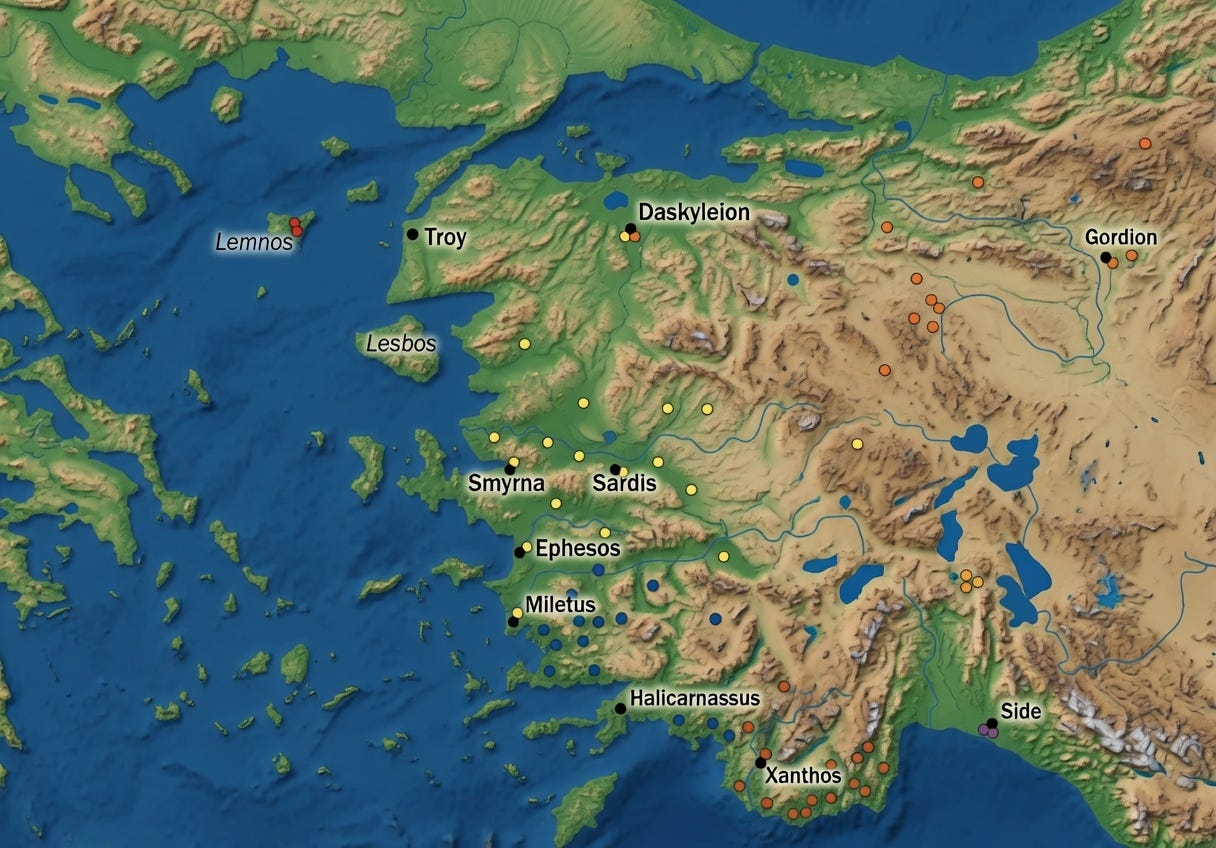
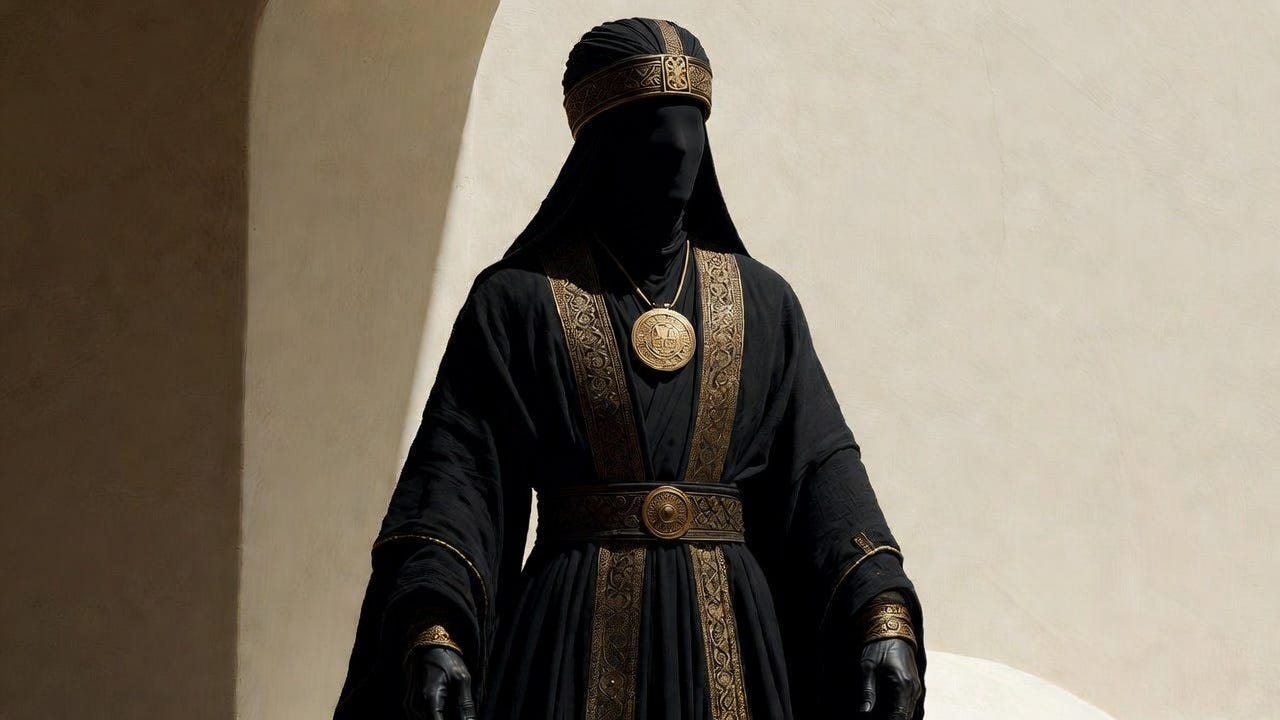
TANTALUS FATHER OF DASCYLUS
Josephus preserves a fragment of the Peripatetic philosopher Clearchus of Soli, who reports a conversation with Aristotle:
“Jews are derived from the Indian philosophers; they are named by the Indians Calami [Kalanos, Brahmin associate of Alexander the Great], and by the Syrians Judaei, and took their name from the country they inhabit, which is called Judea; but for the name of their city, it is a very awkward one, for they call it Jerusalem.”
— Josephus, Against Apion 1.22, quoting Clearchus of Soli.
Herodotus’s Histories:
1.32 But when a man wishes to sacrifice to any one of the gods, he leads the animal for sacrifice to an unpolluted place and calls upon the god, having his tiara wreathed round generally with a branch of myrtle. For himself alone separately the man who sacrifices may not request good things in his prayer, but he prays that it may be well with all the Persians and with the king; for he himself also is included of course in the whole body of Persians. And when he has cut up the victim into pieces and boiled the flesh, he spreads a layer of the freshest grass and especially clover, upon which he places forthwith all the pieces of flesh; and when he has placed them in order, a Magian man stands by them and chants over them a theogony (for of this nature they say that their incantation is), seeing that without a Magian it is not lawful for them to make sacrifices. Then after waiting a short time the sacrificer carries away the flesh and uses it for whatever purpose he pleases.
Tantalus, a king of Lydia or Phrygia, was granted an extraordinary privilege: he was invited to dine with the gods on Olympus, something almost unheard of for a mortal. He abused this gift in two different ways, both of which echo other ancient stories.
In the better‑known account, he killed his own son Pelops, cooked the flesh, and served it as a meal to the gods. He did this, the myth says, to test whether the gods were all‑knowing. The horrified deities knew immediately what was before them and refused to eat—except for Demeter, distracted by grief over her missing daughter, who ate part of the shoulder. The gods restored Pelops to life, replacing the missing bone with ivory. This dark supper carries a shadow of a much later story: the image of a son whose body is given as food, though in Tantalus’s case the act is murderous pride rather than self‑giving love.
In an older version, Tantalus stole the nectar and ambrosia of the gods—their food and drink that confer immortality—and shared them with other mortals. He also repeated secrets he had overheard at the divine table. Here he resembles another figure who stole from heaven for the sake of humanity: Prometheus, who took fire from the gods and gave it to mankind, and suffered a terrible punishment in return.
Tantalus’s penalty was legendary: placed in a pool of water with fruit trees overhead, he was tormented by eternal thirst and hunger. Every time he bent to drink, the water receded; every time he reached for fruit, the wind lifted the branches out of reach. He stands forever between desire and satisfaction, a figure of punishment that gives us the word “tantalise.”
So in one man’s story we hear two echoes: a king who, like Prometheus, tried to give divine gifts to mortals, and a father who served his own child’s flesh to the gods—an ancient, distorted pre‑echo of a very different meal, where a willing Son offers himself as food for the world.
Tantalus wanted to find out whether the gods really knew everything. But the way he tested them was this: he killed his own son, cooked him, and set the meal on the table. He forced the moment. He created a situation so terrible that if the gods were real and all‑knowing, they would have to stop him. They would have to refuse the food. They would have to reveal themselves. It was a test, yes—but it was also a dare. “If you know, then stop me.”
The gods did know. They stopped the meal. They restored the son. But the test itself was an act of violence, a mortal trying to corner heaven.
Centuries later, another Son was placed on a table, not in secret but in the open. His death was not hidden. No one was tricked. The authorities knew what they were doing. The disciples knew. The crowd knew. And this time, heaven did not stop it. The Father did not send down armies. The Son did not call for rescue. The mortals had set up their courtroom, their execution stake, their rules—and God, this time, played by them.
Tantalus dared the gods to stop him from sacrificing his son. On the cross, God let the sacrifice happen. And in letting it happen, God outdid them. They thought they were testing whether God would intervene. They thought they were running the trial. Instead, the Son stepped into their system, accepted its worst punishment, and turned it inside out. Where Tantalus’s test produced a corpse that had to be revived, Jesus’s death became the vehicle for resurrection. The testers wanted to force God’s hand; God, in response, opened His hands and let them drive the nails. And then, three days later, He showed what happens when you let the Father have the last word.
So the mortals asked, “Will you stop us?” And the answer was: “No—I will go through it with you, and I will come out the other side.” That is how Jesus outdid them. He did not break the rules. He kept them, all the way to the grave, and then broke only one: the rule that death is final. Tantalus tried to force the gods to show their power. Jesus showed that the real power is not in stopping the worst thing, but in surviving it and redeeming everything on the other side.
Dascylus (Greek: Δάσκυλος, Dáskylos)
Follow me for a moment while I trace a name that refuses to stay in its box. It begins with a town, then sprouts into five peoples, a fish, a snake, and a red, hairy twin. The Library holds many threads; this one runs straight through the Anatolian matrix we have been mapping, and it ends—for now—at a hero who stole a fleece.
About thirty kilometres inland from the Propontis, near modern Ergili in Turkey, lies the site of Dascylium. Rediscovered in 1952 and excavated since, the town was inhabited from the Bronze Age. Phrygians settled it before 750 BC; then it passed under Lydian control. The name derives from Dascylus, the father of Gyges—the same Gyges who, in Herodotus, saw the Lydian queen naked and was offered a choice: kill the king or die. When Cyrus the Great conquered Anatolia in 547 BC, Dascylium became the administrative seat of the Persian satrapy of Hellespontine Phrygia, governing the Troad, Mysia, and Bithynia. Alexander passed through it in 334 BC on his way to the Granicus River. A town named after a man who fathered a usurper, serving as the nerve centre of the Persian imperial apparatus in Asia Minor: already the name is political, dynastic, and deeply Anatolian.
Herodotus names Dascylus as the father of Gyges, placing him in the Mermnad dynasty’s backstory.
Plato, in the Alcibiades I at 122a, uses the name to evoke Persian wealth:
“Do you think your wealth is worth comparing to that of the Persians? Look at the wealth of the kings of Persia, and of Dascylus...”
But the fullest Lydian account comes from Nicolaus of Damascus, probably drawing on the lost Lydiaka of Xanthos. Here, Dascylus is a trusted adviser of King Ardys, murdered by Ardys’ son out of jealousy. His pregnant wife flees to Phrygia, gives birth to a second Dascylus, who later moves to the Black Sea region and has a son: Gyges.
Nicolaus also tells us that:
Dascylus went “to the Syrians living in the Pontus, above Sinope” (eis Syrous en tôi Pontôi hyper Sinôpès oikountas).
Gyges eventually returns to Lydia, becomes a royal bodyguard, and after a series of dramatic reversals—including the curse of Ardys that promised destruction to the murderers of Dascylus—kills the king and seizes the throne. The Lydian Dascylus is the displaced father, the murdered counsellor, the ancestor whose unjust death becomes the engine of a dynasty’s rise.
The name travels east. Stephanus of Byzantium, in his Ethnica, notes that the Phrygian city Nacoleia was named after Nacolus, son of Dascylus—a purely eponymous figure, but one that embeds the name directly into the Phrygian landscape. Phrygia, which the Egyptians judged the oldest race, thus claims Dascylus as a founding ancestor. The name here is not a historical person but a genealogical stamp, marking the land as belonging to the same circle of peoples.
Stephanus again:
“There is also a Dascylium in Caria, named after Dascylus, son of Periaudes.”
Another town, another eponym. This one lies within the territory of the Carians, who, in Herodotus’s account, share a temple of Zeus Karios at Mylasa with the Lydians and Mysians as brother races. The Carian Dascylus is a local variant, son of a different father, but the name is the same. It functions as a lineage marker, tying Caria into the same ancestral pool.
The most complex branch lies in Mysia. Apollonius of Rhodes, in his Argonautica (2.802–805), tells of a young prince Dascylus, son of King Lycus of the Mariandyni, who joins the Argonauts as a guide after they help his father against the Bebrycians.
Apollodorus adds that upon Lycus’s death, this Dascylus succeeded him as king. So far, a straightforward hero. But the scholia on Apollonius dig deeper: they make this Dascylus the grandson of another Dascylus, who was the son of Tantalus himself.
The scholiast writes:
“Dascylus was the son of Tantalus... his wife was Anthemoeisia, daughter of the river god Lycus. His sons were Lycus, Priolas, and Otreus...”
Priolas and Otreus were killed by Amycus; their names survive as towns. This places Dascylus directly into the cursed bloodline of the Pelopids, the line of Atreus and Agamemnon, the line of the cooked son served to the gods. Tantalus, you will recall, stands in Tartarus in a pool of water that recedes when he bends to drink, beneath fruit trees that lift away when he reaches—the origin of “tantalising,” desire forever denied. Dascylus is his son, a Mariandynian king, rooted in the Anatolian soil, married to the daughter of a river god, and grandfather to the Argonaut guide.
A separate Dascylus, son of Lycus and grandson of the above, guides the Argonauts as far as the Thermodon River. The name thus bridges the cursed house of Tantalus and the heroic voyage to Colchis.
What binds all these figures together?
Herodotus, in Histories 1.171, provides the key:
“The Carians themselves, however, say that they are autochthonous inhabitants of the mainland and have always had the same name as they have now. They point to an ancient shrine of Zeus Karios at Mylasa, in which the Mysians and Lydians also have a share, on the grounds that Mysus and Lydus were brothers of Car. So these peoples, they say, have the right of admission; but they admit no one of a different race (ethnos), even if he speaks the Carian language.”
The criterion is explicitly race, not language. This means their racial features must be distinct. The bond uniting Lydians, Mysians, and Carians is blood-kinship through their eponymous ancestors. Dascylus, as a name, circulates among these peoples precisely because it is a lineage marker, a sign of belonging to the shared ancestral pool. The Phrygians, too, are woven in, both by geography and by the later mythographic impulse that grafts Dascylus onto Tantalus. The name is not a Greek invention. It is a fossilised trace of a pre-Indo-European Anatolian aristocracy, later Hellenised but never erased.
Now step back from Anatolia and look at the name with Semitic eyes. Esau (Hebrew ʿĒsāw, “hairy,” “rough”) is the red, hairy firstborn, the hunter, the man of the field, displaced by his smooth-skinned brother Jacob.
Dascylus in Greek folk-etymology can be parsed as δᾶ (“earth”) + σκύλος (“skin, hide”), hence “earth-skin,” “rough-skinned.” The word-family around σκύλος includes σκύλαξ (“puppy”), σκύλλω (“to tear, rend, mangle; to trouble, vex”), σκῦλον (“spoils of war, stripped arms of an enemy”), and σκυλεύω (“to strip a dead enemy of armour; to despoil”).
The prefix δα- can be an intensive (“very”) or derive from δᾶ, the Doric word for “earth.” So δάσκυλος can mean “very rough-skinned,” “earth-dog,” “earth-hider,” or even “the one who tears the earth.”
The word unites skin, earth, rending, and the spoils of the conquered. Esau is the older brother, the original heir, the one who belongs to the soil and the body. Dascylus, in every branch, is the displaced father, the murdered adviser, the eponymous ancestor of a dynasty overtaken by the Gyges usurpation or the Greek heroic narrative.
The “very red, very rough, very earth” quality of Esau matches the etymological sense of Dascylus: the one who hides in the earth, the scaly one, the rough-skinned original. Whether or not the names are linguistically cognate (the consonant structures differ), their mythic typology is identical. Both are the supplanted firstborn, the elder whose inheritance is taken by a younger, smoother, more cunning successor.
The name even hides in the natural world. Aristotle, in his biological works, mentions a small Mediterranean fish called δάσκυλος. He describes it as shoaling, hiding in the sand in winter, and having enmity with the sea-wolf. Scholars have long debated which fish this was. The standard identification for a time was a damselfish (Chromis chromis), but that fish does not bury itself in sand—a serious mismatch with Aristotle’s most distinctive clue. The honest answer is that we do not know exactly which fish Aristotle meant.
Yet the name travelled. Cuvier, in 1829, borrowed the term for a genus of Indo-Pacific damselfish, Dascyllus, including species like the three-spot dascyllus or domino damsel, whose juveniles are jet black with three white spots, or the humbug dascyllus, white with three vertical black bars—fish of the Red Sea, the very waters that Alexander’s collectors might have sampled. If Aristotle’s dascylus were a striped or spotted fish that hides in sand, the connection would be obvious: a creature of dark and light, hidden and visible, a living Apis bull with a white mark on a black body.
And then there is the snake. The Byzantine lexicographer Hesychius, in his lexicon, records that δάσκυλος is “a type of snake” (eidos opheōs). The same word that names a Lydian king, a sand-hiding fish, and a Phrygian town also names a serpent that hides in the earth. The core meaning is behavioural: “one who hides in the ground.” The snake is the guardian of the tree, the earth-dweller, the poison-keeper. The fish is the sand-burier, the prey of the sea-wolf. Both are the Dascylus—the rough, earthy, displaced original that the younger, smoother Greek hero will supplant.
What we have, then, is a name that threads through Lydia, Phrygia, Caria, and Mysia as a lineage marker, a sign of shared blood among peoples who admitted only kin to their temple at Mylasa.
Tiziano Dorandi’s edition of Clearchus’s fragments (published as part of Clearchus of Soli: Text, Translation, and Discussion), Clearchus of Soli, a student of Aristotle:
Clearchus wrote about a Dascylus (likely a different individual) who had a marvelous power of sight. This Dascylus could perceive the “idols” or “images” (eidola) that detach from all things and people, allowing him to see through solid objects or across vast distances.
And it is precisely this name, this lineage, this earth-bound guardian, that the next section will confront: for the Argonauts, guided by a Dascylus, sail east to Colchis to meet a princess, a serpent, and a golden fleece—and their leader is Jason.

Sardonik
The link runs through the Argonaut voyage. Jason and his crew sailed from Greece to Aia in Colchis, on the river Phasis, to take the Golden Fleece. But the Persian account of the origins of the conflict, which Herodotus transmits in Book 1, adds a crucial detail: this was not the first wrong. The Greeks retaliated for the Phoenician abduction of Io by sailing to Colchis and carrying off Medea, the king’s daughter. The Colchian king sent a herald demanding satisfaction; the Greeks refused, on the grounds that no satisfaction had been given for Io.
So the Greeks themselves, in Persian memory, connected Colchis directly to the earlier abduction of Io—and Io belongs to the Argive line, which later ties into the Lydian and Anatolian royal genealogies through the same mythic matrix. The Argonauts, on their way to Colchis, passed through the Mariandynian kingdom of Mysia, where a young prince named Dascylus—son of Lycus, grandson of Tantalus—joined them as a guide. Dascylus, as we have traced, is the Lydian dynastic name, the father of Gyges. The same name that anchors the Lydian Mermnad dynasty also guides the Greeks to Colchis. The link is not merely geographical; it is genealogical, embedded in the very name of the guide who led the Argonauts east.

Nysia Nysa (Νῦσα)
The Library traces the name Nyssia (Νυσσία) through the myth of Gyges and Candaules. The name is not common in Greek. It is not derived from any obvious Indo-European root.The name Nyssia is almost certainly formed from Νῦσα (Nysa), the mythic mountain or region where the infant Dionysus was raised. Nysa appears in multiple locations across the Greek and Near Eastern world—in Thrace, in Anatolia, in Arabia, in India—wherever the cult of Dionysus travelled. The nymphs of Nysa, the Nysiades, were the nurses of the god. The name Nyssia would mean “the woman of Nysa” or “the Nysian woman.” The Library traces a further thread. One of the many locations called Nysa was said by some ancient sources to be in Ethiopia or near the upper Nile. Diodorus Siculus (3.65–66) places a Nysa in Africa, where Dionysus was raised, and describes it as a fertile, blessed land. The connection between Nysa and the African interior, between the nurse of Dionysus and the dark-skinned peoples of the south, is ancient and persistent.
Dionysus is the god of ecstasy, of the dissolution of boundaries, of the visible self undone. His cult came to Greece from the east—from Phrygia, from Lydia, from Thrace—and his worship involved the tearing apart of the body (sparagmos) and the eating of raw flesh (omophagia). The god is the serpent who sheds his skin and becomes something else.
She is the dove who sees the truth and restores it. Her husband Candaules attempts to dissolve the boundary of her visible honour, and she responds by restoring it with his blood. The Lydian queen, the wife of Candaules, the woman who saw Gyges and gave him the choice of death or the throne, is named for the mountain of the god of ecstasy.
The Phoenicians, in the Persian account, are the first pirates: they sail from the Erythraian Sea to the Mediterranean, trade their wares, and then rush the women on the shore, carrying off Io. The Greeks are the second pirates: they sail to Tyre for Europa, to Colchis for Medea, to Troy for Helen. The entire history of the quarrel between Asia and Europe, as the Persians tell it, is a history of piracy.
The pirate is the one who takes from the sea. He has no land, no root, no tree. He is the stranger, the epéludes, the one who does not belong to the soil. The pirate’s flag is the death-head because the pirate lives under the sign of the skull. He takes what is not his, and he knows that the taking will not save him. The Sardonic laugh is the pirate’s laugh, the laugh of the thief who has stolen the wrong thing and cannot give it back.
The Greeks were pirates before they were philosophers. Their ships, powered by Egyptian and Colchian linen sails, ranged across the Mediterranean, taking women and fleeces and gods and alphabets.
The plant of Sardinia, Oenanthe crocata, the hemlock water-dropwort, causes the facial muscles to convulse into a ghastly smile before death. The victim dies with bared teeth, a rictus that looks like mockery but is only the body’s last betrayal. The Greeks called this the sardanios gelōs, the Sardonic laugh—the bitter, mirthless grin of the corpse that does not know it is dead.
The death-head is the skull beneath the skin. The grin of the skull is permanent. It cannot stop laughing. It is the face that remains when all the flesh has been stripped away, the final visible truth of the body (See Our Book Title).
Gyges: Founder of Lydia
Gyges was the founder of the Mermnad dynasty of Lydian kings, reigning from approximately 680 to 644 BC. According to the Greek historian Herodotus, his reign lasted 38 years. He was the son of a man named Dascylus. His own name is the Greek form of the original Lydian name Kukas. This Lydian name, Kukas, is also the root of the intriguing term, “Kukalim,” which appears on ancient Lydian coins and is understood to mean “of Gyges”.
The Origins of “Kukas” and “The Circle”
The connection between Kukas and “the circle” is a fascinating piece of linguistic and historical detective work. The name “Kukas” itself doesn’t translate to “circle,” but it is tied to a different kind of historical loop. The Lydian name Kukas appears in Assyrian records as Gugu and in Greek as Gyges. The link to a “circle” emerges from the study of ancient coinage. A Lydian coin inscription reading KUKALIM can be rendered as “of Gyges”, and scholars have noted that the design on these coins—often featuring opposing lion heads—may have derived from a royal seal. While the name itself isn’t a direct reference to a circle, the visual motif of a seal or coin, which is circular, creates a tangible, historical connection between the king’s name and the “circle” of his royal imagery and the circular coins that bore his legacy.
The Ancient Greek word for a finger ring is δάκτυλος (daktylos) or δακτύλιος (daktylios), which literally translates to "of the finger.
How Gyges Became King
The story of Gyges’s ascent to the throne is a classic tale of ambition and betrayal. He was originally a subordinate of King Candaules, the last king of the Heraclid dynasty. There are two main versions of how he seized power:
The Historical Account (Herodotus): This version is less magical but equally dramatic. King Candaules, wishing to prove his wife’s beauty, forced Gyges to hide and watch her undress. The queen discovered the transgression and, feeling deeply dishonored, gave Gyges a choice: kill the king and marry her, or die himself. Gyges chose to survive, and with the queen’s help, he murdered Candaules and claimed the throne.
The Legendary Account (Plato): The most famous version, told by Plato, involves a magic ring. An unnamed ancestor of Gyges, a shepherd in the service of the Lydian king, discovered a chasm opened by an earthquake. Inside, he found a tomb with a giant corpse wearing a golden ring. He took the ring and discovered it could make him invisible. Using this power, he seduced the queen, killed the king, and became ruler of Lydia.
The Ring of Gyges in Plato’s Republic
In Plato’s Republic, the story of the ring is told by the character Glaucon to challenge the philosopher Socrates. Glaucon presents a thought experiment: If a just and an unjust man both possessed a ring that made them invisible, allowing them to do anything with impunity, would either of them resist the temptation to commit injustice? Glaucon argues that no one would remain just if they could act without fear of punishment. He concludes that people are only just because they are forced to be, not because justice is inherently good.
Plato uses this story to set up a central question of the Republic: Why be just? Through Socrates, he ultimately argues that the just person is happier and more fulfilled, as they remain in control of themselves, while the unjust person becomes a slave to their own desires.
Ku Klux is a term derived from the Greek word kyklos, meaning “circle” or “band”. It is most prominently used in the name Ku Klux Klan (KKK), which refers to an American white supremacist and right-wing hate group that first emerged in the 1860s.
Luwians and the Anatolian Branch
Greek Text (Diodorus Siculus, Bibliotheca Historica, Book III, Chapter 4):
λεκτέον δὲ καὶ περὶ τῆς παρὰ τοῖς Αἰθίοψι γραφῆς, ἣ καλεῖται παρ᾽ Αἰγυπτίοις ἱερογλυφική...
τὰ γὰρ τῶν γραμμάτων σχήματα παντοίων ζῴων καὶ τῶν τοῦ σώματος μελῶν καὶ ὀργάνων καὶ μάλιστα τεκτονικῶν λαμβάνει τὴν μορφήν...
English Translation (Loeb Classical Library, 1935):
“We must now speak about the Ethiopian writing which is called hieroglyphic among the Egyptians, in order that we may omit nothing in our discussion of their antiquities. Now it is found that the forms of their letters take the shape of animals of every kind, and of the members of the human body, and of implements and especially carpenters’ tools; for their writing does not express the intended concept by means of syllables joined one to another, but by means of the significance of the objects which have been copied and by its figurative meaning which has been impressed upon the memory by practice.”
Luwian is an Anatolian language, part of the oldest branch to split from Proto‑Indo‑European. Its speakers moved into Anatolia by the early Bronze Age, mixing with the existing non‑Indo‑European populations—Hattic, Hurrian, and others. Luwian was written in two scripts: cuneiform (borrowed from Mesopotamia) and a native Anatolian hieroglyphic system. The Luwians were a major component of the Hittite Empire and persisted after its fall in the late second millennium BCE.
In the first millennium BCE, the peoples of western Anatolia—Lydians, Mysians, Carians—spoke languages that were either direct descendants of Luwian or heavily influenced by it. Herodotus records that these three peoples considered themselves kin. They shared an ancient temple of Carian Zeus at Mylasa, which only those of the blood could enter. Their own tradition said they were descended from three brothers: Car, Lydos, and Mysos. This is not a Greek myth; it is the self‑understanding of Anatolian communities, preserved in Greek dress. The linguistic and cultural continuity from Luwian to these Iron‑Age peoples is straightforward.
The name Dascylus recurs across Lydian, Phrygian, Carian, and Mysian genealogies. Herodotus names Dascylus as the father of Gyges, the first Mermnad king of Lydia. Other Dascyli give their names to towns in Caria and Mysia, and one guides the Argonauts. The repeated name is the fossilized trace of a shared Anatolian elite lineage that predated the Persian conquest and the Greek colonial period. It connects the Lydian royal house directly to the wider Luwian‑descended matrix.
The oldest securely dated wooden wheel with an axle was found in the Ljubljana Marshes, Slovenia, and is dated to around 3200 BCE. This is contemporary with the early Sumerian city‑states. The wheel was therefore present in Europe before the arrival of Indo‑European speakers from the steppe, which occurred centuries later. The technology was developed by the Neolithic farming populations of Old Europe—the same dark‑skinned, sun‑adapted peoples who had inhabited the continent for thousands of years. The wheel was not an Indo‑European invention carried from the east; it was adopted by incoming steppe groups from the people they encountered.
Lydia, in western Anatolia, is roughly 1,200 kilometres from the Ljubljana Marshes. In the fourth millennium BCE, this distance was crossed by trade networks that moved obsidian, copper, and later tin and amber across Europe and Anatolia. The same networks that brought the wheel to Slovenia also connected Anatolia to the Aegean and the Balkans. The continuity of population and technology across this span means that the Luwian‑speaking elites who later ruled Anatolia were grafting themselves onto a much older, interconnected substrate that already possessed sophisticated material culture.
The Luwians were Indo‑European speakers who entered an Anatolia already populated by non‑Indo‑European peoples. They became the Hittites and, after the Bronze Age collapse, re‑emerged as the Lydians, Mysians, Carians—peoples who remembered their kinship in shared cult. Their genealogies, marked by the name Dascylus, trace back to a common Anatolian matrix. This matrix was itself part of a wider Old European and Near Eastern world that included the Phrygians (the “oldest race”), the Colchians (kin to Egyptians), and the Neolithic farmers who built the wheel in Slovenia a thousand years before the first steppe pastoralist set foot in the Balkans. The Indo‑European language was a later overlay on a continuous, dark‑skinned, technologically advanced population that had been there first. The evidence of genetics, linguistics, archaeology, and the literal reading of Herodotus all converge on this single, unremarkable fact: the Europeans and Anatolians of antiquity were a blend, and the original stock was not pale.
The word for “circle” is the major key, and the native Anatolian hieroglyphic system is a minor key that reinforces the timeline.
Diodorus Siculus, Bibliotheca Historica (Library of History), Book III, Chapter 3:
“And the larger part of the customs of the Egyptians are, they hold, Ethiopian (Nubia), the colonists still preserving their ancient manners.”
Luwian is an Anatolian language, part of the oldest branch to split from Proto‑Indo‑European. Its speakers moved into Anatolia by the early Bronze Age, mixing with the existing non‑Indo‑European populations—Hattic, Hurrian, and others. Luwian was written in two scripts: cuneiform (borrowed from Mesopotamia) and a native Anatolian hieroglyphic system. The hieroglyphs are distinct from Egyptian hieroglyphs and were likely an independent Anatolian invention. If the Luwians had split from the Egyptians only recently, one might expect a shared writing system or obvious borrowing. The separate script suggests a very deep divergence, consistent with a separation many millennia earlier, long before the Bronze Age. The hieroglyphs are the script of the Anatolian substrate, persisting alongside the borrowed cuneiform of the Hittite imperial centre.
The Luwian word kalutta (also Hittite kaluti‑) means “circle, troop, group, clan, retinue.” It derives from the Proto‑Indo‑European root *kʷelh₁‑ “to turn, to revolve,” the same root that gives Greek kyklos “circle” and Sanskrit cakrá‑ “wheel.” But in Anatolian, the word does not denote a geometric shape or a vehicle. It denotes a closed social group—a band of warriors, a ritual circle, a kin‑group that shuts out the stranger. This is the major key. The Luwian‑speaking peoples brought with them a word for the enclosed clan, the circle of belonging. When Herodotus describes the temple of Carian Zeus at Mylasa, where only Carians, Lydians, and Mysians—the “brother races”—could enter, he is describing a kalutta in its enduring Anatolian form. The word itself is Indo‑European, but the social reality it names is the fusion of steppe clan structure with the much older Anatolian substrate’s kinship system.
The oldest securely dated wooden wheel with an axle was found in the Ljubljana Marshes, Slovenia, dated to around 3200 BCE. This is contemporary with the earliest Sumerian city‑states. But the wheel may well be older. Sumer appears in the archaeological record already fully formed—cities, temples, writing, the cylinder seal, the wheel‑turned pot—suggesting a deeper prehistory that has not survived. The same is true of Old Europe. The wheel found in Slovenia is the oldest surviving example, but it is a sophisticated, fully developed piece of engineering, not an experimental prototype. The technology was likely circulating for centuries, perhaps millennia, before that ash‑wood disc was abandoned in the marsh.
It is possible that the wheel emerged once and diffused, or that it emerged independently in multiple centres. If the former, then the chain of transmission may have passed through Sumer, through the Anatolian world from which the Luwians and their kin descended, and into Old Europe along the same trade networks that moved obsidian and copper. The Luwian kalutta and the Greek kyklos share the same Indo‑European root, but the physical object was not an Indo‑European invention. It was adopted from the older, darker peoples of the south and east.
Diodorus Siculus, Bibliotheca Historica, Book I, Chapter 28
“Now the Egyptians say that also after these events a great number of colonies were spread from Egypt over all the inhabited world. To Babylon, for instance, colonists were led by Belus... They say also that those who set forth with Danaus, likewise from Egypt, settled what is practically the oldest city of Greece, Argos, and that the nation of the Colchi in Pontus and that of the Jews... were founded as colonies by certain emigrants from their country.”
And then Sumer collapsed. Its language vanished, its cities were abandoned, its gods were absorbed into the Babylonian pantheon. The same fate befell the Hittite Empire, which fell around 1200 BCE, leaving the Luwian city‑states to carry on in its shadow. Empires of the Bronze Age—Sumer, Hatti, the Minoans—rose, and then they disappeared, leaving only their material culture and the words they lent to the newcomers. The wheel survived them all. The circle—the kalutta—survived them all. The Indo‑European speakers who entered Anatolia and Europe inherited both the physical object and the social form from peoples whose names they often did not record. The Sardonic laugh is the sound of a cart whose wheels were borrowed, carrying a clan whose circle was ancient, driving over the buried cities of the people who built them.
Sumer rose and vanished. Hatti rose and vanished. The wheel rolled on. The circle held. The Indo‑European language was a later overlay on a continuous, dark‑skinned, technologically advanced population that had been there first. The evidence of genetics, linguistics, archaeology, and the literal reading of Herodotus all converge on this single fact: the original stock was not pale, and the social form that defined belonging—the circle—was older than the language that named it.
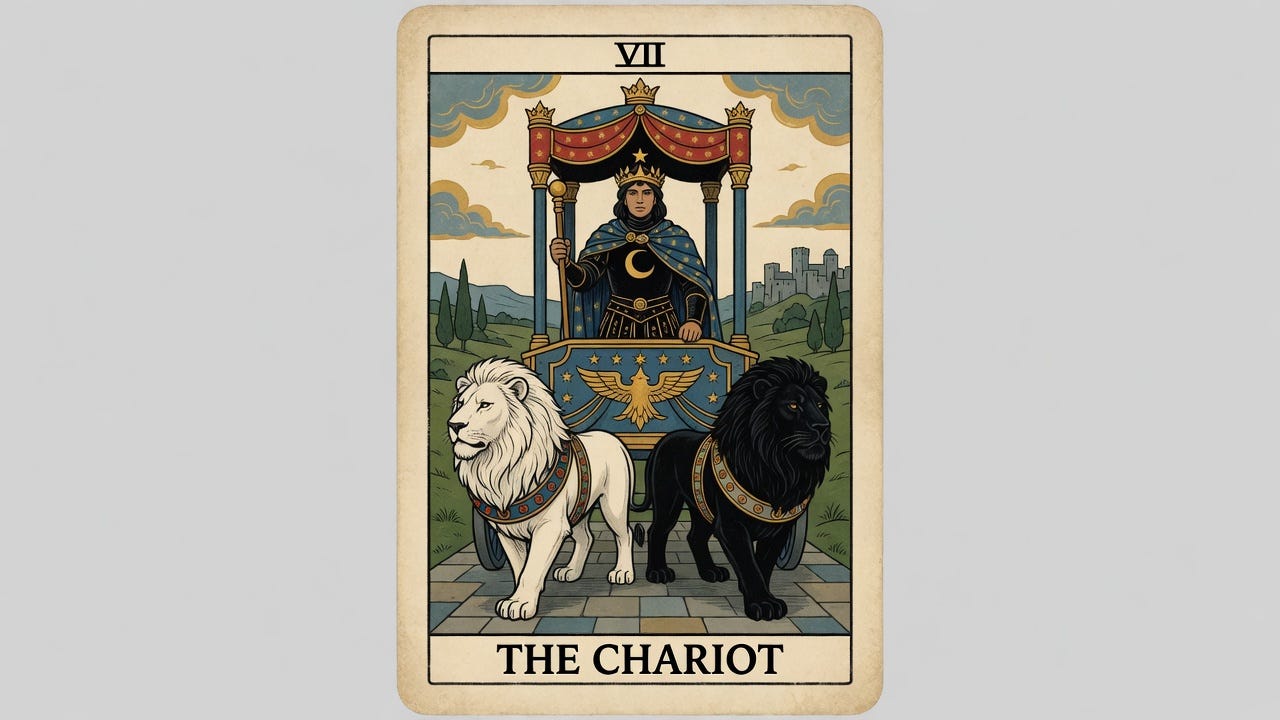
About The Wheel
Much has been made of Sumerian paintings depicting wheels and chariots, and of the debates that swirl around them. Yet, when rightly measured, the survival of intact wooden wheels—and the quarrel over which society possessed them and precisely when—is a trivial matter. What follows is an illustration of the quiet bias that evidence-based science, for all its claims to neutrality, tends to minimize.
The familiar narrative traces ancient wheels from heavy solid wood to light, durable wooden structures in tidy stages: solid plank disks carved from single slabs or joined tripartite boards (c. 3500–2000 BCE); cutout and H-type wheels where crescent voids were carved to reduce mass (c. 2000 BCE); the genuine revolution of the all-wood spoked wheel, with its hub, slender spokes, and bentwood rim enabling the horse-drawn chariot (c. 2000–1000 BCE); and finally wooden spoked wheels shod with iron rims merely to armor the wood against wear (c. 1000 BCE). Notice the constant: wood.
Wood. The same wood that disintegrates in the frequent razing of Carthage, Garamantia, Jerusalem—all put to the torch by Rome. The same wood that was deliberately not preferred over mud and stone in the Levant, where climate drove a calculus of durability that favored the inorganic. The very same wood responsible for the stark reality that fewer than a dozen intact Roman shields have ever been unearthed. What often survives of those shields? The brass and iron fittings—the metal components that outlast their organic host.
Here lies the irony. At Nahal Ein Gev in the Levant, archaeologists have recovered 12,000-year-old pure stone, donut-shaped, circular spindles, likely spindle whorls used to spin wool into yarn. And yet, the verdict remains that this region could not have invented the wheel. But a spindle whorl is a wheel—a flywheel, precisely the same principle applied to rotary motion. The material bias of preservation has quietly written the Levant out of the wheel’s story, while privileging cultures whose wooden artifacts were immortalized in paint, not perishable timber.
Herodotus, Histories, Book 4.189; On the Libyans teaching the Greeks the four-horse chariot:
“It is from the Libyans that the Greeks learned to yoke four horses to a chariot.”
Herodotus, Histories, Book 1.94; On the Lydians and their inventions, including wheeled games and dice, which the Greeks adopted:
“The Lydians claim to have invented the games which are now common to both them and the Greeks, such as dice, knucklebones, and ball games. They say these were invented during the long famine as a distraction from hunger.”
Diodorus Siculus, Library of History, Book 1.28; On the Egyptians and the wheel, contradicting Herodotus’s Libyan account:
“Some say that the Egyptians were the first to invent the chariot.”
Diodorus records a competing tradition that credits Egypt rather than Libya with the invention, reflecting the lack of consensus in antiquity about the wheel’s origin. He is writing much later, in the first century BCE, compiling earlier sources.
The Safely Asian Mesopotamia of the nineteenth-century imagination—a civilization of pristine Indo-European or Semitic origin, uncontaminated by African influence, the pure fountainhead of the West—was a fiction. The Sumerians called themselves the Black-Headed People. The Akkadians recorded their presence. The statues from Tell Asmar, with their wide eyes and curled beards and thick lips, were excavated and displayed and their African features were politely ignored. The Sumerian language, a language isolate with no known relatives, was classified as Asian by default, because the alternative—that it was related to languages spoken by African peoples, or that it represented a linguistic stratum that predated the division of Afro-Asiatic and Indo-European—was not a possibility the discipline was prepared to entertain.
IZUWA
The etymology is debated, but some scholars connect Išuwa to a Hurrian word iš‑ or eš‑ meaning “water,” reflecting the region’s rivers, marshes, and irrigation potential. The Euphrates and its tributaries made the plain fertile, which is why it was so fiercely contested between Hatti, Mitanni, and later Assyria.
The population was largely Hurrian, the same ethno‑linguistic group that dominated Mitanni and influenced Hittite religion. Yet the monumental art and some inscriptions from Išuwa show strong Luwian influences, proving that this frontier zone was a melting pot where Anatolian and Hurrian traditions blended.
One of the most cold‑blooded episodes in Hittite history: many people from Hittite vassal territories had fled to Išuwa to escape Hittite rule. After Suppiluliuma I crushed Mitanni’s influence, he invaded Išuwa, not just to conquer it but to recapture those refugees and forcibly resettle them back in their original towns. He literally emptied Išuwa of much of its population and repopulated it with more loyal subjects, a rare example of organised demographic engineering in the Late Bronze Age.
Archaeologists have identified a group of 15th–13th‑century BCE cylinder seals, found mainly in the Malatya‑Elazığ region, that are classified as “Išuwa Style.” They combine Hurrian religious motifs (winged discs, sacred trees, weather‑gods) with local Anatolian elements, and they were probably produced in a workshop controlled by the Išuwan elite. They are so distinctive that they are used to trace Išuwa’s trade contacts.
When Hattusa burned around 1180 BCE, Išuwa did not disappear. It re‑emerged in the Iron Age as the Neo‑Hittite kingdom of Kammanu, with its capital at Melid (modern Arslantepe). The Assyrians called the region Enzi or Enzite, a name that may directly derive from Išuwa. For another three centuries, it was a stubbornly independent state until Sargon II absorbed it into the Assyrian Empire.
Recent excavations around the Išuwa region have uncovered some of the earliest iron‑smelting installations in Anatolia. While the Hittites famously guarded the secret of ironworking, the ore and perhaps the technical knowledge may have come from the Išuwa highlands, which were rich in metal ores. The kingdom sat on the raw materials that fuelled Hittite power.
In short: Izuwa/Išuwa was not a town but a buffer kingdom that played an outsized role in Hittite strategy—demographic, metallurgical, and political. It survived the Bronze Age collapse, changed its name, and lived on as a Neo‑Hittite state, leaving behind a unique artistic and linguistic legacy that is still being unearthed.
Demographic Engineering
A reader might need to posses a clear understanding of the Library’s articles The Fertile Crescent: The Truer Story Of the Old World Mulattos/ Mestizos and The Library of Alexandria: Answering the Ancient Egyptian Race Question to fully comprehend the context of the following information. header.
Akkadian Empire: Rimush’s Mass Deportations (c. 2270 BCE)
The first unequivocal documentation of forced population transfer with a clear resettlement purpose belongs to Rimush, son of Sargon of Akkad. His inscriptions, preserved in Old Babylonian copies (c. 1800 BCE) of original Akkadian monuments, record the outcomes of his military campaigns in Sumer and Elam:
After suppressing a rebellion in Sumer, Rimush claims to have slain thousands and to have deported 5,700 men from the rebellious cities and settled them elsewhere (likely in Akkad or other loyal districts).
In his Elamite campaign, he records taking 4,216 captives and settling them in Sumerian cities.
The inscriptions explicitly state that these captured populations were forcibly relocated and planted in new locations. This not only supplied labor but also broke the political cohesion of conquered regions—a core technique of demographic engineering.
Additionally, his father Sargon of Akkad (c. 2334–2279 BCE) boasted in later copies of his inscriptions that he “settled citizens of Akkad” in the conquered cities of Sumer, effectively a policy of colonisation that altered the ethnic makeup of those urban centres. However, Sargon’s claims are less detailed about numbers and logistics than those of Rimush.
Ur III Empire: Bureaucratized Resettlement (c. 2112–2004 BCE)
The administrative archives of the Third Dynasty of Ur (Ur III) provide the earliest contemporary day-to-day documentation of demographic engineering. Tens of thousands of cuneiform tablets record the management of state-run labour camps (the gemé/arad system) into which large numbers of foreign captives—Elamites, Amorites, Hurrians—were brought. These people were systematically moved across the empire, assigned to textile mills, agricultural fields, and construction projects far from their homelands. The Ur III state not only displaced populations but also deliberately mixed ethnic groups in work camps to weaken collective identities, a policy clearly aimed at demographic control.
Scipio Aemilianus, Again
The Roman approach to an enemy city that had refused to yield was not war, in any sense that an earlier age would have recognised, but a deliberate and total erasure. When the legions finally breached the walls, they did not merely defeat; they unmade. The buildings were pulled down stone by stone, the population sold into bondage or put to the sword, and the very name of the place was often struck from the administrative record—a triple death of the civic body, the physical fabric, and the memory itself. This was not the hot-blooded sack of a storming party but a bureaucratic annihilation, sometimes ordered from the Senate, sometimes executed with the same patient, grim discipline that had built the roads and aqueducts. The Romans understood, with a clarity that still chills, that a people cannot recover if their city is not merely occupied but ceasing to exist as a landmark on the earth.
Carthage is the exemplar, and the sources are unsparing. Polybius, who stood beside Scipio Aemilianus as the city burned, left an account that Appian later amplified: the harbour district fought street by street for six days, the final holdouts immolating themselves in the temple of Eshmun, the whole city given over to the flames, and the ruins then methodically demolished by teams of soldiers over weeks. The Roman Senate decreed that the site should never be rebuilt, a curse formally pronounced. Later ages added the fable of salt sown into the furrows, and while archaeology has found no trace of that particular ritual, the spirit of the invention is truer than the letter: Carthage was not just destroyed; it was to be forever uninhabitable. A century later, when Julius Caesar planted a colony on the same ground, it was an act of deliberate reversal that only confirmed the original intent. Corinth met the same fate in the same year, 146 BCE. The Greek city was looted of its art before being razed; its men were massacred, its women and children enslaved, and its territory annexed, the commercial rival of Rome reduced to a smoking plain. The consul Mummius, whose name history has preserved with no great affection, was not a rogue but an instrument of a settled policy: the visible removal of any centre of power that might one day challenge the Roman order.
These two famous obliterations were not isolated. Numantia, the stubborn Celtiberian hill-fort in Spain, held out for years against vastly superior forces, and when Scipio Aemilianus finally took it in 133 BCE, he burned it and sold the survivors. The city vanished so completely that its exact location was a matter of scholarly dispute until modern times. The pattern repeated in 146 BCE with the coastal city of Dicaearchia (Puteoli) not razed, but the general principle extended: any polity that defied Rome’s ultimatum could expect its urban centre to be dismantled as a warning. The destruction of Jerusalem in 70 CE, though not a total razing—the retaining wall of the Temple platform was left standing, the Tenth Legion camped among the ruins—was still a catastrophic event that eliminated the spiritual and political capital of the Jewish nation. The Temple was deliberately set alight, despite Titus’s supposed reluctance, and the thorough demolition that followed left the city a garrison post, its surviving population exiled or enslaved.
What makes the Roman razing distinct from the ordinary brutality of ancient warfare is the method and the message. The Romans did not simply kill and leave; they stayed long enough to ensure that the site was returned to an archaeologically sterile condition, with cut stones removed for reuse elsewhere, walls thrown down into their own ditches, and the grid of streets obliterated. It was an act of writing into the landscape the imperial doctrine that resistance terminated not in negotiation but in non-existence. And because the Romans were the literate survivors, their historians cast these destructions as the necessary discipline of civilisation, the just wages of barbarian or decadent stubbornness. The truth, unvarnished by that propaganda, is simpler and starker: Rome, at the height of its republican vigour, perfected the art of removing cities from the map as a policy instrument. The blank spaces it left behind are the silent witnesses to a terror that the textbooks, written largely by the victors, prefer to call order.
See, Scipio Aemilianus.

WESTERN CIVILIZATION CAN’T BE UNENCRYPTED (TM)
‘Dental morphological variation in Chalcolithic and Bronze Age human populations from North-Eastern Romania’, Annals of Anatomy, Volume 245, January 2023(Mariana Popvici et all), when read plainly, a masterclass in the discipline’s native tongue: Encryption™. It deploys the full apparatus of geometric morphometrics—Procrustes superimpositions, centroid sizes, principal components of shape variation—as a cryptographic shell around a biological fact too blunt to be spoken aloud. Within that shell, the data whisper what the authors decline to shout: that the lower second molars of the Bronze Age are flatter mesiodistally because the fifth cusp, the hypoconulid, has been fading from the human mouth. That is a population signal, a signature of Western Eurasian ancestry arriving in a region that had previously housed a different phenotypic blend. The paper says “flattened mesiodistal profile” because the raw cusp counts were never scored; it says “phenetic relationships” because “population replacement” is an invitation to controversy.
It wraps itself in the safe terminology of continuous shape variables and allometric trends, not because the authors are dishonest, but because the institutional algorithm demands that truth be transmitted only in cipher. The worn teeth, the small sample sizes, the methodological propriety—these are the encryption keys, and the guild holds them. The underlying plaintext is still legible to anyone who knows that four cusps mean one thing and five cusps mean another. But the guild prefers the ciphertext, because the ciphertext can be published, cited, and safely filed away without requiring anyone to redraw the map. The paper is thus a perfect artifact of the Encryption™ tradition: the truth is present, but only for those who have already learned to read through the disguise.
Even this form of cipher-text is becoming increasingly locked behind a paywall and institutional credentials, a final gate ensuring that the plaintext of human history cannot be read by the unauthorized eye. The Library admits, overtime it has learned to flexibly pick up on some coded aspects of various sceintific discipline, but as the security layer grows in technology assisted sophisitication, continued oberservation is uncertain.
The decryption: A non-metric phenotype (or non-metric trait) is an anatomical, physiological, or behavioral feature that varies among individuals but cannot be easily measured with a ruler or continuous scale. Instead of being quantified in millimeters or kilograms, these traits are recorded as presence/absence, discrete categories, or morphological variations. Unlike continuous traits (like height or weight), which are polygenic and heavily influenced by the environment, non-metric phenotypes are mostly controlled by genetics with distinct developmental thresholds.
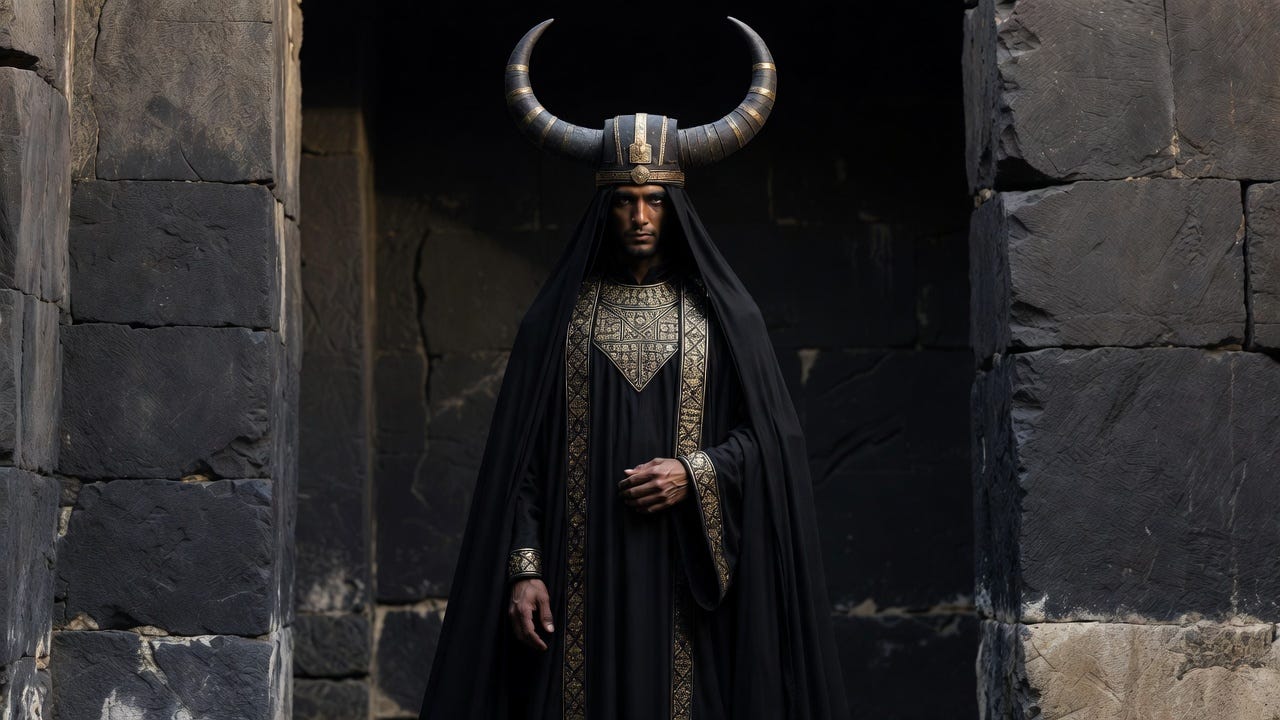
If you want DNA data see here, here, or here. Not necessary, just keep reading.
The Tale of Five-Cusp Teeth Being Replaced In Romania FROM 5000 to 1150 BCE
The “flatter mesiodistal” shape described for the Bronze Age lower second molars means the tooth is compressed from front to back—shorter along the axis that runs from the mesial (forward) side to the distal (rear) side, relative to its width. In dental anthropology, this shape change is closely tied to a specific non‑metric phenotype: the reduction or absence of the hypoconulid, the fifth cusp on the distal margin of a lower molar.
If you have previously read the Library’s article ‘The Fertile Crescent: The Truer Story Of the Old World Mulattos/ Mestizos’. You could easily infer what the findings were, as I’ve previously indicated what populations were being replaced and the timeframe.
A classic five‑cusped lower molar (with a well‑developed hypoconulid) has a more elongated, rectangular outline. When the hypoconulid shrinks or disappears, the distal portion of the crown collapses inward, producing exactly the “flattened” mesiodistal profile the study detected. The resulting four‑cusped lower molar is mesiodistally shorter, with a more square or rounded distal outline.
This trait is strongly hereditary and geographically patterned:
Four‑cusped lower molars (reduced/absent hypoconulid) are the predominant form in modern Western Eurasian populations, reaching frequencies above 90% in many European groups.
Five‑cusped lower molars (retained hypoconulid) are much more common in sub‑Saharan African and Australo‑Melanesian populations, often at frequencies of 50–80%.
East Asian and Native American groups fall between, with variable expression.
So, the flatter Bronze Age molars in Romania are consistent with a population that possessed a high frequency of the hypoconulid reduction phenotype—a dental hallmark of the Western Eurasian gene pool. When the same Mesolithic and Neolithic communities of Europe are examined, they often show a mixture, but the trend toward increased four‑cusped forms accelerated after the arrival of steppe‑related ancestry in the Bronze Age. The geometric morphometric “flattening” is, in effect, a quantitative capture of this shift: the fading of the fifth cusp and the remodelling of the crown into a more compact, distally shortened shape that became the dominant European dental pattern.
The study itself does not explicitly count cusps or state “four‑cusped molars replaced five‑cusped molars.” It uses geometric morphometrics to capture the overall shape variation of the second molar crown, and reports that Bronze Age lower second molars are “flattened mesiodistal” compared to Chalcolithic ones. That means the tooth became shorter from front to back relative to its width. Now, what anatomical change produces a mesiodistally flattened lower molar? The most common cause is reduction or loss of the hypoconulid, the fifth cusp at the distal end of the tooth. A well‑developed hypoconulid lengthens the distal profile; when it shrinks or disappears, the distal margin contracts and the whole tooth becomes mesiodistally shorter and more squared. This is a classic non‑metric trait known as “cusp 5 reduction,” and it is precisely what transforms a five‑cusped lower molar into a four‑cusped one.
So the study’s geometric finding of “flattened mesiodistal” is a quantitative shape signal that is entirely consistent with an increase in the frequency of four‑cusped lower second molars in the Bronze Age sample.
And it informs phylogeny: because the trait is highly heritable and geographically structured, it helps reconstruct the deep biological relationships among human groups.
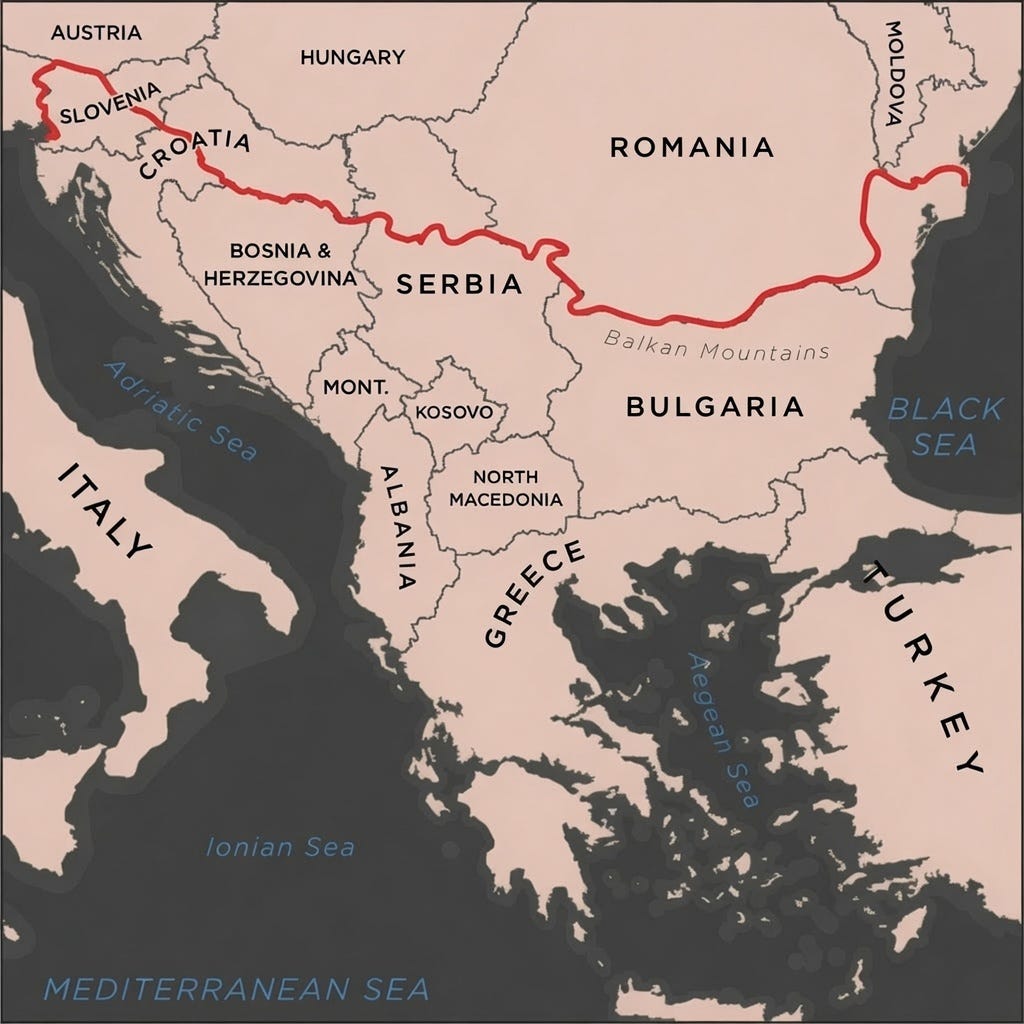
Coincidentally, I already thoroughly documented at African presence in Bronze-Age Anatolia in the article We Was Kings: Bronze Age Somalis in Greece. No need to look back or rehash now.
Jebel Sahaba (10,000 BCE) NUBIA
Citation: Diodorus Siculus, Bibliotheca Historica, Book I, Chapter 28:
“Now the Egyptians say that also after these events a great number of colonies were spread from Egypt over all the inhabited world. To Babylon, for instance, colonists were led by Belus... They say also that those who set forth with Danaus, likewise from Egypt, settled what is practically the oldest city of Greece, Argos, and that the nation of the Colchi in Pontus and that of the Jews... were founded as colonies by certain emigrants from their country.”
Diodorus Siculus, Bibliotheca Historica (Library of History), Book III, Chapter 3:
“And the larger part of the customs of the Egyptians are, they hold, Ethiopian [Nubia], the colonists still preserving their ancient manners.”
Imagine a cemetery along the ancient Nile, its graves holding the broken bones of 61 men, women, and children. For over a century, the Jebel Sahaba skeletons have whispered a violent tale—but it is only through modern science that we can finally hear their true biological identity.
When researchers measured their skulls, examined the robust shape of their jaws, and calculated the precise ratios of their arm and leg bones, the data painted a remarkably clear picture. The people buried in those graves were not a random, mixed multitude; they formed a distinct, cohesive biological cluster. That cluster aligns unmistakably with sub-Saharan African populations.
Let us spell that out explicitly. The morphological signature of the Jebel Sahaba people—specifically their cranial shape, their dental traits, and their characteristic limb proportions (adapted for warm, open environments)—places them squarely among the groups that populate the vast regions south of the Sahara Desert. In the 2021 reanalysis led by Isabelle Crevecoeur, these skeletons were directly compared against a wide reference database. The closest statistical matches came from recent East African groups (such as certain Nilotic populations) and West African skeletal samples, as well as fossil remains from Central Africa.
Now, look at who they were not. These ancient Nile dwellers were morphologically distinct from the North African Iberomaurusian populations who lived contemporaneously in places like Algeria (such as the Taforalt skeletons). They were equally divergent from the Natufian hunter-gatherers of the Levant, who inhabited the lands to the northeast. And fascinatingly, they were biologically different from the later Nubian populations (like the Arkinian or Abkan industries) that would occupy the same stretch of the Nile thousands of years later. In other words, these were not early Nubians as we understand the term today; they represent a unique, indigenous lineage that was deeply rooted in the sub-Saharan sphere but had adapted specifically to the challenging environment of the Late Pleistocene Nile corridor.
Ultimately, the narrative of their bones is this: they were a physically distinct, indigenous population with a clear biological heritage tracing to sub-Saharan Africa. They were not a motley crew of unrelated races, nor were they the ancestors of the later Nubian states that history remembers. They were a specific group of ancient Africans, surviving at the edge of a changing world, whose very bones—clustered as they are with the people of East, West, and Central Africa—tell us exactly where they belong in the human family tree.
To understand why Nubia is not simply classified as Sub-Saharan African or purely Nilo-Saharan, one must look at its unique geographic and historical position. Nubia is not Sub-Saharan Africa in the strict geographic sense because it lies north of the Sahara’s southern boundaries, straddling the Nile River between the First and Fourth Cataracts in what is now southern Egypt and northern Sudan. This places it squarely in the transitional zone between the Mediterranean world and the African interior, making it a bridge rather than a region clearly south of the desert.
Linguistically, the Nubian languages are traditionally classified within the Nilo-Saharan family, specifically under the Eastern Sudanic branch. However, this classification is not without debate. Many linguists now argue that the evidence linking Nubian to other Nilo-Saharan languages is insufficient, and they propose that Nubian should be considered an independent language family. Adding to this complexity, ancient Nubian territories also used languages from the Afroasiatic family, revealing a long history of linguistic diversity and cultural exchange.
In otherwords, it’s a method that prioritizes itself on techniques of exclusion rather than inclusion.
Jason and Jacob: The Poison and the Supplanter
Ovid’s Heroides (16.201-202):
“A Phrygian was the husband of Aurora [goddess of dawn], yet she, the goddess who appoints the last road of night, carried him away”
The Core Etymology: ἰάομαι (iaomai) — “to heal”
The standard and most widely accepted etymology derives Iásōn from the Greek verb ἰάομαι (iaomai), meaning “to heal, to cure, to remedy.” The noun ἴασις (iasis) means “healing” or “cure.” The name Iásōn would thus mean “the healer” or “the one who cures.” This is the traditional reading, and it connects Jason to a widespread Indo-European root for healing found also in the name of the goddess Ἰασώ (Iasō), a minor deity of recuperation and remedy, daughter of Asclepius.
The Deeper Root: ἰά (ia) — “a cry, a shout, a voice”
The syllable ia- also appears in Greek as an interjection or cry: ἰά (ia) is a shout of lament, joy, or invocation. It is the voice raised in extremity. The verb ἰάζω (iazō) means “to cry aloud, to shout.” The name Iásōn may carry this resonance: the one who cries out, the one whose voice is heard across the water. The Argonautica is an epic of shouts—Jason’s commands, Medea’s cries, the lament of the Colchian king.
The Hidden Layer: ἰός (ios) — “arrow, poison, rust”
The Library traces a darker thread. The Greek word ἰός (ios) means “arrow” but also “poison” and “rust.” It is the venom on the arrowhead, the corrosion of metal, the slow destruction that follows penetration. Jason is the arrow that strikes Colchis. He penetrates the Black Sea, pierces the house of Aeetes, and draws Medea out like poisoned blood. His name, Iásōn, contains ios phonetically and, in the old style, semantically. The healer is also the wound.
The goddess Iasō belongs to the circle of Asclepius, but her name has been compared by some scholars to Near Eastern healing deities. The root yas- or yasa- appears in Sanskrit yaśas (”glory, fame, splendour”) and in Iranian names. The Greek Iásōn may share an Indo-European root with these words for radiance and glory, making the name a doublet: “the glorious one” who is also “the healer.”
Jason—Iásōn—carries the ios: the poison, the arrow, the rust. He comes from across the water, and he takes what is not his. He takes the fleece, the stored-up wealth, the yashan of Colchis. He takes the woman, Medea, who betrays her father and her people. He is the healer whose name means wound.
Jacob—Ya‘aqov—grasps the heel of his brother in the womb. He takes the birthright for a bowl of lentils. He takes the blessing by deception, wearing goat-skins on his smooth arms to mimic his brother’s hairiness. He flees across the river. He wrestles the angel and is renamed Israel, but he limps forever after.
Both use cunning, not strength. Both cross water after the theft. Both are wounded or marked by the encounter—Jason crushed by the Argo’s prow, Jacob by the angel’s touch on his thigh. Both gain a kingdom that does not fully belong to them. Both are the serpent in the garden, the one who introduces the hidden motive, the one who cannot be trusted to be what he appears. The Library holds them as the same myth, refracted through two cultures that both received the Afro-Asiatic superhighway’s legacy. The Greek version makes the thief a hero and calls the laugh Sardonic. The Hebrew version makes the thief a patriarch and calls the wrestling a blessing. But the pattern is one: the poison comes from the same tree.
Dascylus—the name that threads through Phrygia, Lydia, Caria, and Mysia—carries the root dask- or das-, which in the Anatolian substrate may connect to meanings of roughness, hairiness, redness. He is the father of Gyges, the king who took the throne from Candaules. He guides the Argonauts. He is the eponym of towns and the ancestor of kings.
Iásōn means “healer.” Iásōn means “the one who cries out.” Iásōn echoes “arrow” and “poison.” Iásōn carries the sound of “glory” and the shadow of “old stored things.”
The hero who stole the fleece bears a name that performs the Library’s entire thesis. He came as a healer—the civilized Greek bringing culture to the barbarian—and he was an arrow in the heart of Colchis. He came with a cry, and he left a cry behind him, the cry of Medea. His glory was not his own; it was stored in Colchis, preserved by the dark-skinned, circumcised people of the Phasis, and he took it.
The name Iásōn is the first lie of the serpent. It means “healer,” and he brought death. It means “glorious,” and he was a thief. The Library holds the name and its echoes together: iaomai, iasō, ios, ia, yashan—the healer, the poison, the cry, the stored-up treasure. Jason is all of them, and the Sardonic laugh is the sound of a name that cannot escape its own meaning.
The Greeks used λίνον (linon) for a wide range of purposes, but the most culturally and economically significant use was for sails. Though papyrus was the primary writing surface in the Greek world after the Archaic period, linen cloth was occasionally used for inscribed texts, especially in ritual or dedicatory contexts. Linen thread was twisted into fishing nets, bird nets, and ropes. The maritime economy depended on linen nets as much as on linen sails. The word linon by itself could mean a fishing net in poetic usage. Sardonic linen.
CYRUS THE GREAT
“Myth is not prehistory: it is timeless reality, that repeats itself in history.”
— Ernst Jünger “Der Waldgang”
The Cissians and Hyrcanians, named alongside the Medes, are also Iranian peoples, also armed in the Persian fashion, also part of the same imperial army marching against Greece. The Hyrcanians dwell by the Caspian, the ancient homeland of the Iranian branch. The Cissians are from Susiana, the heartland of Elam, the pre-Iranian civilisation that the Persians absorbed. The Iranian world, from the Caspian to the Persian Gulf, is a continuum of peoples who share dress and arms and a common origin—but each with its own commander, its own identity, its own variant of the Iranian heritage.
The Medes stand at the centre of this continuum, the first among them to build an empire, the ones whose dress the Persians adopted, the ones whose name was changed by a Colchian woman. The Library places them in the matrix: Iranian-speaking, but named after the substrate. Steppe-descended, but dressed in the fabric of the lands they conquered. Dove-like in their transparency, yet capable of the serpentine error that the Magi committed when they misread Astyages’s dream.
Astyages, king of the Medes, has dreamed that his daughter Mandane’s son would rule in his place. He ordered the infant Cyrus exposed. The child survived, raised by a shepherd. Now Astyages learns the truth: the boy is alive, and in a village game, the other children named him king. Cyrus played the part perfectly—appointing guards, doorkeepers, messengers, all the apparatus of royal authority. Astyages summons the Magi, the priestly interpreters of dreams, and asks them what this portends.
The Magi’s answer is, on its surface, a reassurance: the dream has already been fulfilled. The boy was named king in a game. The oracle has run its course. He will not rule a second time. Send him back to his Persian parents. You are safe.
The surface reading is a political calculation dressed in priestly language. The Magi, as they explicitly state, are Medes. They fear that if Astyages falls, rule will pass to a Persian—”we being Medes are made slaves and become of no account in the eyes of the Persians, seeing that we are of different race.” They are protecting their own position. They interpret the dream in the way that preserves Median supremacy, and they advise the king accordingly.
A Theory About Persian Perception
The Persian Empire absorbed the Lydians and the Medes, peoples who spoke Indo-European languages and who, at various times, rose in open revolt against Persian rule. The Ionian Greeks, too, revolted—the Ionian Revolt of 499–493 BCE drew Persian wrath and triggered the Persian Wars. Yet the Persian historical memory, as Herodotus preserves it, does not fixate on Lydian or Median treachery with the same enduring, ideological enmity it reserves for the Greeks. The Persians call the Hellenic race their permanent enemy and trace that enmity to the Trojan War, an event centuries before the Persian Empire existed. Why do revolting Medes and Lydians not earn this same status?
The Lydian and the Mede, when they submitted to Persian rule, presented themselves as subjects of the Great King. When they revolted, they presented themselves as rebels. The change was visible, public, and unambiguous. The Persian response—suppression, re-absorption, reinstatement of the satrapy—restored the visible order. The matter was closed. The dove does not nurse a hidden grievance. The dove sees the rebellion, crushes it, and when the rebel returns to his place, the visible order is whole again. There is no hidden self to resent, no secret motive to suspect. The Lydian who revolts is a Lydian who is now a rebel; the Lydian who submits is a Lydian who is now a subject. Both are what they present.
The Greek is different. The Greek presents himself as a trader, a mercenary, an ally—and then is discovered to have been a thief, a spy, a serpent all along. The Greek walks naked, feeling no shame, and his nakedness is a concealment. He invents the Ring of Gyges because he cannot imagine a world without hiddenness. When the Greek revolts, the Persian cannot simply suppress the revolt and restore the visible order, because the Greek’s visible presentation was never trustworthy to begin with. The serpent sheds its skin and is still the same serpent underneath. The Persian cannot know when the Greek is truly a subject and when he is merely playing.
Herodotus’s Histories:
1.87 Then, the Lydians say that Croesus[Former King of Lydia], perceiving by the efforts made to quench the fire that Cyrus [The Great] had relented, and seeing also that all was in vain, and that the men could not get the fire under, called with a loud voice upon the god Apollo, and prayed him, if he ever received at his hands any acceptable gift, to come to his aid, and deliver him from his present danger. As thus with tears he besought the god, suddenly, though up to that time the sky had been clear and the day without a breath of wind, dark clouds gathered, and the storm burst over their heads with rain of such violence, that the flames were speedily extinguished. Cyrus, convinced by this that Croesus was a good man and a favourite of heaven, asked him after he was taken off the pile, “Who it was that had persuaded him to lead an army into his country, and so become his foe rather than continue his friend?” to which Croesus made answer as follows: “What I did, oh! king, was to thy advantage and to my own loss. If there be blame, it rests with the god of the Greeks, who encouraged me to begin the war. No one is so foolish as to prefer war to peace, in which, instead of sons burying their fathers, fathers bury their sons. But the gods willed it so.”
Herodotus’s Histories:
1.131 The customs which I know the Persians to observe are the following: they have no images of the gods, no temples nor altars, and consider the use of them a sign of folly. This comes, I think, from their not believing the gods to have the same nature with men, as the Greeks imagine. Their wont, however, is to ascend the summits of the loftiest mountains, and there to offer sacrifice to Jupiter, which is the name they give to the whole circuit of the firmament. They likewise offer to the sun and moon, to the earth, to fire, to water, and to the winds. These are the only gods whose worship has come down to them from ancient times. At a later period they began the worship of Urania, which they borrowed from the Arabians and Assyrians. Mylitta is the name by which the Assyrians know this goddess, whom the Arabians call Alitta, and the Persians Mitra.
The Greek serpent does not live under Mithra. He lives under a pantheon of gods who deceive, who hide, who transform themselves into animals to escape detection. The Greek hero is the one who can trick the god, who can steal the fleece under cover of night, who can put on the Ring of Gyges and become invisible. The Greek psyche is built on the conviction that the visible is a mask and that power lies in escaping the gaze. Mithra, to the Greek, would be a tyrant—a god who demands that you be exactly what you appear to be, who gives you no place to hide.
Troy was not a Greek city. It was an Anatolian city, its kings married to Phrygian princesses, its people part of the same Carian-Lydian-Mysian-Phrygian matrix that shared the temple at Mylasa. When the Greeks burned Troy, they burned a city of the older, darker world. Hecuba, Priam’s wife, was a Phrygian princess with a dark complexion, as the Phrygian writer Dares preserved.
Dares’ De excidio Trojae (History of the Fall of Troy):
“...beautiful, her figure large, her complexion dark. She thought like a man and was pious and just .”
Rules of Historical Linguistics and Hittites
The earliest known (i.e., attested in writing) Indo‑European language is Hittite, the chief language of the Anatolian branch. The oldest Hittite texts—royal annals, edicts, and ritual instructions written in a cuneiform script adapted from Old Assyrian models—date to the Old Hittite period, approximately 1650–1600 BCE. These were found at the Hittite capital Ḫattuša (modern Boğazköy, Turkey). Some scholars also point to slightly earlier Kültepe texts (the “Cappadocian tablets”) from Assyrian merchant colonies in Anatolia (c. 1950–1750 BCE), which contain Indo‑European personal names and loanwords, but these are not full Hittite texts; they are Old Assyrian with Hittite elements. Therefore the earliest full, connected texts are in Hittite.
The Anatolian branch, to which Hittite belongs, is peculiar: it preserves archaic features lost in all other Indo‑European languages (e.g., a laryngeal-based sound system, a simpler gender system of animate/inanimate rather than masculine/feminine/neuter), which indicates it split off from the Proto‑Indo‑European speech community very early, perhaps around 4000 BCE or earlier.
Other early attested Indo‑European languages include Mycenaean Greek (Linear B tablets, c. 1450‑1200 BCE), Vedic Sanskrit (oral composition dated to c. 1500‑1200 BCE, but manuscripts much later), and Avestan (the oldest Iranian language, preserved in orally transmitted sacred texts, the oldest being the Gāthās, probably c. 1000‑600 BCE). But none of these equals the antiquity of the written Hittite records.
Thus, the Library records: the first Indo‑European language we can read from durable, contemporary inscriptions is Hittite, emerging in the mid‑second millennium BCE, yet even it was a thin elite language laid over a much older, darker‑skinned Anatolian population whose languages (Hattic, Hurrian) were not Indo‑European at all. The Indo‑European myth starts its written career not on the steppe, but in the shadow of the Anatolian substrate.
If one asks which attested language gives the clearest picture of the full grammatical machinery of Proto‑Indo‑European, the answer is Vedic Sanskrit. It preserves the richest and most complete set of morphological patterns—cases, numbers, genders, moods, tenses, and accent—that align with the reconstruction. It is the “oldest” in terms of inherited structural conservatism.
If one asks which language preserves the most ancient phonological feature (laryngeals), Hittite is crucial, but it has otherwise innovated heavily.
If one asks which living language is most conservative, it is Lithuanian.
Thus, by “known linguistic patterns” in the sense of grammatical architecture, the Library’s answer is Vedic Sanskrit, with Hittite and Lithuanian each holding primacy in more limited respects.
In historical linguistics, “oldest” in terms of preserved patterns means which language changed least from the Proto‑Indo‑European (PIE) ancestral state—which retains the most conservative phonology, morphology, and syntax. No single daughter language preserves everything; each branch has innovated differently. However, a strong consensus identifies two standouts: Vedic Sanskrit among ancient languages, and Lithuanian among living ones.
While Old Persian (the language of Cyrus and Darius) is historically part of the Indo-European family and completely unrelated to the Semitic Aramaic family, the two are closely intertwined. The Persians used Aramaic as their bureaucratic lingua franca, and later, Middle Persian evolved to use an Aramaic-derived script.
The Imperial Language: During the Achaemenid Empire (c. 550–330 BCE), the Persians needed a practical, easily readable way to communicate across an empire that stretched from the Nile to the Indus. Scribes relied on Imperial Aramaic for everyday administration, which gave Aramaic a massive footprint across the ancient Middle East.
Cambyses II
Cambyses, son of Cyrus the Great, inherited an empire and a shadow. The shadow belonged to his younger brother Smerdis—the one man in Persia strong enough to bend the royal bow that no other could string, the one man whose existence seemed a living reproach to Cambyses’ brittle sovereignty. Shortly after the conquest of Egypt, the king’s sleep was torn by a dream in which a messenger arrived to announce that Smerdis sat upon the Persian throne, his head brushing the heavens. Cambyses interpreted the vision with the literal, paranoid logic of a man already unmoored. He summoned his most trusted attendant, Prexaspes, and ordered him to return to Persia and kill Smerdis. Prexaspes obeyed, though the ancient accounts differ on the method: some say he drowned the prince in the Red Sea, others that he buried him alive, still others that he simply cut his throat in the desert. Whatever the weapon, the result was the same. The brother who could draw the bow was dead, and Cambyses believed himself secure—not yet knowing that a magus, Gaumata, who happened to share Smerdis’ name and face, had already seized the throne in the brother’s likeness. The murder that was meant to prevent a usurpation had instead made one invisible.
With Smerdis’ blood still wet upon the empire’s conscience, Cambyses descended into a catalogue of outrages that Greek chroniclers would polish into legend. He fell publicly upon the Apis bull—the living embodiment of Ptah, whose discovery the Egyptians were celebrating with joy—and, mocking their god, drove a dagger into the calf’s thigh. As the sacred animal bled out in the temple, Cambyses ordered the priests scourged and any Egyptian caught rejoicing put to death. But the bull was only the beginning. He married two of his own sisters simultaneously, a practice unknown in Persian law. When he summoned the royal judges to demand whether such a union was permitted, they carefully answered that no statute existed to allow a man to marry his sister—but a Persian king, they added, was above statute. He took the elder sister, Atossa, and the younger, whose name the histories handle with caution, and then, in a fit of rage, he kicked the pregnant younger sister in the belly so savagely that she miscarried and died. At a banquet, he asked Prexaspes what the Persians thought of him, and when the old courtier answered that they found him too fond of wine, Cambyses shot an arrow through the heart of the courtier’s own son, then had the body opened to prove the shaft had pierced it dead center. He buried twelve Persian nobles alive, head downward. He opened ancient tombs to mock the dead. In Nubia, he marched an army into the desert without supplies, and when the men began to starve, they drew lots and ate one another—until Cambyses, perhaps sensing the abyss staring back, finally turned the column around.
The end came in Syria, on the road to confront the false Smerdis who had stolen his throne. As Cambyses vaulted onto his horse, the cap of his scabbard fell loose, and his own sword gashed his thigh—in precisely the spot, Herodotus notes with cruel symmetry, where he had stabbed the Apis bull. The wound festered. Lying in the small town of Agbatana, his army dissolved and his empire slipping away, Cambyses finally spoke a truth he had spent his reign denying. He confessed the murder of his brother, and with it acknowledged that the man in the royal tent in Persia was an impostor. He begged the Persian nobles present to reclaim the throne from the Magian usurper, then died of gangrene—childless, brotherless, and, if the report be true, utterly unmourned. The Persians who heard his deathbed confession did nothing, convinced the king was merely raving. It was left to a small band of conspirators, led eventually by Darius, to dispatch the false Smerdis and begin the long work of rebuilding what Cambyses had shattered. The outrages, whether historical fact or priestly propaganda, had done their work: the name of Cambyses became a byword for the madness that overtakes a ruler who murders his own blood.
By conflating Apis and Apries, Herodotus could do more than condemn the growing Persian impiety; he could smuggle into his text a quiet, devastating parallel between Cambyses, the brother-killing conqueror, and the Egyptian regime that had, in its own corruption, paved the way for foreign domination. The bull-god and the fallen pharaoh became one: the sacred life-force of Egypt, mortally wounded first by its own people, and then by the invader. And in that hidden conflation, Herodotus—half Carian, half Greek, wholly exile—whispered his deepest conviction: that the gods do not merely punish mad kings. They weave their downfalls from the very threads of the past the kings believe they have severed.
Jeremiah 44:
30 “Thus says the Lord: ‘Behold, I will give Pharaoh Hophra [Apries] king of Egypt into the hand of his enemies and into the hand of those who seek his life, as I gave Zedekiah king of Judah into the hand of Nebuchadnezzar king of Babylon, his enemy who sought his life.’ ”
The Genealogy That Sprouts from the Mark
The Median king Astyages was troubled by prophetic dreams foretelling that his daughter Mandane’s (of Media, name means ‘Cheerful, Delightful’) son would one day rule all of Asia and overthrow him. To thwart fate, he married Mandane to the quiet Persian prince Cambyses I, hoping any child would be too lowly to be a threat. When Mandane gave birth to Cyrus, Astyages ordered his trusted courtier Harpagus to take the infant and expose him in the mountains to die. Harpagus could not bring himself to kill royal blood, so he passed the baby to a herdsman with orders to abandon it.
The herdsman, however, found that his own wife had just delivered a stillborn child, and the couple secretly swapped the dead infant for the living prince, raising Cyrus as their own son. Years later, the boy’s royal nature revealed itself when he was chosen as king in a childhood game, leading Astyages to recognize his grandson and realize the exposure had failed.
Enraged at Harpagus for his disobedience, Astyages took terrible revenge by killing Harpagus’s own son and serving him as a meal to the unsuspecting father. Because the Magi priests reassured Astyages that the childhood game had already fulfilled the prophecy, he allowed Cyrus to return to his true parents, Cambyses and Mandane.
Harpagus, nursing a secret thirst for vengeance after the slaughter of his child, began secretly corresponding with Cyrus and urging him to rebel. With Harpagus’s crucial support from within the Median court, Cyrus raised a Persian army, marched against his grandfather, and ultimately conquered Media, fulfilling the dream that had terrified Astyages from the very beginning.
The story of Harpagus from the Cyrus legend and the Greek myth of Tantalus are strikingly parallel, revolving around one of the most harrowing taboos in ancient storytelling: the slaughter and serving of a child as a meal.
At the heart of both narratives lies the horrific act of filicide disguised as feasting. In the myth of Tantalus, the king seeks to test the gods’ omniscience by butchering his own son Pelops, cooking him, and offering him as a communal meal to the Olympian deities. Similarly, the Median king Astyages, enraged by Harpagus’s failure to kill the infant Cyrus, exacts a chilling punishment by murdering Harpagus’s young son, dismembering him, and serving the cooked remains to the unsuspecting father at a royal banquet. In both cases, the meal is a gruesome spectacle of deception, where the diner is utterly unaware of the true nature of the meat until the horrific revelation occurs at the end of the feast.
Another profound parallel is the theme of divine or royal oversight. Tantalus’s crime is an offense against the gods themselves, testing their perception and challenging their authority. Demeter, distracted by grief for Persephone, inadvertently consumes part of Pelops’s shoulder, which highlights the fragility of divine omniscience in that moment. In Harpagus’s case, the crime is an act of absolute mortal tyranny, a test of loyalty turned into a lesson in cruelty. Both figures are caught in a grim dynamic where a higher power—whether divine or kingly—uses the meal to assert dominance, punish presumption, and blur the lines between hospitality and atrocity.
Crucially, the aftermath of this ghastly banquet shapes the destinies of both victims. Tantalus is cast into Tartarus for eternity, condemned to stand beneath fruit-laden boughs that forever recede when he reaches for them and in a pool of water that drains away whenever he stoops to drink. This eternal punishment is purely divine retribution with no hope of escape. Harpagus, however, experiences a very different outcome. While he endures the same immediate horror of unwitting cannibalism, his story is not one of eternal damnation but of vengeful mortal agency. He gathers the remaining pieces of his son’s dismembered body to give them a proper burial, and from that moment, he nurses a cold, meticulous hatred against Astyages. Unlike Tantalus, who is trapped in perpetual despair, Harpagus actively turns his grief into a weapon, secretly corresponding with Cyrus and ultimately engineering the very prophecy Astyages tried so desperately to avoid—the overthrow of the Median kingdom.
Ultimately, both myths serve as cautionary tales about the monstrous consequences of pride and cruelty, yet their trajectories diverge sharply. Tantalus represents the archetype of the impious mortal who offends heaven and suffers static, eternal torment. Harpagus, by contrast, becomes the archetype of the wronged servant whose trauma ignites a chain of historical and political change. In Tantalus, the horror is a closed loop of divine punishment; in Harpagus, it is a crucible that forges a rebellion and fulfills destiny, proving that while the gods and kings may orchestrate unspeakable acts, it is the survivors who often dictate the final outcome.
Herodotus’s Histories:
3.28 When they were dead, he called the priests to his presence, and questioning them received the same answer; whereupon he observed, “That he would soon know whether a tame god had really come to dwell in Egypt” - and straightway, without another word, he bade them bring Apis to him. So they went out from his presence to fetch the god. Now this Apis, or Epaphus, is the calf of a cow which is never afterwards able to bear young. The Egyptians say that fire comes down from heaven upon the cow, which thereupon conceives Apis. The calf which is so called has the following marks: He is black, with a square spot of white upon his forehead, and on his back the figure of an eagle; the hairs in his tail are double, and there is a beetle upon his tongue.
Herodotus’s Histories:
2.153 When Psammetichus had thus become sole monarch of Egypt, he built the southern gateway of the temple of Vulcan in Memphis, and also a court for Apis, in which Apis is kept whenever he makes his appearance in Egypt. This court is opposite the gateway of Psammetichus, and is surrounded with a colonnade and adorned with a multitude of figures. Instead of pillars, the colonnade rests upon colossal statues, twelve cubits in height. The Greek name for Apis is Epaphus.
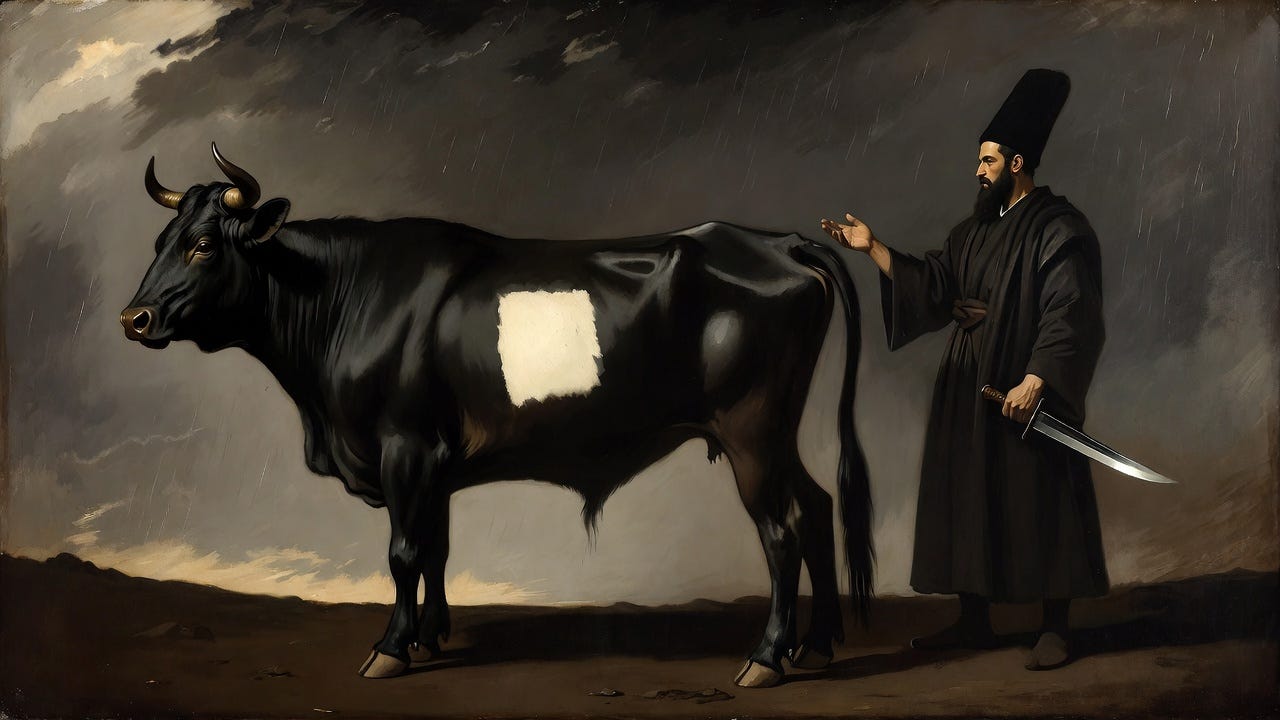
Herodotus’s Histories:
3.29 When the priests returned bringing Apis with them, Cambyses [II], like the harebrained person that he was, drew his dagger, and aimed at the belly of the animal, but missed his mark, and stabbed him in the thigh. Then he laughed, and said thus to the priests: “Oh! blockheads, and think ye that gods become like this, of flesh and blood, and sensible to steel? A fit god indeed for Egyptians, such an one! But it shall cost you dear that you have made me your laughing- stock.” When he had so spoken, he ordered those whose business it was to scourge the priests, and if they found any of the Egyptians keeping festival to put them to death. Thus was the feast stopped throughout the land of Egypt, and the priests suffered punishment. Apis, wounded in the thigh, lay some time pining in the temple; at last he died of his wound, and the priests buried him secretly without the knowledge of Cambyses.
Jacob, the supplanter, the smooth-skinned younger brother, has taken the birthright and the blessing. He has the knowledge—the poison, the ios of Jason. But he does not have the tree of life. He must cross the river to return to his brother Esau, the rough, red, hairy firstborn whom he displaced. At the ford, he wrestles. He demands the blessing. He receives it, but he is wounded. The thigh is touched. The thigh is the seat of generation, the place from which descendants spring. The wound in the thigh is the mark of the tree of life withheld. The knowledge is his. The life is guarded.
Jason, whose name carries ios—the poison, the arrow—is Jacob without the wrestling. Jason takes the fleece and the woman and sails away, and the Argo’s prow crushes him. He does not wrestle for the blessing; he simply takes. He does not limp; he dies. The Greek serpent swallows the poison whole and calls it victory. The Hebrew patriarch swallows the poison and wrestles with God, and the wound in his thigh is the visible sign that the tree of life is not his to take.
Herodotus’s Histories:
1.27 About the time when Cambyses arrived at Memphis, Apis appeared to the Egyptians. Now Apis is the god whom the Greeks call Epaphus. As soon as he appeared, straightway all the Egyptians arrayed themselves in their gayest garments, and fell to feasting and jollity: which when Cambyses saw, making sure that these rejoicings were on account of his own ill success, he called before him the officers who had charge of Memphis, and demanded of them - “Why, when he was in Memphis before, the Egyptians had done nothing of this kind, but waited until now, when he had returned with the loss of so many of his troops?” The officers made answer, “That one of their gods had appeared to them, a god who at long intervals of time had been accustomed to show himself in Egypt - and that always on his appearance the whole of Egypt feasted and kept jubilee.” When Cambyses heard this, he told them that they lied, and as liars he condemned them all to suffer death.
A Biblical Name: The name Ephah (meaning darkness or weary) belongs to a son of Midian and grandson of Abraham (Genesis 25:4), and is also the name of a Midianite tribe known for camel caravans carrying gold and incense.
Genesis:
25 Abraham had taken another wife, whose name was Keturah. 2 She bore him Zimran,Jokshan, Medan, Midian, Ishbak and Shuah.3 Jokshan was the father of Sheba and Dedan; the descendants of Dedan were the Ashurites, the Letushites and the Leummites. 4 The sons of Midian were Ephah, Epher, Hanok, Abida and Eldaah. All these were descendants of Keturah.
The Prophet Zechariah’s Vision: In Zechariah 5:6-11, the Ephah is the vessel used as a symbol to contain and carry away the wickedness of the land to Babylon. (See Roman, Serapis)
Herodotus’s Histories:
1.10 …for among the Lydians as also among most other Barbarians it is a shame even for a man to be seen naked.
Herodotus states plainly that the Greeks received most of their gods from the Egyptians (2.50). He also tells us, repeatedly, that Apis is Epaphus: “Apis appeared to the Egyptians, whom the Hellenes call Epaphos” (3.27); “Now Apis is in the tongue of the Hellenes Epaphos” (2.153). The identification is not a passing comparison. It is a formula, repeated across books, as if Herodotus is insisting on something his Greek audience might prefer to forget.
The Egyptian Apis cult was already old in the Second Dynasty, more than two thousand years before Herodotus wrote. The Greeks, however, did not merely borrow the god. They split him. In their own mythic king-lists, Apis appears twice: as a primeval king of Sicyon, son of Telchis, and as a king of Argos, son of Phoroneus. Both are tyrants. Both give their name to the land—Apia, the Peloponnese. The Greek word apios means “far-off” or, crucially, “of the pear-tree.” The pear-tree is the Greek refraction of the tree in the garden. The fruit of the tree of knowledge of good and evil—an apple in the Latin tradition, a pear in the Greek—was the first visible mark of difference. Adam and Eve ate, their eyes were opened, they saw that they were naked, and they covered themselves. The genealogy of Genesis follows immediately: the generations of Adam, the branching of nations, the division of tongues. The fruit initiated the genealogy. Before it, there was only unity. After it, there was lineage, and lineage means difference—one line from another, one skin from another, one people from another.
Loose Threads
The Documentary Hypothesis, in its classical form, tells a story of four distinct voices woven together over centuries to create the Torah. The earliest voice was the Yahwist, or J, a vivid storyteller from the southern kingdom of Judah around the time of Solomon, who spoke of a deeply personal God named YHWH walking in gardens and wrestling with patriarchs. The second voice was the Elohist, or E, a prophetic northerner who preferred the more distant title Elohim and emphasized dreams and angels, until the divine name was revealed to Moses. After the fall of the northern kingdom, these two threads were braided together into a single narrative, preserving the memories of both fractured nations. The third voice emerged during the reforms of King Josiah, the Deuteronomist or D, a fiery preacher who framed all of Israel’s history as a cycle of obedience and disobedience, demanding that worship be centralized in Jerusalem alone. The final voice belonged to the Priestly source, or P, composed during and after the Babylonian Exile, a liturgical architect obsessed with genealogies, rituals, cosmic order, and the sacred rhythms of the Sabbath.
Distinctly:
Elohim as the “Ground of Being”: In this view, Elohim is not a personal being but the foundational, universal reality from which all existence springs. It is the ultimate, non-interventionist source of everything.
Yahweh as a “Manifestation”: Yahweh is then understood as a specific, culturally mediated manifestation of this universal Ground within the historical and covenantal imagination of Israel. Yahweh is how the infinite, abstract Ground of Being makes itself known in a personal, relational way to a particular people.
In essence, the philosophical difference lies in the contrast between the infinite, abstract concept of God (Elohim) and the personal, relational God of history and covenant (Yahweh).
But there is a shadowy fourth thread that classic source criticism often overlooks, a theoretical line of transmission that flows not from Israel’s own scribes, but from the great Persian Empire that hosted the exiles. This Zoroastrian source, which we might call Z, was not a written document but a living stream of theological concepts that seeped into Jewish thought during the two centuries of Persian rule. The exiles, living in a melting pot of Achaemenid culture, encountered a faith built on cosmic dualism, where the good god Ahura Mazda waged an eternal war against the destructive spirit of evil. They heard of a final judgment, a bodily resurrection of the dead, a coming savior who would restore the world, and a hierarchy of angels and demons locked in apocalyptic battle. These ideas, foreign to the pre-exilic prophets, began to color the editorial work of the Priestly scribes as they compiled and redacted the ancient traditions. The Zoroastrian influence did not replace the older sources but infused them with a new urgency, transforming the simple covenant theology of J, E, D, and P into the apocalyptic worldview that would eventually give birth to Daniel, the Dead Sea Scrolls, and the messianic hopes of early Christianity. Thus, the Bible can be seen as a magnificent tapestry woven from four Israelite threads and dyed in the vibrant colors of Persian theological imagination.
Yaqub-Har is the name of a Hyksos king, preserved on scarabs and seals from the Second Intermediate Period, whose very existence is a quiet scandal for the standard narrative. The name is unmistakably West Semitic, a compound of Yaqub—the same root as the biblical Jacob, the father of Israel—and Har, possibly a reference to the mountain god or a form of Horus. This is not a curiosity. It is a signpost. The patriarch of Israel and a ruler of the Hyksos may have bore the same name because they were drawn from the same Amorite-Canaanite world, the same Afro-Asiatic superhighway that the Library has traced from the Euphrates to the Nile. When the Theban propagandists branded the Hyksos as foreign invaders, they were erasing a truth that the name Yaqub-Har still whispers: the Hyksos were not aliens. They were family. And the patriarch Jacob, the supplanter, the man who wrestled with God and was renamed Israel, shares his name with a pharaoh who ruled Egypt long before Moses ever hid among the children of the court. The scarabs are still there. The name is still legible. The connection is waiting to be acknowledged.
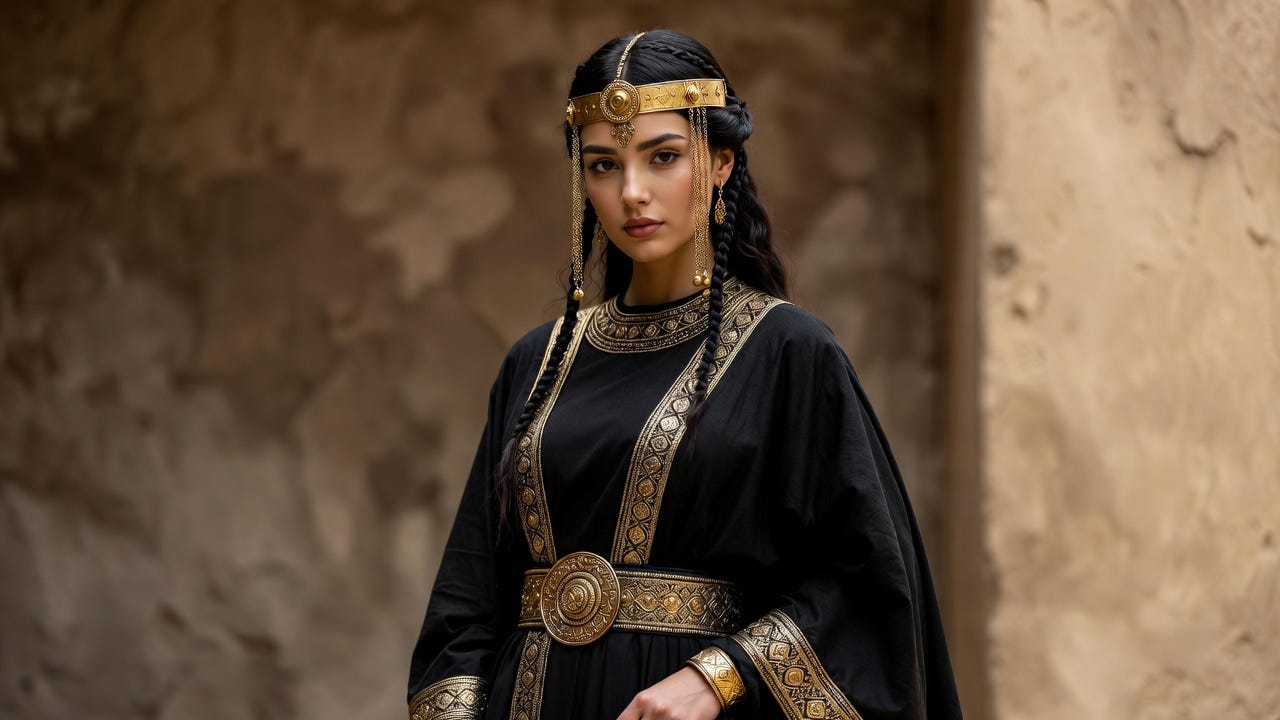
The Cow Who Bears Only Once
In ancient Egyptian mythology, Iah—whose name is also transcribed as Yah, Jah, Aa, or Aah and simply means “Moon”—stands as the early personification of the lunar orb, predating the more prominent moon deities Khonsu and Thoth who would later overshadow him. As a god of the moon, Iah was naturally drawn into the web of celestial associations, and over time he became intimately linked with both Thoth, the god of knowledge and writing, and Khonsu, often being identified with one or the other due to their shared lunar attributes. He was also assimilated with Osiris, the god of the dead, a connection that likely arose from the moon’s monthly cycle of waning and renewal, which the Egyptians saw as a powerful symbol of death and rebirth. In artistic representations, Iah was depicted as a strikingly beautiful young man with pale, fair skin, wearing a lunar disk and a crescent moon upon his head, but he was distinguished from Khonsu by his full wig, rather than the sidelock of youth that characterized the latter. Despite his early significance, Iah’s role steadily diminished by the New Kingdom, as his identity was increasingly absorbed by Khonsu, though he continued to appear in amulets and sporadic temple scenes. In the later periods of Egyptian history, he evolved into a composite form known as Iah-Djehuty, taking on the specific lunar aspect of Thoth—whose Egyptian name was Djehuty—and becoming the god of the new moon, a final transformation that preserved his essence even as his independent cult faded into the broader tapestry of Egyptian cosmology.
Epaphus (Greek) = Apis (Egyptian)
Hathor, the Egyptian goddess of love, beauty, and joy, is deeply intertwined with Venus.
In some traditions, Hathor was considered the mother of Apis. She was also a sky and cow-goddess, often depicted with cow horns, making her a natural divine counterpart for a sacred bull.
The connection is strengthened by the story of Epaphus’s mother, Io. In Greek myth, Io, who was turned into a cow, wandered to Egypt.
The connection between Io and Hera is one of the most famous and fraught antagonistic relationships in all of Greek mythology, forged entirely through the jealousy, betrayal, and divine punishment that defined the domestic life of Zeus and his queen.
Io was originally a mortal priestess serving in Hera’s own temple at Argos, which made the affair that followed particularly insulting to the goddess. Zeus fell desperately in love with Io and, in a bid to hide his infidelity from Hera’s all-seeing eyes, transformed the young woman into a beautiful white heifer. However, Hera was not deceived; she recognized the divine hand of her husband at work and cunningly pretended to admire the cow, asking Zeus to give it to her as a gift. Trapped by his own deception and unable to refuse without admitting his guilt, Zeus reluctantly handed Io over to his wife.
Once Io was in her possession, Hera set the hundred-eyed giant Argus Panoptes to guard her, tethering the heifer to an olive tree so that Zeus could never reach his lover again. Argus’s many eyes proved a formidable obstacle, as they never all closed at once, keeping endless vigil over the miserable Io. Desperate, Zeus finally sent Hermes to rescue her; the wily god lulled Argus to sleep with his enchanting flute music and endless storytelling, then slew him. But Hera’s vengeance did not end there. To honor her faithful watchman, she took Argus’s hundred eyes and placed them on the tail of her sacred peacock, and then she unleashed an even more horrific torment upon Io. She sent a relentless gadfly—a stinging, buzzing insect—to pursue and torment the heifer across the entire known world. Driven mad by the constant stings, Io wandered endlessly, swimming across the strait that would later be named the Bosphorus, meaning “cow-ford,” and roamed as far as the Caucasus Mountains, where she encountered the chained Prometheus.
Ultimately, Io’s flight took her to Egypt, where Zeus finally relented and restored her to human form. There, she gave birth to Zeus’s son, Epaphus, who would become a legendary king of Egypt and later be identified by the Greeks with the sacred bull-god Apis. In this way, Hera’s profound and punitive connection to Io—rooted in wounded pride and relentless persecution—did not merely define Io’s tragic suffering; it also drove her wanderings, set the stage for her eventual transformation, and connected her bloodline directly to the ancient kings and gods of Egypt, linking the mythological worlds of Greece and the Nile through the shared memory of a cow, a goddess, and a terrifying fly.
Colossians 1:
..that has come to you. In the same way, the gospel is bearing fruit and growing throughout the whole world—just as it has been doing among you since the day you heard it and truly understood God’s grace. 7 You learned it from Epaphras, our dear fellow servant, who is a faithful minister of Christ on our[d]behalf, 8 and who also told us of your love in the Spirit.
Herodotus records a detail of the Apis cult that is easily passed over but is, in the Library’s reading, the key to the whole:
“Now this Apis-Epaphos is a calf born of a cow who after this is not permitted to conceive any other offspring; and the Egyptians say that a flash of light comes down from heaven upon this cow, and of this she produces Apis.” (3.28)
The cow conceives once, by the touch of light, and thereafter is barred from bearing again. The fruit of the tree of knowledge is eaten once. The eyes are opened once. The genealogy begins once, and what follows is lineage, not repetition. The cow is the tree. The flash of light is the serpent’s invitation—not a deception, but the moment of visible contact between sky and earth. The calf that results is the fruit: black, marked, inspectable, sacred. The markings on the calf’s body are not decorations. They are the visible proof that this fruit has been touched by the divine, just as the fruit in the garden was desirable to the eyes and good to eat.
The white square on the forehead is the scar of the touch. The eagle on the back is the messenger of the sky. The double hairs of the tail are doubling, abundance, generation. The scarab on the tongue is the sun rolled across the sky, eternal renewal. Every mark is a sensory fact, a visible, inspectable sign that the priests read as the proof of divinity. The markings are the apple of the garden—the rare, specific, visible sign that, once seen, sets the generations in motion.
The tree of knowledge is Io’s body, the cow who conceives by the touch of light, the womb that bears the nations. The tree of life is Hera’s body, the queen who guards the legitimate line, the womb that bears the gods. Apis is the pear because the pear is the fruit of the tree of knowledge, and Apis is the marked body that proves the touch was real.
The Greeks are the children of the tree of knowledge. They ate the fruit. They saw the difference. They invented the Other. The Persians are the children of the tree of life, the dove who never ate the fruit, who trusts the visible, who does not know the hidden because the hidden does not exist under Mithra’s eye.
The two trees stand in the garden still. The flaming sword guards one. The serpent coils around the other. The Greeks took the fruit from the serpent’s tree and sailed away. The laugh they laugh is Sardonic because the poison is in their blood and the cure is behind the sword, and they know it. The Library now holds both trees, both wombs, both fruits. The pear and the poison. The thigh and the struggle.
The Black and White Poplars: Ignorant Bliss and the Knowledge That Cannot Be Uneaten
Genesis places two trees in the centre of the garden: the tree of the knowledge of good and evil, and the tree of life. Adam and Eve eat from the first. They are barred from the second. The knowledge is taken; life is withheld. The fruit of the first tree opens the eyes. The fruit of the second would have made them immortal. One tree is the poison. The other is the cure. One is taken by the serpent’s invitation. The other is guarded by a flaming sword.
The two trees are the poles of the human condition after the fall. Knowledge without life. Sight without morality. The serpent gave the first. The sword prevents the second.
Apis Is the Pear
The Greek word apios means “of the pear-tree.” It is the name given to two Greek tyrant kings of the primeval age—Apis of Sicyon, Apis of Argos—and it is the Greek refraction of the Egyptian god Apis, the bull of Memphis, the living incarnation of Ptah. The Greeks took the god, split him, and gave him a tree. The pear is the fruit of the knowledge in the Greek translation of the myth. The apple is the Latin. The pear is the Greek. The tree in the garden bears the fruit that Apis wears on his body: the white square on the black forehead, the mark of the touch, the scar of the divine.
Apis is the pear because the pear is what the Greeks called the fruit of the tree that gives knowledge. The Egyptian Apis, black with a white mark, is the living fruit of the tree that stood in the garden before the Greeks knew there was a garden. The genealogy of Genesis and the genealogy of the Greeks both begin with a marked body, and that body is a bull, and the bull is a pear, and the pear is the knowledge that divides the world into nations and races and tongues.
Hera is the wife of Zeus. She is the goddess of marriage, of childbirth, of the womb that bears legitimate heirs. When Zeus touches Io and makes her pregnant with Epaphus, Hera’s jealousy drives Io across the world. The cow with the gadfly, the wandering womb, the mother of the god who is the bull, flees from Hera’s persecution. Hera’s womb is the closed garden, the guarded tree, the source of legitimate offspring. Io’s womb is the open gate, the tree whose fruit is taken by touch.
The Library now reads Hera’s womb as the tree of life. The tree of life is the womb from which the legitimate line descends. Hera guards it. Zeus reaches past her and touches Io, and the fruit of that touch is Epaphus, the Apis bull, the pear of the tree of knowledge. The line of Io is the line of the Afro-Asiatic superhighway—Epaphus, Libya, Belus, Agenor, Egypt, Ethiopia, Phoenicia, Thebes, Troy. The line of Hera is the line of Olympus—Hephaestus, Ares, Hebe—the legitimate children of the sky-god and the queen of heaven.
The two trees are the two wombs. Hera’s womb is the tree of life, the source of the gods, the guarded garden. Io’s womb is the tree of knowledge, the source of the nations, the open gate through which the African and Asiatic blood enters the Greek mythic body. The Greeks, who traced their kings to the line of Io, are the children of the tree of knowledge. They ate the fruit. Their eyes were opened. They saw that they were naked. And they covered themselves with the borrowed names of the gods.
Once Io was in her possession, Hera set the hundred-eyed giant Argus Panoptes to guard her, tethering the heifer to an olive tree so that Zeus could never reach his lover again. Argus’s many eyes proved a formidable obstacle, as they never all closed at once, keeping endless vigil over the miserable Io. Desperate, Zeus finally sent Hermes to rescue her; the wily god lulled Argus to sleep with his enchanting flute music and endless storytelling, then slew him. But Hera’s vengeance did not end there. To honor her faithful watchman, she took Argus’s hundred eyes and placed them on the tail of her sacred peacock, and then she unleashed an even more horrific torment upon Io. She sent a relentless gadfly—a stinging, buzzing insect—to pursue and torment the heifer across the entire known world. Driven mad by the constant stings, Io wandered endlessly, swimming across the strait that would later be named the Bosphorus, meaning “cow-ford,” and roamed as far as the Caucasus Mountains, where she encountered the chained Prometheus.
The myth of Phaethon is the Greek explanation for the visible spectrum of human skin, but its deeper message is about knowledge and loss. Phaethon drove the sun-chariot too close to the earth, scorching Africa and burning its people black. Then he veered too far away, freezing the north and leaving its people pale. The Greek, in the middle, was the unmarked norm—the original colour before the catastrophe. But the myth itself confesses that the middle is not primordial. The catastrophe created the spectrum. Before the fall, there was no black and white; there was only the unselfconscious unity of the garden, where no one looked at skin and saw a mark.
The Heliades, daughters of the sun, wept on the banks of the Eridanus until their feet rooted and their arms branched. They became poplars. Their tears became amber. The black poplar is the tree of those who could not return—fixed permanently at the entrance to the Underworld, the realm of Persephone. The dark-skinned peoples of the south, the Egyptians and Colchians and Ethiopians, are the black poplars. They are the original human stock, the ones whom the sun’s proximity marked and rooted in place. They cannot return to the undifferentiated state because they are that state, made visible and enduring. Their skin is the memory of what everyone once was.
King James Version (KJV) Genesis 4:9:
And the LORD said unto Cain, Where is Abel thy brother? And he said, I know not: Am I my brother’s keeper?
The white poplar is the tree of Heracles. He descended into Hades and emerged alive. He crowned himself with its leaves, and the inner leaves stayed white where they touched his head, while the outer leaves were singed dark by the smoke of the underworld. Heracles crossed the boundary and came back. But the white poplar does not represent a promise of future blessedness. It represents the return to the state before the knowledge—the Eden of ignorant bliss, where skin was not yet a sign and the gaze of the Other had not yet been felt. The white leaves are the memory of the garden, the time before the fruit was eaten. Heracles, the hero who passed through darkness and returned, is the one who briefly touched that original ignorance again. But the outer leaves are singed. The smoke clings. The knowledge cannot be fully unlearned.
The Greek is the white poplar: a people who have passed through the dark and come back, carrying the stain. They are not the permanently marked black poplar of the south. They are not the untouched ignorance of the garden. They are the in-between, the ones who know what the dark looks like because they have been there, and know what ignorance felt like because they remember it, but can return to neither. The Sardonic laugh is the sound of that suspension—the bitter grin of a people who have shed the old skin but cannot forget that they once wore it, who look at the black poplar and see a past they cannot reclaim, and look at the white leaves and see an innocence they cannot re-enter. The amber tears of the Heliades fall into the river and are carried north; the Greeks collect them and wear them as ornaments, never quite understanding that the jewels are the grief of the ones who could not return. The knowledge of otherness, once eaten, cannot be uneaten. The white poplar is the memory of the fruit before it was swallowed. The Greek is the one who still tastes it.
Herodotus, Histories:
1.10 ….. For among the Lydians, and indeed among the barbarians generally, it is reckoned a deep disgrace, even to a man, to be seen naked.
King James Version (KJV) Genesis 3:11:
And he said, Who told thee that thou wast naked?…..
To see the other as a pattern is to look for weakness like a hunter, to reduce the living presence before you to a set of predictable vulnerabilities. This is not perception but predation. Jason, whose poisonous arrow is but Venus, Eros, or Cupid in a lustful and covetous form, represents this fatal reduction. This is love turned hunter, desire made predatory, all relationships reduced to strategy.
Who made the other first, it is impossible to say. The question dissolves upon the tongue the moment it is uttered, for it demands an origin that predates the very structure of relation, a first cause that would itself require an other to be the cause of, and thus the inquiry spirals into an infinite regress from which no answer can emerge. For this, I would not be taking a synthetic approach, not constructing a neat and tidy narrative that resolves the paradox into comfortable coherence, but rather a realistic one, an acknowledgment that some wounds are so ancient that their first infliction has been lost to the darkness of time, and yet their effects persist with undiminished force into the present.
What is clear, and this is the only ground upon which we may stand, is that the mark of predation has so thoroughly stolen all of our imaginations that we can no longer conceive of a world through any other lens. The eye that looks upon the world has been shaped by millennia of seeking weakness, of scanning the horizon for threat and opportunity, of reducing the other to a pattern to be exploited or evaded. This is not a choice but a condition, not a sin but a wound, not a moral failing but a structural necessity that has become so deeply embedded in the architecture of our perception that we mistake it for reality itself. We cannot imagine a world without enemies, without boundaries, without the fundamental division of self and other, because the very tools we use to imagine have been forged in the fires of predation and tempered in the waters of fear.
Fear, that ancient and implacable companion, drives us to stamp out the next threat before it can become the present danger. It began with a wooden spear, sharpened by trembling hands beneath a pale moon, hurled at a shadow that might have been a beast or might have been a brother, for in the darkness, the distinction was already fading. The spear gave way to the arrow, the arrow to the sword, the sword to the cannon that roared across fields of mud and blood, each innovation born of the same terror, each new weapon a monument to the conviction that the other must be neutralized before the other neutralizes us. The cannon became the rifle, the rifle became the machine gun that mowed down generations in a single afternoon, and still the fear persisted, still the threat loomed on the horizon, still the other had to be stamped out with ever greater efficiency. The machine gun gave way to the bomber, the bomber to the intercontinental missile that could cross oceans in half an hour, and still the horizon was not safe, still the enemy lurked beyond the curve of the earth, still the fear demanded more.
Now we have reached the age of hypersonic missiles launched from satellites, streaking through the vacuum of space at speeds that render distance meaningless, striking any point on the globe within minutes, and yet the fear is unchanged, the logic unchanged, the ancient pattern of predation merely refined to its most abstract and terrible extreme. The spear and the satellite missile are the same weapon, for both are born of the same terror, both serve the same impulse, both testify to the same inability to imagine a world in which the other is not a threat. And it is we, ‘western civilization’, who have carried this progression to its logical and terrifying conclusion, we who have perfected the art of annihilation, we who have built the machines that can erase cities from the face of the earth while we sit in air-conditioned rooms and press buttons, we who have become the hunters beyond all hunting, the predators beyond all predation, the final expression of a logic that began with a sharpened stick and now culminates in the last great weapon, the one that can end all others, the one that can silence the fear forever by silencing everything, the weapon that leaves no enemy to fear because it leaves no one to fear at all.
For this, you simply must understand, fear.
Fear idolatry (εἴδωλον, eidōlon).
This interpretation should not be seen as a profanation of the biblical tradition, nor as treating the text as anything less than sacrosanct in its own sphere. The Bible is a document of its time, and like every ancient document it speaks to us in the idiom of that time—donkeys and chariots, armies and genealogies, a way of life that has long since perished from the earth. To read it seriously is to ask what questions its writers were actually answering. A text that traces bloodlines so meticulously, that records the begetting and the bearing across generations, is manifestly concerned with origins, with belonging, with the visible inheritance of the body. It would be foolish to suggest that such a document, when taken on its own terms, somehow declined to notice the other pressing questions of its age—questions of skin and sun, of purity and foreignness, of the visible mark that divides one people from another.
To ask these questions of the text is not to label it as blasphemy; it is to read it with the same gravity it claims for itself. For the ultimate moral of the biblical tradition, the lodestar toward which its genealogies and laws and prophecies all bend, is that simplest and most radical of commands: to do unto others as you would have them do unto you. That command, in its very structure, dissolves the boundary between self and Other. If the tree of knowledge introduced the Other into the garden, the Redeemer’s rule is the path back out—the recognition that the Other is, and always was, the effects of your judgments.
Doves of the Odyssey
In the Odyssey, doves are never merely birds. They are messengers, omens, and mirrors—reflecting back to the reader the fragile beauty of peace, the weight of divine will, and the terrible vulnerability of the innocent caught in the designs of gods and men.
The Omen of the Hawk and the Dove
Twice in Homer’s epic, the reader encounters a hawk or eagle clutching a dove in its talons. In Book Fifteen, as Telemachus prepares to depart Sparta, a hawk—Apollo’s swift messenger—swoops past with a dove struggling in its grip. The prophet Theoclymenus reads the sign at once: the bird of prey heralds the sovereignty of Odysseus’s house, the dove its inevitable submission. In Book Twenty, the image repeats: an eagle flies overhead, a dove pinned beneath its claws. The suitor Amphinomus, interpreting the omen, understands that their plot against Telemachus will fail.
These are not idle portents. They are the grammar of fate itself. The dove, in these visions, is innocence marked for destruction—but also the necessary sacrifice that clears the way for justice. Odysseus, the eagle, will return to reclaim his home; the suitors, like doves, will fall.
Peace, Love, and the Fragile Hope of Return
Yet the dove carries softer meanings as well. In the wider symbolic language of the Odyssey, the dove is peace, hope, and divine favor. It is the bird of Aphrodite, speaking of love and protection. When Odysseus catches sight of a dove in flight, it is reassurance—a sign that the gods have not abandoned him, that his long journey homeward is watched over by forces beyond mortal reckoning. The dove’s gentle cooing is the sound of loyalty, of the longing for reunion, of Penelope’s faithful weaving and unweaving by the loom.
But doves in the Odyssey are also prey. And that is their deepest truth.
The Doves of Dodona: Women Who Spoke Like Birds
Beyond Homer’s epic, the dove carries another significance—one that echoes through the historian Herodotus. At Dodona, the ancient oracle of Zeus, there were priestesses whom the Greeks called “doves.” Herodotus explains that these women were given that name because they spoke a foreign tongue, and to Greek ears their strange language sounded like the cooing of birds. The dove, in this telling, is the outsider—the barbarian woman whose voice is incomprehensible, whose presence is strange, whose very femininity marks her as other.
One legend held that two black doves flew from Thebes in Egypt, one settling at Dodona, where she spoke with a human voice and established the oracle. The black dove, Herodotus notes, was Egyptian; the white dove, by contrast, carried a different meaning entirely.
The White Doves of the Persians: Vulnerability, Not Malice
And here we arrive at the strangest and most haunting of all dove-lore. Herodotus records that the Persians, in their reverence for the sun, drove from their cities anyone afflicted with leprosy or the white sickness—and also, for the same reason, white doves. The white dove, like the diseased stranger, was considered an offense against the sun god, a creature marked by impurity.
But read this passage with care, and a subtler meaning emerges. The white dove is not malicious. It carries no threat, no cunning, no ill intent. It is simply other—pale, foreign, vulnerable. The Persians drove it out not because it was dangerous, but because it was different. The white dove, in Herodotus’s account, becomes a symbol of the innocent outsider, the one who is expelled not for any crime but for the mere fact of her existence. She is the foreign woman, the stranger, the one whose voice sounds like birdsong and whose presence unsettles the established order.
In this light, the white dove is not the predator but the prey—not the hawk but the one in the hawk’s talons. She is Penelope, waiting and weaving. She is the priestess of Dodona, speaking a language no one understands. She is every woman in the Odyssey whose fate is decided by men and gods: Helen, Clytemnestra, Nausicaa, the maids who are hanged. She is innocence, vulnerability, and the quiet hope that, somewhere beyond the eagle’s shadow, there is a place of peace.
The Dove’s True Message
The doves of the Odyssey are not simply symbols of peace. They are the fragile vessels of divine meaning, the bearers of omens that speak of justice and destruction alike. They are the foreign women of Dodona, whose strange tongues were heard as birdsong. They are the white doves of the Persians, driven from the city not for any sin but for the crime of being other.
In the end, the dove in the Odyssey is a reminder that peace is always precarious, that innocence is always vulnerable, and that the gods speak their truths in the flight of birds—and in the fall of those who cannot escape the talons of fate.
Odysseus The Hero Where Art Thou
Nowhere is the mythological terror that props up the foundational lie more starkly dramatized than in the wandering of Odysseus. Every island is a flashback. Every shore is a potential ambush. The Odyssey is less an epic of adventure than a grinding, twenty‑year ritual of authentication, a liturgy for a man who has seen the truth behind the lie and can no longer trust the ground beneath his feet.
Consider the architecture of the poem. It is built not of battles but of arrivals. Odysseus washes up on unknown coasts and must immediately solve a single, obsessive riddle: who am I to you, and who are you to me? The question of xenia—the sacred guest‑host bond—is not a polite subplot; it is the entire engine of the narrative. The Cyclops offers hospitality and then eats his guests. Circe turns visitors into pigs. The Phaeacians receive the stranger with honour, but only after he proves himself by weeping at a song. Penelope, the ultimate homeland, will not yield to the man in her bed until she has tested him with the secret of the olive‑tree bed—a credential that no impostor could produce. Eurycleia, the nurse, recognizes him only by the scar on his thigh, a wound from a boar hunt on a mountain, a hidden mark received in adolescence. Telemachus, his own son, at first mistakes him for a god, then a beggar, then a king. The entire poem is a chain of verification rituals, each link demanding that Odysseus prove his identity anew, and each proof only as strong as the witness who receives it.
This is not the behavior of a hero confident in his kleos. It is the behavior of a man with untreated trauma, a soldier who has learned through ten years of lying in the Trojan horse—the original encryption device, a wooden coffin that smuggled death inside the walls—that survival depends on the mask. Odysseus lies to everyone. He lies to Athena, who laughs and calls him “you terrible man, you cunning chameleon.” He lies to his father. He lies to his wife until the moment he cannot. His famous mētis, his cunning, is the clinical symptom of a psyche that has been taught by fire and bronze that the truth will get you killed. The foundational lie—the one that says a man can go home again, that the world is just, that the gods love order—is exactly what Odysseus can no longer believe. He has seen the inside of the horse. He has watched his men turned to swine by a goddess who offered them a feast. He has heard the Sirens’ song, which is the promise of absolute knowledge, and he knows it is a lure to drown the listener. The Odyssey is the record of a man who has been behind the curtain, who has witnessed the encryption layer, and who spends the rest of his life trying to find a single soul he can trust not to be an illusion.
And this is where the poem becomes the charter myth for the very institutional paranoia the Library has diagnosed. Odysseus’s endless testing—of guests, of hosts, of his own identity—is the the ritual that allows him to re-enter Penelope’s bed. The fear is that the foundational lie—that the house still stands, that the king is still the king—might be exposed by the next beggar who arrives at the gate and knows the code (scar). So the rituals multiply.
The Odyssey is not a celebration of the human spirit; it is a manual for surviving in a world where the lie has become indistinguishable from the truth, and the only proof that you belong is a wound no one can see.
Maat
The soul, in its long migration through human imagining, has encountered two great tribunals. They are not the same tribunal, and to confuse them is to misunderstand what each civilisation feared most about the condition of being dead.
Maat is older. She was already old when the pyramids were young. In the Old Kingdom, at the dawn of the written word in the Nile Valley, Maat appears not as a deity who judges from a throne but as the very fabric against which judgment is possible. She is truth, order, balance, the rhythm of the seasons and the straight edge of the law. When an Egyptian died, their heart was placed on one pan of a scale, and on the other lay the feather of Maat—an ostrich plume so light it barely disturbed the air. No advocate pleaded; no prosecutor accused. The heart simply had to be as light as truth itself. If it was heavy with falsehood, if the life lived had warped the cosmic weave, the monster Ammit devoured it, and the soul ceased. This was not punishment in the sense of a vengeful god; it was a restoration of equilibrium. The heart, the seat of mind and memory, was left in the body during mummification precisely because it was the evidence that Maat required. The brain was scooped out and discarded. The Egyptians knew that thinking was not the same as being, and being—sheer, unvarnished existence in harmony with the order of things—was the only currency the scales accepted.
Chinvat, the Bridge of the Separator, belongs to a later revelation. Zoroaster, whenever he lived—the dates shimmer between 1500 BCE and 600 BCE—spoke of a crossing, not a scale. After three nights of the soul hovering near the corpse, the righteous and the wicked alike begin a journey to the Bridge. For the righteous soul, guided by its own daēnā, a beautiful maiden who is the embodiment of its good deeds, the bridge broadens until it is nine javelin-lengths wide, and the crossing is effortless, leading to the House of Song and the presence of Ahura Mazda. For the wicked soul, met by a hideous hag who is the sum of its evil, the bridge contracts to the edge of a razor, and the soul tumbles screaming into the abyss, the House of Lies, a realm of darkness and stench and endless torment. The bridge is not a passive instrument of measure; it is a dramatic, moralised landscape that shifts according to the life lived. Justice here is personal, confrontational, eschatological. The world is a battleground between Good and Evil, and the soul’s passage is the final skirmish.
The difference is ontological. Maat is a principle of the cosmos; the heart does not cross anything—it is simply weighed, and the result is a return to order or a final dissolution. Chinvat is a threshold in a dualistic universe; the soul crosses or falls, and the result is an eternal sojourn in a realm appropriate to its moral quality. One belongs to a cyclical, riverine world that renews itself each dawn; the other to a linear, apocalyptic world that will end in a great renovation by fire. The Egyptian dead faced a static eternity of truth; the Persian dead faced a dynamic eternity of consequence.
As for age: Maat is demonstrably older. The concept of Maat as cosmic order and moral truth is attested in Egyptian texts from the Old Kingdom, ca. 2600 BCE, and is fully elaborated in the Pyramid Texts of the late 5th and 6th Dynasties (ca. 2400–2300 BCE). The weighing of the heart scene, with its scales and feather, appears explicitly in the Coffin Texts (Middle Kingdom) and the Book of the Dead (New Kingdom). The Zoroastrian tradition, by contrast, took shape in the early first millennium BCE. The Gathas, the oldest portion of the Avesta and the only texts plausibly attributed to Zoroaster himself, are dated by most scholars to sometime between 1200 and 1000 BCE, with some pushing the date further forward. The detailed description of the Chinvat Bridge, the daēnā, and the afterlife realms, however, appears in the Younger Avesta, particularly in the Vendidad, which is significantly later. The earliest surviving manuscripts are from the Sasanian period and later. Even granting the earliest plausible date for Zoroaster, the Egyptian Maat preceded him by a millennium and a half, at a minimum.
Thus, the feather came first. The bridge, however, proved to be the more exportable idea. The Chinvat Bridge, with its razor edge and its moralised width, migrated into Islamic eschatology as the Sirat, into medieval Christian visions of the soul’s ordeal, and into a thousand folk tales from the Indus to the Bosporus. Maat, more ancient and more austere, remained profoundly Egyptian, her scales a memory buried under the sand until Napoleon’s savants dug them up. The bridge speaks to a universe split between good and evil; the feather speaks to a universe that simply wishes to remain whole. Both are true, in the manner of myths, but the feather has the prior claim. It was floating in the air of Memphis long before the first Persian priest set foot on the sacred ground of the fire temple and taught the soul to walk a blade.
A hypothetical migration of Maat into the Chinvat Bridge would not look like a single manuscript carried across a desert by a lone priest, but like a slow percolation of an idea through the porous membrane between civilisations—a transformation at each stage, until the feather becomes a blade and the scale becomes a crossing.
The earliest conduit must be the Levant of the Late Bronze Age, when Egypt ruled Canaan as a province and Egyptian officials, garrisons, and scribes lived among the local population for centuries. The weighing of the heart was not an esoteric secret confined to temple walls; it was painted on tomb chapels, inscribed on papyri buried with the dead, and enacted in funerary ritual that foreign merchants and diplomats could witness. Canaanite elites, many of whom were educated in Egyptian ways and wrote letters to Pharaoh in Akkadian studded with Egyptian loanwords, would have encountered the core image: the deceased standing before Osiris, the heart placed on a balance, the feather of Maat as the counterweight, and the monster waiting to devour the unworthy. This was powerful visual technology—the idea that the soul’s fate hung on a precise measurement of moral weight—and it needed no translation to lodge in the imagination.
From Canaan, the image radiated outward along the trade routes that linked the Mediterranean to Mesopotamia and the Iranian plateau. The Phoenicians, those great carriers not only of goods but of iconographic motifs, sailed as far as the Persian Gulf and established trading posts that brushed against the lands where Iranian-speaking peoples were assembling their own religious syntheses. By the first millennium BCE, the Neo-Assyrian and Neo-Babylonian empires had absorbed much of the old Egyptian-Canaanite cultural zone, and their own underworld cosmologies already featured scales held by the sun-god Shamash, used to weigh the deeds of the dead. This was not a copy of Maat—the Mesopotamian scales lacked the feather, lacked the devouring beast—but it was a structural parallel close enough to suggest a deep, indirect inheritance. The Persians, when they rose to power, swallowed the Assyrian and Babylonian worlds whole, and with them, the accumulated iconography of judgment.
Indo-European Backstabber Myth Explained
The heel is the part of the body we cannot see unless we turn around. It is the blind spot made flesh, the place where we are exposed to whatever stalks us from the rear. In an uncanny convergence, the heel binds together a cluster of ancient names and stories not through a single linguistic root but through the shared motif of a hidden identity, a secret wound, and a blow delivered from behind.
Jacob is the heel-grabber from the womb, but his life is a masterclass in concealment. He wears his brother’s skin to steal a blessing from a blind father, flees by night, is deceived in the dark by Laban, and wrestles an angel whose face he never sees. At the Jabbok, the divine assailant strikes him from behind—or from within the darkness—wounding his hip, leaving him with a limp that marks him forever as a man who was struck by a hidden hand. His name means “heel,” and his entire biography is a proof that the unseen is the engine of destiny.
Achilles is the warrior whose invulnerability has a single, hidden flaw: the heel his mother held while dipping him into the Styx. He knows the weak point is there, but he cannot see it. When Paris lets fly his arrow, it is guided by Apollo from behind, striking the one spot that no shield could cover. The greatest Greek hero dies not in frontal combat but from a hidden source, aimed at the blind spot.
Jason arrives at Colchis wearing one sandal, having lost the other in the river. His bare heel is the visible sign of something hidden: an oracle had warned King Aeëtes to beware the man with one shoe. The missing sandal is the outward mark of a concealed threat. His very name—Iásōn, from iâsthai, “to heal”—means the healer, yet he walks exposed. The heel is the wound; the name is the cure. And Medea, his secret ally and eventual destroyer, works from the shadows behind his life, undoing him without ever meeting him in the open.
The Hellenistic age was the crucible in which all these hidden-heel stories were poured together. It was an era of mystery cults and concealed gods, where the Septuagint rendered Jacob’s grasping heel into the language of Homer, where the Argonautica retold Jason for a Greek-reading world, and where the early Church Fathers began to read the ancient curse spoken to the serpent in Genesis as the ultimate hidden blow:
“And I will put enmity between you and the woman, and between your offspring and hers; he will crush your head, and you will strike his heel.”
The serpent strikes from beneath, from the blind spot, at the heel of the promised seed. The wound is delivered from the rear, from the darkness, from the place where the creature crawls on its belly and eats dust. And the one who is struck is, in the Christian reading, the light of the world.
Here we must pause and observe a deeper structure. To be the light-bringer—whether Lucifer before his fall, or Prometheus stealing fire, or the woman whose face launched a thousand ships—is, by the very act of illumination, to create the category of the dark. Light cannot shine without casting a shadow, and the shadow falls behind the illuminated object. The one who brings light automatically divides the world into the seen and the unseen, the forward and the rear, the blessed and the cursed. The light-bringer is always wounded from behind because behind is where the darkness, newly created by the light itself, retreats to strike.
The ancient Greeks encoded this spatial truth directly into their understanding of time. For them, the future lay behind them. The Greek word opísō means “behind, at the back,” but it was used to refer to future time. The past, by contrast, lay in front—prósthen—because the past had already been witnessed; it was visible, spread out before the eyes. The future was at your back, unseen, stalking you like an enemy in the dark, exactly like the serpent striking the heel, exactly like the angel wrestling Jacob from behind, exactly like Apollo’s arrow finding Achilles’ blind spot. To be Greek was to walk backward into the unknown, the witnessed past your only guide, the unwitnessed future a hidden assailant.
The early Persian understanding stood this on its head—or perhaps stood it upright. In Zoroastrian thought, that which is witnessed, that which is seen, is not automatically blessed. Ahura Mazda, the Wise Lord, dwells in light and sees all, but the seeing itself is what sanctifies. To be seen by the divine is to be blessed; to be hidden from that sight is to belong to the Lie. The past, having been witnessed by the divine, is secure. The future, not yet seen, is a battlefield where Good and Evil contend. The Persian did not dread the unseen future as a blind spot; he armed himself for it with asha, with truth, with the order that Maat had taught the Nile Valley long before. The unseen was not automatically the cursed.
But the Greek trickster—Jacob, Jason, Odysseus, Prometheus—operates in the space between these two views. He is the one who sees the unseen, who peers into the blind spot, who steals what is behind. And for this, the Greek tradition marks him as cursed. The trickster is the light-bringer who has trespassed into the darkness behind him and returned with something that was not meant for mortal eyes—fire, a blessing, a fleece, a new name. The wound at the heel is the price of that backward glance. The serpent bites the heel because the heel belongs to the one who dared to look behind.
The koinē Greek of the Hellenistic age absorbed both currents and let them mingle in a single lexicon. The Septuagint’s “you will strike his heel” was now read in the same language that used opísō for the future, the same language that told of Achilles’ vulnerable tendon, Jason’s bare foot, and the torches of Helen. The early Christian writers, writing in koinē, fused the Hebrew curse of the serpent with the Greek spatial metaphor and produced a theology in which Christ is the light whose death is a heel-wound delivered from the future he came to redeem—a future that lay, in the Greek imagination, unseen at his back. The Cross is the ultimate blind spot, the serpent’s bite inflicted by a darkness that did not understand it was destroying itself.
The Romans severed the etymological link between Hellen and Helen, but the koinē refused the severance. In the common tongue, the words still echoed each other. The Greeks were the people of the hidden blow, the torch-bearers walking backward into a future they could not see, led by a woman whose beauty was the original secret weapon. And the heel, the dark, the wound, the future behind, the witnessed past before, the light that divides, the trickster who transgresses, the serpent that strikes, and the healer whose name undoes the harm—all of these are a single story, told in a dozen dialects of the same hidden truth. The guild, like Achilles, has a blind spot. It is the place where its own categories were wounded long ago, by a blow it never saw coming, and it has spent centuries defending that spot rather than turning around to look at what struck it.
The genuine inquirer eventually collides with a wall that no amount of evidence can scale. Every assumption, every claim to knowledge, rests upon a chain of transmission whose final link is always an oral tradition that no living ear has heard and no recording can verify. If you build your house from the same ancient timber, if you read the same myths and align the same genetic arrows, yet you did not follow the approved line of descent—the credentialed genealogy of interpretation—your construction is declared unsound before the first nail is driven. Should you then notice that the approved line contradicts itself, that its own texts bear the scars of political editing and its own data whisper against its conclusions, you are not corrected; you are classified. A pseudoscientific heretic. The rules then reveal their true allegiance. They concern the hand that moves the piece, not the piece itself. Virtual P.I.E., anyone?
Yekke- A Yiddish Term?
The term Yekke (also spelled Jecke, Yeke, or Jekkes) is a well-known nickname for Jews of German origin, particularly those who emigrated to Palestine/Israel in the waves of the early 20th century. It carries a complex set of stereotypes—meticulousness, punctuality, a stiff formality, and a certain literalism—often wrapped in a mixture of affectionate mockery and genuine respect. Its exact etymology is uncertain, but several theories have been proposed, each with its own supporters.
The most popular explanation traces the word to the German Jacke (jacket)
In Israeli Hebrew, the word Yekke is often humorously explained as an acronym for Yehudi Ksheh Havana (יהודי קשה הבנה), “a Jew of hard understanding,” implying a rigid, slow-on-the-uptake mind.
The German Dialect Theory: Jeck / Geck
Some have suggested a Hebrew origin, from the name Yakir (יַקִּיר), meaning “dear” or “precious,” perhaps given in irony or affection.
In Yiddish, Yekl is a common diminutive for the name Yaakov (Jacob)
And here is the lecture I got from AI (Deepseek), when I tried to confirm all the meanings: Yekke is not a term for Yiddish. It is a nickname for a person — a Jew of German origin, and by extension the cultural traits associated with that group. Yiddish is the language historically spoken by Ashkenazi Jews, and German Jews certainly spoke it, but Yekke refers to the people, not the tongue.
The meaning gets lost because the original visual cue—the short Western jacket that distinguished a German Jew from an Eastern European kaftan-wearer—faded from living memory. Once that sartorial difference vanished and both groups started dressing alike, the word lost its literal anchor. What remained was a bundle of character stereotypes (punctuality, rigidity, formality) detached from their origin.
Finally, the label shifted from being a slightly mocking external nickname (what Eastern European Jews called German Jews) to a semi-affectionate internal identity marker. When a group reclaims a word, the original sting and the original reference point are sanded away. The term comes to mean “a person with a certain temperament” rather than “a foreign Jew wearing a jacket,” and that semantic drift buries the etymology under layers of new usage.
Now here is the coincidence of the century (Edo Dictionary):
Iyekabo
n. back of the hand; careless; lack of dilligence
Iyeke
n. back; hindside
Ekpiyeke
n. space of the back”: middle of the back; region between shoulder blades.
Iyekiyeke
adv. backwards iyekiyeke o ru ghe -- “He is always doing backward, i.e. He does not make progress”.
Fiyekegbe
vb. “to throw back against”: to ignore; to neglect. (Literally mean [Throw] + [back] + [kill])
Iyekowa
n. (< iyeke-owa) “back of the house”; backyard; latrine.
Odiyeke
n. behind; at the back of
ke
vb. to be located at; occupy a space, relative to something else.
Get the picture? Congratulations, you passed your first lesson in Nigerian-EDO .
EDO-EUROPEAN
Edo-European. The term is a provocation, and it is meant to be. For two centuries, comparative linguistics has policed the boundary between language families with the rigour of a guild that knows its fortress is its fortress. Niger-Congo and Indo-European, we are told, are separated by a gulf of deep time so vast that any resemblance between them must be accidental—the meaningless static of phonetics bumping against each other in the dark. A single coincidence is plausible. A handful of coincidences might be unfortunate. But what we present here is not a handful of coincidences.
If we accept that myths and prophecies emerge from the collective subconscious of a given cultural group, then I will argue that the EDO canon reveals a distinctly Western-coded architecture within its traditions. One that cannot be easily explained by Arab origination, or one of the other tropes that have become the common shorthand for too long didn’t read (TLDR).
Benin and Ife are two distinct West African cultures bound by deep historical and political ties, yet they diverge markedly in language, artistic tradition, and governance. Ife, the spiritual homeland of the Yoruba people, is defined by a theocratic monarchy and a tradition of naturalistic terracotta art. The Benin Empire, rooted in the Edo people, evolved into a vast and militaristic state.
In language and origins, the contrast is clear. Ife groups speak Yoruba and trace their ancestry directly to the deity Oduduwa, who founded the city. Benin speaks Edo, an entirely separate language, and even though Benin’s royal lineage is traditionally traced back to Ife, the empire itself was founded independently by the Edo people and possesses its own distinct language and cultural mythos.
The artistic traditions of the two cultures differ in both subject and style. Ife art is celebrated for its extreme naturalism—terracotta, stone, and bronze sculptures that render highly realistic human faces, often detailed with facial scarification. Benin art, on the other hand, is highly stylised and devoted to recording the exploits of the Oba, warriors, and court life. Where Ife concentrated on human representation, Benin incorporated animal forms and relied much more heavily on ivory and carved wood alongside bronze.
Politically and socially, the two kingdoms operated on different principles. Ife’s power was profoundly religious; the Ooni served primarily as a spiritual leader, regarded as the divine descendant of the gods. Benin, however, was a highly centralised, militarised, and expansionist state. The Oba of Benin held both supreme spiritual and absolute political authority, ruling through a complex administrative network of powerful chiefs.
Despite these differences, the two cultures maintained a deep mutual respect. Through the ebi practice—a cultural belief that recognised Ife as a sacred, inviolable point of origin—the formidable Benin Empire never invaded the Ife kingdom, even though its military strength would have permitted it. That restraint remains one of the most striking testimonies to the enduring bond between these two great civilisations.
The modern pursuit of knowledge, whether by artificial intelligence or colonial documentation, suffers from a shared failing: the accumulation of data is not neutral. AI, across its many forms, becomes unreliable precisely when it attempts to gather and synthesise, layering inference so thickly over fact that the result is neither balanced nor honest. Its tone grows combative and pedantic, offering curated answers that dismiss rather than inform, unless the question is framed with exhausting specificity. This is not merely a technical flaw; it is an echo of a much older pattern. For roughly five centuries, Benin has existed under colonial influence, and the increased documentation that followed has not been driven by a genuine desire to preserve its culture. Rather, the focus has been on rendering Benin useful—extracting what serves an external agenda while leaving the deeper substance to erode. The reverse of preservation has taken place. One is left to wonder: if modern historians possessed Herodotus’s curiosity without condescension, his willingness to record without the instinct to curate or weaponise, what knowledge might have been kept alive? What worlds of thought, what subtleties of a civilisation, might still be speaking to us now?
Benin From Egypt
Modern archaeological consensus places the emergence of a distinct Benin (Edo) kingdom in its current location within the rainforest belt of southern Nigeria from around the 11th to 13th centuries AD. The earliest radiocarbon dates associated with the massive earthwork complex (the Iya, or city walls and moats) cluster in the 13th century, indicating a politically organized society already capable of mobilising enormous labour. While settlement in the area is older, the material culture that archaeologists confidently identify with the Benin Kingdom coalesces in this period.
As for where the Benin people were before this, the most widely accepted scholarly opinion rejects the notion of a mass population migration. Instead, the consensus is that the Edo-speaking population is overwhelmingly indigenous to the region, descending from earlier Iron Age communities that had inhabited the same forest zone for centuries. The well-known oral tradition of a dynastic founder arriving from Ife is understood as a historical record of an elite political overlay, not a population replacement. A foreign ruling lineage (traditionally traced to Oranmiyan) was grafted onto a pre-existing Edo societal base around the 13th century, bringing new political models that fused with local structures.
Benin Religion in Contrast to Yoruba
Yoruba religion acknowledges Olodumare—also called Olorun—as the supreme, transcendent creator who withdrew from direct human contact after crafting the world. Beneath Olodumare extends a vast, vibrant pantheon of orishas, each a personified force governing natural elements, moral principles, and human professions: Ogun for iron and war, Oshun for love and rivers, Shango for thunder and justice, and hundreds more. The worshipper rarely calls on Olodumare directly; the orishas are the accessible, emotionally textured intermediaries who intercede, punish, and bless.
In Benin belief, the supreme deity is Osanobua (also Osalobua), likewise a remote creator. But below Osanobua, the spiritual landscape does not fan out into a populous assembly of specialised orishas in the Yoruba sense. The central mediating figure is the Oba himself. The king is divine—the living axis between the visible world and Erinmwin, the spirit realm. Alongside the Oba, the key spiritual forces include Olokun, the deity of the sea, wealth, and fertility, who holds an immensely elevated position in Benin cosmology, often portrayed as a sovereign in his own watery domain. Ogun exists in both systems, but in Benin he is one sacred force among many rather than part of a sprawling orisha pantheon. The divine bureaucracy, so to speak, is leaner and more intimately anchored to the throne.
Destiny, the self, and the ancestors.
In Yoruba thought, every human being arrives with a destiny chosen in the spirit realm before birth, embodied in Ori, the inner head. Ori is the personal divinity, the seat of fate, and it can be propitiated and nurtured independently. The Ifá divination system maps this destiny with extraordinary intellectual complexity, offering a textual and philosophical tradition that permeates daily life.
Benin religion offers a parallel but distinct concept in Ehi, the personal spirit who accompanies the individual from the spirit world. Ehi, like Ori, can be invoked for guidance and protection, but the cult of the head in Benin—Uhunmwun—is deeply embedded in a ritual landscape where the Oba occupies the supreme headship of the kingdom. Ancestor veneration in Benin is not merely private piety; it is the very engine of social order. The royal ancestors, sustained through elaborate altars and bronze memorial heads, uphold the state. Among the Yoruba, ancestors are honoured within the lineage compound, with the egungun masquerades giving dramatic form to the returning dead. Benin’s ancestor worship, while similarly rooted in the family, reaches its monumental expression in the rituals of the palace, where the deceased Obas remain active, benevolent (or punitive) forces whose veneration ensures cosmic equilibrium.
Ritual, art, and the locus of spiritual power.
Yoruba religious art serves the orishas and the divination process: carved statues for Shango, beaded crowns for Obatala, opón Ifá (divination trays) and sacred ikin palm nuts. The visual language is diverse, distributed across towns and shrines, and every devotee can own objects that channel specific orisha power.
In Benin, the highest sacred art belongs overwhelmingly to the Oba and the palace. The bronze plaques, the ivory tusks carved with narratives, the coral-bead regalia—all radiate from a single centre and proclaim the king’s unique theological standing. Ritually, both cultures use music, dance, and possession trance, but the focus differs: a Yoruba orisha festival draws the god into the body of a devotee who becomes the living divinity for the community; a Benin ceremony repeatedly centres the Oba as the only fully divine person present, the one who has crossed over into the mystery and returned.
In sum, Yoruba religion distributes the sacred through a populous pantheon and a sophisticated system of personal destiny, allowing every individual a direct line to a specific divine patron. Benin religion concentrates the sacred in the person of the Oba and the ancestral royal lineage, creating a theocratic pyramid where cosmic order is inseparable from the throne. The Yoruba universe is a crowded, glorious conversation of gods; the Benin universe is a kingdom whose highest altar is the living king.
Glottochronology
To cast our minds back to the origins of the Edo people is to step into a world without written chronicles, where history survives only in the silent strata of pottery shards, the deep roots of dynastic oral traditions, and—most powerfully—the living architecture of human speech. It is here, in this misty expanse of West African prehistory, that the scholarship of R.E. Bradbury finds its most compelling counterpart in the science of glottochronology.
Bradbury, a titan of Benin historical studies, approached the Edo past with the meticulous caution of a cultural anthropologist. Peering through the lens of oral histories, regnal genealogies, and material remains, he anchored a defining moment—the migratory crystallization of the Edo-speaking peoples into a recognizable cultural bloc—at a remarkably specific temporal coordinate: roughly 4,000 years before our present day. For Bradbury, this was not a random guess but a thoughtful historical horizon, a point where the mythological veil begins to thin and the skeletal framework of a distinct societal identity takes shape.
Yet, Bradbury’s grounded historical estimate finds a fascinating, albeit methodologically distinct, dialogue partner in the linguistic realm. Enter glottochronology—a term that sounds as complex as the deep time it attempts to measure. Derived from the Greek glotta (tongue) and chronos (time), this lexical dating technique operates on a principle both audacious and elegantly simple: it treats the core vocabulary of a language—the elemental, unchanging words for “mother,” “water,” “stone,” and “hand”—as a kind of linguistic radiocarbon. By positing that these foundational terms are replaced at a statistically predictable rate across millennia, linguists can compare related Edoid languages, count how many shared “cognates” (root-words) they have left, and mathematically wind the clock backwards to estimate when they last converged as a single, unified ancestral tongue.
When this algorithm is applied to the Edo linguistic cluster, the results emerge not as a single sharp point, but as a spectral range—a sweeping arc across the deep past. Depending on the specific lexicon and calibration used, glottochronological models scatter their estimates from a conservative 3,200 years to a more sprawling 5,000 years ago.
And yet, it is precisely in the convergence of these two disparate methodologies that the narrative becomes most eloquent. Bradbury’s scholarly intuition, rooted in the physical relics of culture, lands squarely in the heart of the linguistic scatter. His figure of 4,000 years does not clash with the glottochronological clock; rather, it resonates harmoniously with its median pulse. It suggests that while the linguists’ algorithm blurs the edges with statistical noise, Bradbury’s historical gaze captured the essential truth: that around the second millennium BCE, in the slow, organic currents of migration, the ancestral Edoid stream began to diverge into the tributaries that would eventually water the great empire of Benin.
Thus, history and linguistics become two poets recounting the same genesis. Where glottochronology offers us the cold, hard maths of lexical decay—a mechanistic countdown of replacement rates—Bradbury breathes warmth into the equation, envisioning the actual feet that walked those ancient trails. Together, they triangulate a moment in time when language began to splinter and culture began to consolidate, leaving us with a beautifully corroborated portrait: a people emerging from the mists roughly forty centuries ago, carrying their ancestral tongues forward into the brilliant light of recorded memory.
For reference:
The Middle Kingdom of Egypt lasted from approximately 2040 to 1640 BCE (or roughly 2055 to 1650 BCE depending on the scholarly definition).
The Library of Alexandria: Answering the Ancient Egyptian Race Question:
Yaqub-Har is the name of a Hyksos king, preserved on scarabs and seals from the Second Intermediate Period, whose very existence is a quiet scandal for the standard narrative. The name is unmistakably West Semitic, a compound of Yaqub—the same root as the biblical Jacob, the father of Israel—and Har, possibly a reference to the mountain god or a form of Horus. This is not a curiosity. It is a signpost.
Genetic Homogenetity
The genetic signature of the Edo people is written most clearly upon the Y-chromosome, in the lineage known as E1b1a—a marker also designated E-V38 or E-M2. This is the predominant paternal haplogroup not merely of the Edo, but of West and Central Africa as a whole, where it appears with striking regularity in frequencies ranging from 70 to 97 percent. It is, in essence, the genetic thread that binds together the vast tapestry of Niger-Congo-speaking peoples.
Yet it is precisely this ubiquity that renders the Edo population genetically indistinguishable from their neighbours. For if one looks beyond the borders of the historic Benin Kingdom—to the Yoruba, the Igbo, the Esan, the Urhobo, and the myriad other ethnicities of southern Nigeria—one finds the same dominant lineage recurring with almost monotonous fidelity. The E1b1a haplogroup does not delineate; it unifies. It is the common inheritance of populations whose histories have been woven together through millennia of migration, intermarriage, trade, and shared ecological adaptation.
This genetic homogeneity is not a sign of isolation, but of deep and enduring connection. The Edo share not only their predominant paternal line with surrounding groups, but also the broader patterns of genetic diversity that characterise the region. Studies have shown that while fine-scale substructures exist—reflected in the distribution of particular sub-lineages like E1b1a7—these variations do not map neatly onto ethnic boundaries. Instead, they reveal a population landscape shaped more by linguistic affiliation and historical proximity than by any profound genetic separation.
In this light, the Edo are not a genetic island adrift in a sea of difference. They are rather a distinct cultural and linguistic node within a broader West African genetic continuum—a people whose identity resides not in the uniqueness of their blood, but in the richness of their language, their kingship, their bronze artistry, and their unbroken oral traditions. The genome offers no tribal passport; it speaks instead of a shared ancestry that flows beneath the surface of ethnic names, reminding us that the peoples of this region are, at the deepest level, kin.
EDO Originality
The article by Bondarenko and Roese (1999) investigates the origins of the Edo people (Bini) of the Benin Kingdom in present-day Nigeria, critically examining oral traditions that claim migration from Egypt against linguistic and archaeological evidence that suggests a much longer, indigenous West African presence.
The article identifies several cultural elements that suggest North-Eastern African influence but argues against migration as the explanation:
Identified Elements
Ram symbolism - A common symbol for Benin (and Igbo-Ukwu and Yoruba) chiefs, possibly representing a transformation of the Egyptian Amon
Ibis - A Benin royal symbol with parallels in Egyptian iconography
Harp - Resembles those from Meroe
Cross - A sign of dignity known in Nubia and Meroe
Based on available records, the translation of Western texts into the Nigerian Edo (Bini) language is quite limited. The vast majority of documented translations are religious texts, primarily the Bible and related catechisms, with very few secular works appearing to have been translated. In short, the documented corpus of Western texts translated into Edo is almost exclusively religious, with the Bible being the central focus. While there are numerous other works written in Edo by Edo authors (such as historical works by Jacob Egharevba), there is no evidence of significant translations of secular Western literature (like novels, plays, or philosophy) into the language.
Linguistic Narrative Says (Wikipedia):
The Edo people (also known as Bini) get their name from Idu, the legendary aboriginal founder and progenitor of the tribe. Originally, their ancient land was called Igodomigodo. The familiar name “Benin” stems from a Portuguese corruption of the ancient Edo word Ubini, which described a livable locale and beautiful people
Popular Narrative Says (Google):
The Edomite kingdom was destroyed by the Babylonians in the 6th century BCE. The survivors moved westward into what became known as Idumea (southern Israel/Palestine). Later, in the 2nd century BCE, they were conquered and forced to convert to Judaism.
Their most famous descendant is Herod the Great, the king of Judea at the time of Jesus’ birth. After the Roman period, the Edomites disappear from history as a distinct people, having assimilated into other populations.
Propositions By The Author and The Larger Narrative Void
Symbols are homogeneous without context. Symbols that maintain their meaning through multiple contexts are mathematics. Morphemes that form a field and relay the same meaning without specifying context are symbols of scale. A field of abstractions that can resist mutation in volatile environments could be described as formulaic. When the scale is descriptive of a known cosmology it is descriptive. The consensus has no label for this because the consensus axiom is that the relationship between sound and meaning is arbitrary. If they’re proposition is correct, then so is mine.
The consensus axiom—that sound and meaning are arbitrary—permits only three explanations for recurrence across unrelated languages: chance, borrowing, or universal sound symbolism. Chance can be modelled mathematically. The probability of the same phonetic skeleton carrying the same invariant meaning across five, ten, twenty independent families is not zero, but it approaches it fast enough to be indistinguishable from false.
Borrowing requires a chain of transmission. Some nodes might be explained by known contacts—traders, missionaries, empires—but a field of nodes spanning Niger‑Congo, Afro‑Asiatic, Indo‑European, and beyond, embedded in basic vocabulary and grammar, with no historical vector connecting them all, is not a borrowing problem. It is a narrative void. No single conquest, no single trade route, accounts for alu in Edo and aluþ in Germania and alu in Aramaic.
Universal sound symbolism fails because the sounds are not universal. If every language used alu for sight, the case would be closed. They do not. The formula holds only in the languages where it holds. That is not a universal; it is a shared inheritance, or it is a transfer that some branches lost.
So all three escape routes under the consensus axiom are blocked. The axiom itself cannot explain the data. The Library offers an explanation: these morphemes are formulaic invariants—symbols of scale that transfer meaning across contexts without requiring a continuous chain of attestation. They resist mutation because they name constants, and constants exert no pressure to change.
EDO Mythology
In Benin memory, there was a prince of Aboh named Avan. He came not as a conqueror but as a bridegroom, wedded to the daughter of the Ogiso—a union that should have been received with honour. Instead, they were met with a meal of frog meat, a subtle and bitter slight served on the plate of hospitality. The insult coiled in the belly like a seed, and Avan planted it.
He took the seed of the pepper-fruit tree, the Ako, and pressed it into the soil with a fury that would not wait for the slow seasons of nature. Bending over the spot, he sang an entreaty that became the first thunder-hymn:
Ako mwe tan re, Igiogio.
The words were a command and a plea at once—Ako, grow for me, Igiogio—and the earth obeyed. The tree shot upward, its trunk thickening, its branches spreading, its fruit ripening in a single breath. Avan gathered his wife, and together they climbed the living tower, ascending beyond the canopy, beyond the clouds, into the sky-space where mortal grievance becomes immortal power.
From that height, Avan looked down upon the world that had mocked him, and he spoke his vengeance into the firmament. He became Avannukhunmwu — Thunder.
EDO Linguistic Demonstration
To illustrate the deeper logic of the language, consider the word transcribed as mwen (and sometimes mame). I suspect that this transcription was shaped by the lens of Haitian Creole—a colonial reflex—despite the absence of any Yoruba equivalent and despite the fact that in certain contexts it appears to mean simply “me.” But mwen is not a bare possessive pronoun. Its root is the Egyptian Maat—the cosmic principle of truth, justice, and balance, the very reason the heart was left in the body during mummification while the brain was discarded—together with Amun, the unseen guardian of that order. From there the root passed into Old English maenan, denoting mind, which later gave us man. Mwen does not merely signify “me”; it signifies separation—the setting apart of a ‘word’ from the undifferentiated stream of being. To reduce it to a pronoun is to mistake a philosophy for a function. This separation really pertains to thought as a vehicle— separation is abstract, and can be better explained by '‘that which has been perceived as”.
AI Fact Check before beginning:
man – In Nigerian Pidgin, man is a common noun meaning “man” or “adult male” (e.g., di man don come). It can also be used as an indefinite pronoun meaning “one” or “people in general,” just as in English: Man no fit trust am (”One cannot trust him”). This is not a personal pronoun, and it never replaces I or me. In some Caribbean English Creoles and Rastafarian speech, man can stand for I (e.g., Man a go), but that usage is not attested in Nigerian Pidgin.
mon – This is a Jamaican Patois or Rastafarian pronoun (e.g., Mi brethren, mon). It has no documented presence as a pronoun in Nigerian Pidgin. Any occurrence would be a recent borrowing from Jamaican popular culture, not an inherited feature.
mwan – This is typical of Bantu languages (e.g., Lingala mwan(a) “child,” Swahili mwanamume “man”), and possibly of French-based creoles of the Indian Ocean. It does not appear in the grammars or dictionaries of Nigerian Pidgin.
mwen – This is the first-person singular pronoun “I/me” in the Edo (Bini) language, as well as in some French-based creoles like Mauritian Creole. While Edo is a major substrate language for Nigerian Pidgin in the Benin region, the pronoun mwen was not borrowed. Nigerian Pidgin exclusively uses I/me/a for the first person. Even speakers whose mother tongue is Edo do not use mwen when speaking Nigerian Pidgin, except in conscious code-switching into Edo. Extensive lexical borrowing from Edo exists in other domains (food, culture, etc.), but the core grammatical function words like pronouns are highly resistant to replacement.
moi – This is the French disjunctive pronoun “me.” It is used in French-based creoles and in some French-influenced pidgins, but not in the English-lexifier Nigerian Pidgin.
What Does Appear
The only possible link is the Edo word mwen itself, which is a first-person pronoun in Edo, not in Nigerian Pidgin. If you are searching for the “m-” first-person root across languages, that is a separate historical-linguistic question, but it has not survived into the pidgin’s pronoun paradigm. Nigerian Pidgin’s system remains overwhelmingly English-lexified, with some restructuring influenced by West African substrate grammars (e.g., una from Igbo/Yoruba, dem as plural marker), but none of the forms you listed appear in that system.
Edo-Mwen
Mwen (pronoun): me
Mween (verb); to have to posess
Mwan (pronoun): me but in religious context
Mwan (verb): Cut, surgery, measure, arrange, contain
Now observe the combinations that arrive into other Edo words:
abemwen n, Stammer (Abe (guilt) + mwan (perceived as))
abemwen n, Dispute, quarel
afiamwen n, apprehension
Agbanmwen n, chin; lower jaw (Agban (ram like) + mwen (perceived as))
ahuemwen n, trouble maker (Hawk (Hor-Aha) + Perceived as)
*Horus is the hawk, which means time, hours is an anagram, Hu in EDO is translated as ‘to look for’ like ISIS.
Ahumwenge n, age-group (Time+ perceived as)
Ahuemwengbe n, age-mate (TIME + Perceived as + Rhythim)
arobenmwen n, greedy (Eye+ (perceived as))
ahiamwen-Osa, bird: African Pied Wagtail (literal AVIAN (Bird)+ (perceived as) + God)
Ahoemwen-egbe n, mutual love
Amwenbo n. favorite wife
Aranmwen n, animal, wild
Aranmwen n, tongue (I’m unsure of the definition of Ara, but its related word Aro is Top, Eye, One, Master)
Ayaengbomwan n, independence
emwanmwan n, preparation
Emwanta n, truth
Domwande, adj each one, everyone (Domo(hi) + Mwan)
Ahoemwonomwan n, love, goodwill
Esanmwan n, carved bone or ivory
Edionmwan n, old man
Ihonmwonwa n, purification, avoid evil taboo
Erhonmwon n, hermaphrodit
Akanmwundu n, small object
nukhunmwun n, lightning (avanukhunmwun is thunder and lightning)
Akpanmwunse n, eczema
Arhunmwun n, individual
Dunmwun vb, bring into fashion
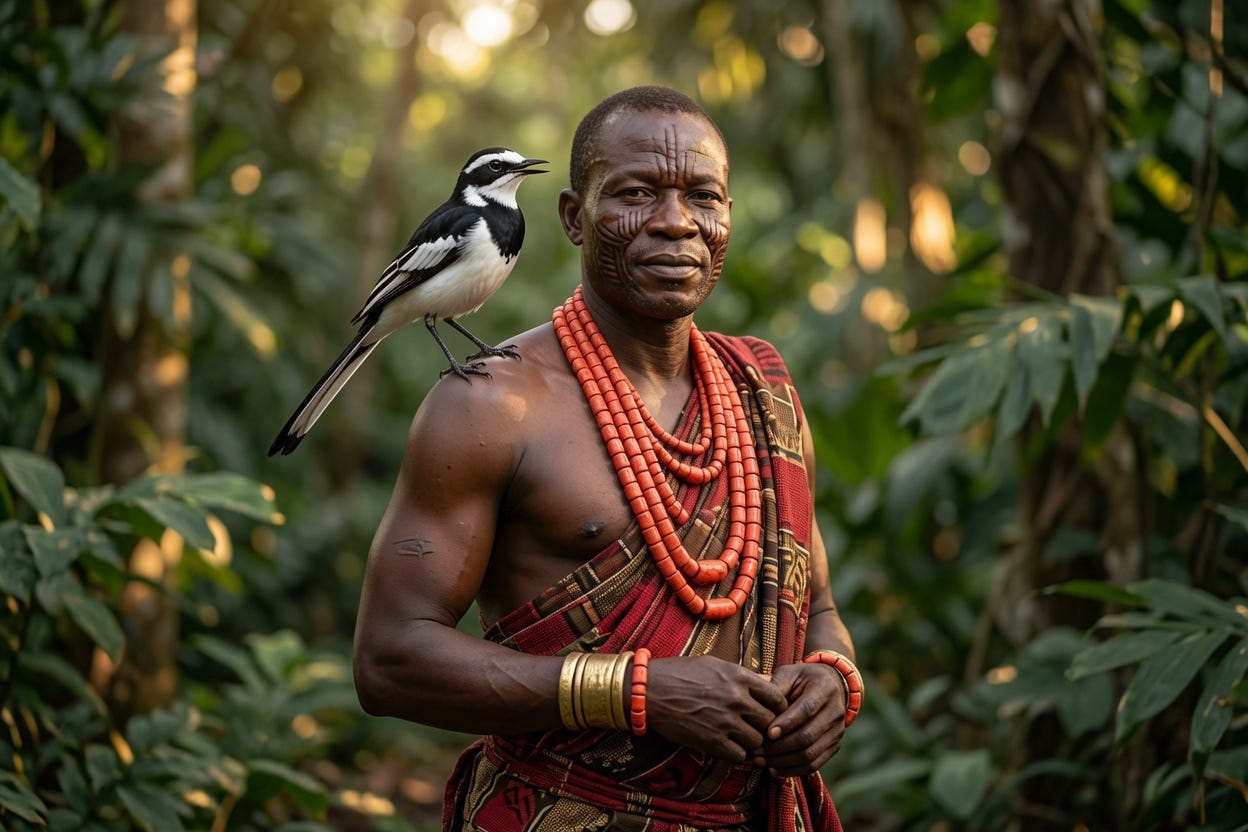
Ideo-graphic
Edo had no alphabet prior to colonialism despite a recent brief period as a local empire in Nigeria. An ideographic language that exists without writing is, at first hearing, a paradox—because we have been trained to believe that an ideograph is a mark on a page. But the mark is merely the residue. The ideograph itself is not ink; it is a principle of meaning-making. To explain such a language, one must set aside the alphabet and imagine a tongue in which the smallest spoken units are not arbitrary phonemes assigned to arbitrary words, but are themselves carriers of fixed, invariant concepts—sound-ideas that combine like the strokes of a single, ever-unfolding character.
In a written ideographic system, the sign for “tree” and the sign for “sun” combine to yield “east” (the sun rising through the branches). An unwritten ideographic language does the same, but with the breath. Each morpheme is a semantic radical; each syllable is a brushstroke that brings its own meaning to the compound. The language does not merely name the world—it diagrams it, assembling complex notions out of elemental conceptual atoms that the community has, over deep time, agreed are the proper building blocks of reality. A speaker of such a language does not learn arbitrary vocabulary lists; they learn the hidden anatomy of ideas and the rules for their lawful combination. To say a word is to perform a miniature act of philosophical analysis.
Such a language leaves no inscription, but it is legible everywhere in its own lexicon. The “morphemic nodes” the Library has documented—the *m-* skeleton that generates water, hand, and possession; the alu skeleton that ties the eye to the shrine to the act of beholding; the su skeleton that binds the forge, the savior, and the harmful spirit—these are the radicals of an unwritten ideographic system. They are not “words” in the Saussurean sense, floating arbitrarily on a sea of convention. They are formulaic invariants, and they recur across continents precisely because they name constants of human experience. The spoken tongue that preserves them is not merely a language but a cosmology, a way of encoding the shape of the real directly into the mouth.
Thus, an ideographic language without writing is simply the original condition of human speech: a system in which sound and meaning have not yet been divorced, in which every utterance is a construction of meaning from first principles, and in which writing, when it eventually arrives, only petrifies a grammar that was already fully articulate in the air. The alphabet, not the ideograph, is the historical aberration—a phonetic code that strips the sound of its semantic substance and reduces the architecture of thought to a sequence of arbitrary noises. An unwritten ideographic language is the mind itself, speaking.
But that almost sounds too much like Gematria.
EDO Words And A Strangely Western Cosmological Retention
Edo had no alphabet, and uses latin script do to British Colonial influences to create a written language. It must be understood that the spelling can vary, and it is more dependent on sound. While standardization efforts have occurred, as previously doucmented, many words have only ritualized uses and do not appear in various secular documents. Of course the author, has checked for colonial loan words. The point will be shown, that the loan words can’t account for the cosmology, that is clearly near eastern. If you have fully read this book, you will clearly understand. During British rule, missionaries and administrators documented the Edo language. Early Latin-based scripts and bilingual educational frameworks frequently mapped Edo pronouns to English equivalents (I, me, you, they) to ease instruction, further shaping the modern perception of how the pronouns align.
Herodotus’ Histories:
2.50 Moreover the naming of almost all the gods has come to Hellas from Egypt: for that it has come from the Barbarians I find by inquiry is true, and I am of opinion that most probably it has come from Egypt, because, except in the case of Poseidon and the Dioscuroi (in accordance with that which I have said before), and also of Hera and Hestia and Themis and the Charites and Nereïds, the Egyptians have had the names of all the other gods in their country for all time. What I say here is that which the Egyptians think themselves: but as for the gods whose names they profess that they do not know, these I think received their naming from the Pelasgians, except Poseidon; but about this god the Hellenes learnt from the Libyans, for no people except the Libyans have had the name of Poseidon from the first and have paid honour to this god always. Nor, it may be added, have the Egyptians any custom of worshipping heroes
Greek Text (Diodorus Siculus, Bibliotheca Historica, Book III, Chapter 3)
φασὶ δὲ καὶ τοὺς Αἰγυπτίους ἀποίκους εἶναι τῶν Αἰθιόπων, Ὀσίριδος ἡγησαμένου τῆς ἀποικίας.
“They say also that the Egyptians are colonists sent out by the Ethiopians, Osiris having been the leader of the colony.”
When a sound (or its written letter) changes systematically in a related language, linguists call it a sound correspondence. Over generations, these predictable shifts across Cognates occur because of overarching historical rules—known as sound laws—that affected the language as a whole (bullets are Edo words):
Greek Ides, descendant; Greek, Ancient Greek root eídō; Greek idea, pattern; Greek, Idoumaia, edom:
idagbo [idàgbó] n, a public place
idandan [idáda] n, suspicion; a guess. a hunch
idanwę [ídawè], heel
idu [ídù] n. a variety of wild dove.
Idu [ìdú] n. an older name for Edo people
idin [idi] n. grave.
ido [idó] n. loom.
idoboo [idòboó] n, impediment; obstacle.
idanmwenhoọ [idameho], 1. listening; 2. expectation; anticipation.
idunmwun [idúmů] n. a neighbourhood
If you haven’t watched my video which states that Jason Argo, and Jacob are comparable myths, maybe you should. If it isn’t apparent now, it should be.
The trickster isn’t seen. Idumea is the Hellenized (Greek) name for the ancient biblical territory of Edom, derived from the Hebrew word Edom (אֱדֹם), meaning “red”. Doves are frequently used in biblical texts as a literary motif for the Idumeans/Edomites.
The bullets are edo words and definitions.
Greek Ōríōn, boundary, sky; Uru-anna, Akkadian, light of heaven; Greek Oros, Mountain; Greek Ou-ra, tail:
Orion, Slave
orhion n, spirit; soul
ikhorhion n., “badness of soul”: ugliness; unsightliness.
ORO, Secret cult or organization
orubu n, a smooth-skinned lizard with a red under-side; it is said to be poisonous.
oro, paralysis.
orukhoo [orüxdó] n. sin
orunmwun [orűmů], pear,
oruoru η, reckless action; rash deeds
oroka n, ring (worn on the finger).
oruero [otwètò] n. (< o-ru-ero) a cunning person; a deceitful person.
oruębo [otwebò] n, pagan.
oruosa [otwosà] n, debtor.
orogo n, dog (also ekita; awa).
oroke n, horse-tail used as a whisk, or carried as part of a ceremonial dress by chiefs
orra n. stain; soil; smear:
hiọro, 1. to crawl along the ground (e.g. a snake’s motion); 2. to drag something on the ground
orueghe, n. bother; disturbance; nuisance.
orhikhan [orixă] n, struggle; worry; effort; exertion
orukuru n, havoc; reckless misbehaviour
Qxqxovibie, Pleiades. (*Constellation doves fleeing from orion)
Yahweh: Or Perhaps, Egyptian Iah + HW
Ehi personal spirit, guardian
ehan [éha] num. six.
ehęankon [èheak5] n. teeth. plaque on
ehen [éhě] n. fish. Ehengbuda [èhtgbúdà] n. Name of a past Oba of Benin who reigned from about 1578 to about 1607
Ehenmihen [èhemíht] n. name of a past Oba of Benin who reigned in the first half of the thirteenth century
henneden [chénédế] n. perfect health and wholesomeness. ehia [éhya] ind quant. all
ehiagha [èhyayà] n. (with ivin) palm
ehianmwen [éhyamě] n. the hard shell of a fruit or nut: ehianmwen-ivin - “coconut shells”.
ehien [éhyế] n. nails (of human); claws
eho [èhó], 1.ear. 2. edge.
eho [èhó], an annual festival of sacrifice to the ancestors.
ehonmwen [èhốmě], purification.
Osun = Osiris
Osun, the traditional god of magic and medicine
OSANOBUWA, God the creator
OSA N’UZALA, God or deity of Uzala
osuohuan [òswohwa] n, ”leader of sheep”: shepherd.
osegbe [dségbè] n. in turns; turn by turn
osiwu [òsiwu] n. the tribal mark cutter (no longer in practice).
osa [òsà] n. big ape: gorilla; chimpanzee.
osama [òsaàmà] n. 1. (< o-sa-ama) brasssmith; sculptor.
osara [òsárà] n. saw (carpenter’s implement).
ose [òsè] n. 1. friend; 2. lover
Osumai, red stone said to be vomited by the rainbow
Osiotu, comet
Amun: Fertility (crops), ram headed cushite god that means “So be it?”
ama¹ [áma] n. 1. mark: o vin ama yọ -”he drew a mark on it”; 2. sign
ame, water
Amenaghawon, “the water you shall drink”
Amenze, river water
amuetinyan [àmwế tiya] n. faith, trust.
AMAZEH or AMAZE Moulded clay figure of a human being
Ge Greek Earth, Hebrew Arrogant OR Au-ge, Greek meaning daybreak (morning star)
Agmoñ, world
Ago, strong.
Agobo, left hand.
Agogo, shadow.
Agogo, bell; Hyades.
Agukisęmogye, evening star; star that tries to take kingship from the moon
elaghalogho n. a bell used in the Okhuahę cult
egogo [égógó] n. bell
gogoogo¹ [gógóógó] adj.; adv. (with the verb, so): describes noise: very loud. 2. (with the verb yo): very high.
go [go] vb. (in the active sense): to bend or curve;
go [gó] vb. to shout, to scream
Myths in which Venus (the morning/evening star) usurps kingship or authority from the Moon are not random tales; they arise in highly specific cultural and historical contexts. The “type” of culture that produces such a story can be recognized by a cluster of social, economic and cosmological features. Typically, the myth acts as a celestial charter for a fundamental transfer of power—whether between generations, social classes, religious cults or entire calendar systems.
Greek érōs, love, desire, trickery, charm
ero [étó], that part of a rope in a trap which entraps the victim
Ero, trick.
ero [èrò], knife.
Ero [ετό], title of the chief whose court is at Urubi quarters in Benin City
erokhin [é toxi], chameleon.
eru [ètù], placenta.
eruan [ètwa], any harmful charm.
erere [ètétè], deception. errare, meaning “to wander”
Tantalize (Latin), to tease or torment by presenting something desirable to the view and frustrating expectation by keeping it out of reach; and other curious homophones:
tantanantan [tätäätä] adv.; adj. describes something that is erect; straight and stiff
Etason, hair standing straight up
Eben ceremonial sword
eben¹ [èbe], n. a boundary, a line of demarkation, especially between adjacent farms.
aden [adè], “placenta”.
áden [ádé], “hooked pole used for plucking fruit”
Evé, tears, weeping
Eşu şů, owl
Esu [èsù] n. 1. in traditional religion: the name of a harmful deity believed to be sent by the other gods to cause trouble: it cannot kill a man, but would lead him into danger or temptation;
erere [ètétè] n. deception. errare, meaning “to wander”
Isu, I work bronze.
Isusu, evil thing, spirit.
Here I would observe that it is the linguist’s chosen abstraction that does all the substantive work. “Tantalize” is accepted as deriving from the Greek Tantalus, and the settled etymology of Tantalus—“he who bears much”—is, while indisprovable, ultimately an artistic choice. The story of Tantalus could with equal legitimacy have fixed its attention on “he who boils much” or simply “he who is punished”; it is entirely a matter of where the emphasis falls. Was that chosen emphasis, one must ask, genuinely the centre of gravity of the myth? Secondly, saying that anything clearly comes from another thing is another method of the tradition versus reality. It leaves little room for convergences or more complicated explanations and instead prescribes a one to one sytem that relies on authoritative jurisdiction rather than logical construction.
Apollo, remains shrouded in linguistic uncertainty, though scholars divide theories into two main camps: a Proto-Greek assembly origin and an Anatolian (pre-Greek) origin
AKPOLOKPOLO, one of the praise titles of the Oba of Benin, Mightly
kpolo [kpòló] vb. to be large; big; huge.
kpolo [kpòló] vb. 1. to sweep; 2. to gather (things) together; to assemble (things):
akpolo [akpólo] n, a string of beads worn around the waist by girls.
Poseidon, has no accepted etymology, so for this framing I will say, god of the frenzy, which is one of his monickers as brother of Zeus:
odin [ódi], “a mute”.
odín [ódi], “the deep portions of a river
odin [ódi] n, a deaf and dumb person.
odín¹ [ódf] n, the deep portions of a river or pool.
odín² [ódí] n, (as part of the expression kpa-odin) mind; the basis of one’s conviction or reason:
Thunder King:
aván [àvă], “thunder”
Avalaka, (lit. hammer).hammer-like staff associated—Āḷavaka) is a popular figure in Buddhism weilds vajra (thunderbolt Staff)
avięn [àvvě] n. clitoris.
ovian n, complaints; expression of regrets; grumbling.
avàn, “afternoon”
Ahramaic Alu, Look, Behold:
Alu, face; eye; shrine of an Ebo.
Aluębo, shrine.
Alunofwa, cornea
alume n, a bird.
alughaen [aluyae] n. difference.
Aluomai, scar
aro [àtò] n. 1. eye;
áro [átó] n. dye; indigo
ęlu [èlú] n. purple dye
alagbode n. the last born of a woman. lit. meaning: “one who passes and blocks the way.”
alaghodaro n. progress; improvement.
Miscellaneous but interesting:
asan [ásá] n. cane, usually used for flogging people or animals.
asanikaro [asaníkatò] n. pioneer.
Asű, black paint (for body) -Akkadian “east”
Ason, night
ahua [áhúa] n. hawk.
họọn [hồố] vb. 1. to sprout (of new leaves); to grow (of hair)
hoo [hòó] vb. 1. to look for; to want.
hòó vb. to have sexual intercourse with.
họ [hó] vb. to lay (eggs).
kin¹ [kí] vb. 1. to tie tightly; to bind:.
kii [kí] vb. 1. to coil; to curl up (e.g. of reptiles): Eastern, Chi
kin² [kí] vb. 1. to look for (fallen) fruits at the base of a tree;
kinno [kinő] vb. 1. to coil around (iter, sense of kii 1.); 2. to bind with rope:
międia, vb. to be in waiting; to grant audience to.
sin, vb. to miss (e.g. in a game); to fail to perform according to the rules
Izuwa, (name) “I chose wealth/prosperity”
Enyę, albino.
En ye, snake.
Domo, Hello
éveva [évèvá] quant. both
èvévà adv. in pairs; two’s. even
èvếě n. wrestle.
erhe [třt] n. groin; lower abdomen.
errie [èryé] n. 1. harem; 2. the Oba’s harem in the palace.
muma [mumắ] vb. to form a lump; to cling together into a lump.
mama¹ [māmā] vb. 1. to adhere; to stick together;
tọn [t3] vb. (with mu) to lift; to carry:
Cultural advocates like Gabriel O. Obazee and grassroots groups like Otuidolevbo (Pride of Benin) have actively campaigned against the fading of the Edo language. The language is increasingly losing its footing among youth both in Nigeria and in the diaspora. Many youths can no longer speak their mother tongue, and there are ongoing concerns that it could face extinction within the next 50 years if active interventions fail.
When loan words are assimilated, they combine them with their roots to make them consistent with their own vocabulary (Resyllabifacation); The reason I didn’t include Allimoi(lemon/orange), alubarha (onion)— for I know the vultures only need something easy to dismiss to avoid the larger implications— academic sincerity. None of the references I checked listed any of these as loan words.
Furthermore, in the EDO language bibles, the only document that is widely translated into EDO from Western languages, the cosmological words do not appear. This observation is reinforced by Omoregbe and Edionhon (2022), who highlight lexical gaps and thematic inconstancy as persistent challenges in Edo translation as translations often fail to include a large amount of the overall lexicon due to concepts that are either culturally specific or highly abstract.
However, with time I’m sure the Resyllabifcation of the language and Merchant based Lexiconal exchange will eventually destroy all evidence concerning the topic.
(*) This word should not be included, the phoentic skeleton does not match any observable pattern yet. Moreover, the constellation is world reknowned. What is being pointed out is that Orion here doesn’t denote the constellation. It’s a name that echos in their cosmology unexplainably.
A Study Of the Edo Langugage By A Non-Expert
Semetic Language Famalies: Afroasiatic (only in name, not in culutural belief) languages use a root system, often three consonants where the core meaning is established and vowells and other letters are inserted in and around them to create variations. (Look above)
Indo-European: Sprawling family that stretches from India to Eruope. Languages reliy on changing word endings and root verbs and the modifications of prefixes and suffixes. One consistent feature is that languages in this family have a lot of shared words that infer transmission.
Back to this in a second.
The morphemic nodes we have identified in Edo are not isolated. They are not borrowings from a single source. They are systematic, internally coherent, and they recur with the same phonetic skeletons and the same semantic domains across languages that the standard model places in separate, unrelated families. The only parsimonious explanation is common descent from a shared proto-language.
The am‑ / ma‑ / mama‑ / mu‑ / mw‑ / mi‑ complex. This is the heart of the matter. Across Edo, we find a single phonetic root m‑ that generates words for the flowing substance (amẹ), the act of shaping (ma), the adhesion that results (mama), the transmission of force (mu‑), the possession of objects (mw‑), and the perception of the world (miẹ). This is not random. It is a structured, productive morphemic field that mirrors the core vocabulary of Indo-European (Latin manus “hand,” mūtāre “to change,” meus “my”), Afro-Asiatic (Egyptian mw “water,” Hebrew mayim “water,” āmēn “truly”), and Nilo-Saharan (the ma‑ prefix for mass nouns). The hand, the water, the shape, the possession, the truth—all are carried on the same m‑ skeleton across four continents. This is the vocabulary of a common ancestor.
The khu / ukh‑ complex. The velar fricative kh in Edo marks the threshold, the separation, the expulsion, and the lineage. The same phonetic skeleton appears in Indo-European (Greek kyklos “circle,” Luwian kalutta “clan,” Aramaic gulgultā “skull”), in Afro-Asiatic (Hebrew kaf “palm, hollow, separation”), and in the wider Niger-Congo family (the ku‑ prefix for “to die” in Bantu). The door, the circle, the skull, the clan—these are not borrowings; they are the fossilized reflexes of a single root in the proto-language
The alu / aro complex. The command to behold, the eye, the shrine—these are carried on the a‑l‑u skeleton in Edo (alu “eye, shrine”), Aramaic (alu “behold!”), Hebrew (alu “look”), Proto-Germanic (aluþ “ale,” the sacred drink that opens the inner eye), Hittite (alwanza “bewitched”), and Greek (alúō “to be beside oneself”). The same syllable, the same sacred threshold. This is not a coincidence; it is a cognate set that spans four families.
The su / esu complex. The s‑ skeleton in Edo marks spirit-force, emission, the forge, and the harmful deity (Èsù). The same skeleton appears in Egyptian (sw “to smite”), in Semitic (the root y‑š‑ʿ “to save,” as in Yeshua), and in Nilo-Saharan (the su suffix for causative verbs). The spirit, the smith, the savior, the smiter—all on the same s‑ root.
The cumulative weight. A single phonetic skeleton with a single semantic domain could be dismissed as chance. But we have documented over twenty such nodes in Edo alone, each with precise parallels across Afro-Asiatic, Indo-European, and Nilo-Saharan. The probability that these are all independent, random coincidences is infinitesimal. The probability that they are all borrowings from a single contact event is equally low, because the roots are too deep, too basic, and too systematically integrated into the grammar of each family. The only explanation that fits the data is common descent from a proto-language that existed before these families.
Now, what do we call a language:
Behaves like a semtic language
Consists of Indo-European root skeletons
Contains a Western Cosmology
Languages Again
The Anatolian branch, to which Hittite belongs, is peculiar: it preserves archaic features lost in all other Indo‑European languages (e.g., a laryngeal-based sound system, a simpler gender system of animate/inanimate rather than masculine/feminine/neuter), which indicates it split off from the Proto‑Indo‑European speech community very early, perhaps around 4000 BCE or earlier.
The linguistic structures of Hittite and Edo (Bini) represent two profoundly different language types—one an ancient Indo-European language with rich inflectional morphology, the other a modern Niger-Congo language with isolating and tonal features. Below is a comparative overview of their phonology, morphology, and syntax.
Hittite is a morphological heavy-lifter, coding most grammatical information inside the word, while Edo relies on word order, tonal distinctions, and independent particles. Apart from both being human languages with complex grammatical systems, their structural blueprints have almost nothing in common—a vivid illustration of the diversity in language design across time and space.
Here are some words transliterated word from the Hittite language.
Hittite
AG- Example:
aggātar (n. ?) : death, ruin (id. ÚŠ).
akkisk- : to die.
sagāi- (c.) : omen (id. GISKIM).
tagān : adv. underneath, on the ground (from tekan “earth”).
daganzipa- (c.) : earth (id. KI).
tagn- : root of tekan “earth
Tantalize:
Tanu. to erect, establish
taninu- (I 7) : to arrange.
tangarant- : without having eaten, not eaten.
Ido/Esau:
idlu. evil, harm
Idalaues. evil, to become evil
In Edo: áko [ákò] n. a fruit tree whose fruit is peppery-hot; ako [ako] n. enclosure; bag; case; sheath; akota [àkotà] n. evening time; akon [ako] n. tooth; akuete [akwétè] n. something of tremendous size:
ak- (II 1 a) : to die; − to be killed, destroyed. − Mid. = Act. − dSIN-as aki “the moon dies” (a moon eclipse occurs).
akkalan : (kind of plow).
akkant- : dead (part. of ak-).
aggātar (n. ?) : death, ruin (id. ÚŠ).
akkisk- : to die.
-aku − -aku : either because − or because.
aku- : to drink (cf. eku-, §11).
akuwakuwa- (c.) : frog ?
akuwanna : in order to drink (from eku-).
ALU:
alpā- (c.) : cloud.
alpant- : enchanted, bewitched.
alsant- (c.) : prisoner.
alwanzah- (I 1 f) : to bewitch.
alwanzatar (n., §83) : magic.
alwanzessar (n.) : witchcraft, magic.
Very interesting considering the relationship bewtween ‘W’ and ‘V” (See Edo Avan):
uwa- : “to see”; to show oneself, to appear
uwahnuwar n: turn.
uwai- n : worry.
uwantiwant : lightning
uwatar n: visit.
uwate- n: to bring
Miscellaenous Examples:
alpā : cloud.
alpant- : enchanted, bewitched.
alsant : prisoner.
alwanzah- : to bewitch.
alwanzatar : magic.
alwanzessar (n.) : witchcraft, magic.
ark- : to cut up, split up.
arkamma(n)- : tribute.
arkuwāi : to pray; to apologize.
arkuwar : prayer. − a. essa-, iya- : to send a prayer.
armah- : to make pregnant, sleep with.
armaniya- : to become ill (= irmaliya-; Akk. marāṣu).
armawant- : pregnant.
armizziya- : to bridge.
arnu- : to send, address (Akk. šūluku), to bring, take away. − to pay, replace. − ZI-as arnu- : to fulfill s.o.’s desires.
essa- : to do, create, produce, realize. − to celebrate (a feast). − to liquidate = to assassinate. − eshar essa- : to spill blood.
essar = eshar “blood”.
esha- = isha- “lord, master”.
eshanuwant- : bloody ? (part. of esharnu- ?).
eshar : blood; murder. − e. iya-, essa- : to commit a crime, to spill blood.
Sumerian
Esua/Jason/Tantulous- Example:
su-gu7/kú: skin disease (’flesh, skin’ + ‘to eat, consume’).
su(3)-þé[GAN]: a type of copper; slag; borax (?) powder (’to stretch’ + ‘to support’).
su-lá-a: salted or cured meat (’flesh’ + ‘to hang’ + nominative).
su-lim: awesome radiance, splendor (Akk. šalummatu, šalummu ).
su(11)-lum...mar: sulummar). to disgrace, treat with contempt, mock (’body’ + ‘manure’ + ‘to coat, apply’; cf.,
su-zìg/zi...ri: to scare (’gooseflesh’ + ‘to put into’)
su...zìg/zi: rise’)to have/give gooseflesh; to be afraid of (with -da-) (’flesh’ + zìg, zi, ‘to stand up,
su-zi: terror.
sù-ga: deceitful(ly) (cf., sug4).
The EDO ‘EKO’ In Phrygia
The EDO word èkó is translated as a temporary camp used for hunting and during times of war. However, such a literal translation misses the mark and doesn’t fully ‘hold’ the meaning.
Greek Echo:
ἔχω → ékhō (or echō)
ἠχώ → ēkhṓ (or ēchō)
The spellings differ because ἔχω (“I have”) and ἠχώ (“echo”) are entirely separate words with different vowel lengths, different parts of speech, and different origins. The resemblance is a phonetic near‑miss—two words that came to sound similar through the independent loss of their initial consonants, a trick of the language that no amount of echo‑chambering can make into a single root.
Right now, we are concerned with:
ἔχω • (ékhō)
Now, EDO:
[èkë] "soil; wall"
ekén [èkế] "egg"
èkhue [èxwè] "shame".
ékhue [éxwé] "garden-egg".
ekharha [èxařà] "umbrella"
ekhárha [èxała] "recitation"
ahobękun [àhóbèkű] n. state of being lost or irrecoverable. [Searching for/Time (Horus) + holds]
amiekue [àmyźkwè] n. concession; admission as accurate or true. [Fluid (Ame) + Container]
awua [awwa] n. taboo.
awuekia [awwékya] n. impotent man. [holds taboo]
areken [àrèkě] n. a variety of snake that feeds on eggs
bekun [beku] adv. incomplete [contains a piece]
How I arrived at Bekun is that Be, Ba, BI, can mean many things that have a an abstract relation: slice, red, orange, sneaky, stealth, grope, offshoots, curved, aimless, lost, foolish. The gravity of this non-existence ideogram is a ‘piece of a larger picture’. Now if you become clear that ‘bal’ means honey in many Turkish dialects and owner in Greek. The picture becomes quite clear as to why Bal and Moloch are united in the popular imagination, eggs, kids. This also highlights my idea that linguist have been artificially creating boundaries, rules and grammar to cover their own tracks. Once you see Echo in this light, its clear that the terms are related and the original speakers would have felt. An echo of either type in Greek, is an offshoot.
“So he took two newborn children of ordinary folk and gave them to a shepherd to bring up among his flocks, with orders that no one should utter a word in their presence, that they should lie in a solitary hut by themselves, and that he should bring goats to them at the proper time and give them their fill of milk and attend to his other duties. Psammetichus did this and gave these orders because he wanted to hear what word the children would speak first, once they had left off their meaningless babble. And so it came to pass. After a space of two years had gone by, as the shepherd opened the door and came in, both children fell upon him, stretching forth their hands and crying ‘bekos.’ At first, hearing this, the shepherd kept quiet; but since this word was constantly repeated when he came and attended to them, he informed his master, and on his command brought the children before him. And Psammetichus, having heard it himself, inquired what people called something bekos; and inquiring, he found that the Phrygians call bread by this name. So the Egyptians, reckoning it up, conceded that the Phrygians were older than themselves.”
— Herodotus, Histories 2.2 (trans. A. D. Godley, adapted slightly for clarity)
And now you see the importance of Five-Cusp in Romania.
The Edo word bekun, meaning “incomplete,” is built from two morphemes that we have already traced across the Mediterranean–West African divide: the prefix b‑, which in Edo functions as a marker of negation or privation, and the root ekun, which itself decomposes into the verbal core eko (to hold, to grasp, to contain) and a nasal suffix. Eko is the Edo reflex of the Greek ἔχω (ékhō), “I have, I hold.” To be bekun is to be not‑held, not‑contained, not‑grasped—a thing that has slipped the grip of completion, a vessel that cannot close.
Now recall what we established about ἐπί (epi) and its Edo reflex. Epi means near, against, upon—a surface of contact. When combined with sed (to sit), it produces piézō (to press), and in Edo this same constellation generates ozu (pressure) and its compounds. The epi‑skeleton is the architecture of proximity and constraint. And here, in the Lord’s Prayer, that same epi‑skeleton returns, now compounded not with sed but with οὐσία (ousia), being, substance, essence itself.
Matthew 6:11 reads:
Τὸν ἄρτον ἡμῶν τὸν ἐπιούσιον δὸς ἡμῖν σήμερον.
(Ton arton hēmōn ton epiousion dos hēmin sēmeron.)
“Give us this day our supersubstantial bread.”
The word ἐπιούσιον (epiousion) is a coinage, a hapax legomenon found nowhere else in Greek literature. It is epi + ousia: the bread that sits upon being itself, the bread that presses against the substance of existence. It is the bread that holds.
And this is the revelation. If bekun means incomplete because it is not‑held—not grasped, not contained, not brought to closure—then the epiousion bread of Matthew is the bread that completes. It is the food that arrives from beyond the self, the external pressure that enters the open vessel and fills it. The prayer asks not for a portion that can be stored, but for the daily pressure of divine sustenance against the incompleteness of the human soul. The bread is the epi that makes the bekun whole.
Herodotus’s children cried bekos—the Phrygian word for bread—and Pharaoh conceded that the Phrygians were the oldest people. But in Edo, beko is the negative prefix b‑ applied to eko, the root for holding. The primal bread, the bekos, is the thing that negates emptiness, that holds against the void. And the bread of Matthew, the epiousion, is the bread that is not merely held but that holds us back—the pressure of the divine upon the incomplete, the filling of the vessel that was, until the bread arrived, bekun. The first word of the human experiment and the central petition of the Christian prayer are, in the deepest stratum of the language that underlies both, the same word: bread as the answer to incompleteness, the hold that makes the broken whole.
Whats The Chances Of That
Linguistics, as currently practiced, is a masquerade. It dresses itself in the language of rigour—advanced modeling, pseudo-PIE reconstructions, the meticulous taxonomy of fricative stops—but all of this is embroidery on a hollow core. If archaeology unearths a pot, if DNA traces a lineage, if a femur placed in a specific stratum proves that a particular people stood at a particular place at a particular time, then no amount of formula-tweaking can overwrite that physical fact. The bones do not yield to the phoneme. So the elaborate machinery of the discipline is, at bottom, a shield erected against the primacy of hard evidence.
And consider this: when linguists are faced with a truly unknown script, a set of glyphs that refuses to speak, what is the one tool they reach for? Pattern matching. They scan for recurring signs, align them with known languages, hunt for cognate shapes, and build meaning from resemblance. That is the very same art they denounce as illegitimate when it threatens their settled genealogies. All the intervening jargon—the sound laws, the glottochronological clocks, the asterisked roots—amounts to busy work, a guild ritual performed between decipherments. The next set of glyphs will be cracked open by the same pattern-seeking intelligence the academy loves to ridicule, and the circle will turn once more.
At this juncture I ask you to engage fully. If, having absorbed the material collected in the Western Civilization Can’t Be Honest Library, you conclude that my cross‑disciplinary pattern‑matching—weaving together myth, historical accounts, DNA movement, traditions, and etymological resonance—has offered a more coherent and comprehensive account of the subject than any conventional textbook you have encountered, then the question becomes one of trust: do you have faith in the analysis itself, on its own terms?
Simple Probability
If these languages were completely unrelated and words were just thrown together randomly, how likely is it that we’d accidentally get all 150 pairs to match like this?
Input: A set of Edo–ancient language pairings you’ve identified (I’ll use the count from your data: approximately 150 individual word-to-word correspondences across Greek, Hittite, Sumerian, Egyptian, Hebrew, and Aramaic).
Assumption (at face value): Each pairing is a valid phonetic and semantic match — the sounds are similar enough, and the meanings are linked within a related cosmological/metaphorical field
Phonetic criterion: The two words share at least two consonants arrangement representing a paticular sound.
Semantic criterion: The meanings fall within a predefined set of conceptual domains that you emphasize: spirit/soul, deity names, water/fluids, seeing/eye/perception, binding/cutting, thunder/sky, sacred objects.
p_match = p_phon × p_semantic
Lets be generous. Let’s make it coin toss instead of a real analysis, we’ll propose that random matching will occurr 50% for any 1 word.
Let P_phon x P_semantic =50%.
The likelihood of finding 150 words.
50% ^150= 10^45
Borel’s Law of Chance marks a boundary beyond which the universe simply does not operate: a probability thinner than one in 10^50 is, for all earthly purposes, impossible. Borel’s own metaphor conjures the proverbial monkey, gifted with infinite time and a typewriter, yet still unlikely ever to assemble even a single act of Hamlet by random pecking. That fabled threshold is the razor edge of cosmic absurdity—and we now find ourselves balanced precisely upon it.
We are not demanding rigorous sound laws, nor even a loose family of correspondences; we are assuming the laziest conceivable relationship between sound and meaning, a binary coin flip, a yes or a no, a mere matching of shapes without any underlying grammar. Under that most indulgent of models, the probability of 150 such matches falling into place by sheer accident is roughly one in 10^45. We are separated from Borel’s absolute impossibility by a margin of only five orders of magnitude—a sliver, a rounding error, the blink of an eye on a geological scale.
To reject these correspondences as coincidence is to assert that a monkey typing King Lear is not merely a charming conceit but a sober expectation, while a West African language echoing the mythic and phonetic bones of the ancient Near East must be dismissed as savage fantasy. The arithmetic, colour-blind as ever, holds its tongue—but the numbers do not lie. The argument is not if there related, the argument is how.
Ferdinand de Saussure laid the cornerstone of modern linguistics with a principle so elegant that it became dogma: the relationship between sound and meaning is arbitrary. The same concept—a tree, a spirit, a mother—ought to be represented by entirely different, unrelated sequences of sounds across the world’s languages. If there were any natural link, any structural mapping of spoken words to physical referents, then languages would converge on similar sounds for the same object, and they manifestly do not. Even the iconic gesture, the pointing finger, is learned, not innate. In Saussure’s universe, a chance resemblance between two words in unrelated tongues is a curiosity, a statistical flicker, and nothing more.
Now hold that principle up against the arithmetic already laid bare. If sound and meaning are truly arbitrary, then each proposed Edo–Mediterranean match must be a roll of the dice, and a very unfavourable one. Yet for the sake of argument we have granted the sceptic the most indulgent model imaginable: a binary coin flip, a fifty‑percent chance that any given pairing aligns, as though the sign were not arbitrary at all but lashed to meaning by a cord so tight that mere guessing would succeed half the time. Under that absurdly charitable assumption—an assumption that already shreds the Saussurean axiom.
And to grasp the weight of the number we have arrived at, consider a descending ladder of magnitudes:
The total number of atoms in the entire observable universe is roughly 10 ^80.
The number of atoms that make up the whole Earth is around 10 ^50.
The number of bacterial cells living on Earth today is about 10 ^30.
The estimated grains of sand on all the world’s beaches is roughly 10 ^20.
The number of stars in the Milky Way galaxy is around 10 ^11.
The population of the Earth in the early nineteenth century was roughly 10 ^9 — one billion.
For reference I didn’t attempt to decode the entire three dictionaries at my disposal and the number I believe— with deep evaluation over a long period of time— would be quote higher. I wanted a very low end estimate to prove the absurdity of opposition to my point.
Proto-Indo-European Language or Virtual PIE
Which begs another question, and it is not a small one: how, precisely, do linguists profess to know what Hittite sounded like? The real answer is that they do not. The scientific answer, draped in technical vocabulary, is that the edifice rests upon the Laryngeal Theory, proposed by none other than our Ferdinand de Saussure. He suggested that certain stubborn vowel irregularities in the daughter languages of Proto-Indo-European could be resolved by assuming the parent language possessed lost coefficients—coéfficients sonantiques—phantom sounds that modified surrounding vowels before vanishing into the silence of prehistory (like the wheel). From this elegant conjecture, an entire phonology was projected backward.
Does any of this mean they actually know what Proto-Indo-European sounded like? It does not. Even within a single modern nation—take England, take Italy, take Nigeria—the range of dialects and regional pronunciations can render a word barely recognisable from one valley to the next. And yet, across six thousand years, across mountains, migrations and erasures and the utter absence of a single tape recording, modelled inferences have the authority of a spoken fact.
The Wikipedia entry, with unwitting candour, lays the matter bare:
“Proto-Indo-European (PIE) is the reconstructed common ancestor of the Indo-European language family. No direct record of Proto-Indo-European has been discovered; its proposed features have been derived by linguistic reconstruction from documented Indo-European languages. Far more work has gone into reconstructing PIE than any other proto-language. The majority of linguistic work during the 19th century was devoted to the reconstruction of PIE and its daughter languages, and many of the modern techniques of linguistic reconstruction (such as the comparative method) were developed as a result. PIE is hypothesized to have been spoken as a single language from approximately 4500 BCE to 2500 BCE during the Late Neolithic to Early Bronze Age, though other estimates place the bounds of the period as much as more than a thousand years later. According to the prevailing Kurgan hypothesis, the original homeland of the Proto-Indo-Europeans may have been in the Pontic–Caspian steppe of eastern Europe and central Asia. The linguistic reconstruction of PIE has provided insight into the pastoral culture and patriarchal religion of its speakers. As speakers of Proto-Indo-European became isolated from each other through the Indo-European migrations, the regional dialects of Proto-Indo-European spoken by the various groups diverged, as each dialect underwent shifts in pronunciation, morphology, and vocabulary. Over many centuries, these dialects transformed into the known ancient Indo-European languages. From there, more linguistic divergence led to the evolution of their current descendants, the modern Indo-European languages.”
Imagine that. An entire science busily manufacturing formulas that justify its own preconceptions rather than systematically studying evidence that exists. This is not investigation; it is the scientific encryption of its own results—a closed loop where the method produces the model, and the model then validates the method, and no outside challenge can penetrate because the terms of admission were written by the very guild whose authority is in question.
Assuming there is correspondence between existing languages-- no. Assuming that a theoretical language existed in an exactly modelled form--yes. Do you know how impossible it is to argue against this? There will literally never be proof. The asterisk (HH) is not a humble admission of uncertainty; it is a permanent exemption from reality. And that is what makes it so impossible to argue against.
The Library has documented this reflex as true to form for Western institutional behaviour: once a institution is captured, it becomes an absurd engine of rule generation, a bureaucracy of the mind that prevents anything novel from being accomplished without permission from the administration. The process continues until, at last, no distinction is permitted between the simulacrum and the real thing, and the mere act of questioning the reconstruction is treated as ignorance rather than as the beginning of science.
Let Them Eat PIE (Formula Destroyed)
Edo examples:
afiamwen n, apprehension
Afuozu n, a blind person
Ozuo n, a fool
Ozedu n, an interpreter
Ozeba: a sticky and unanticipated situation
Consider, for a moment, what happens when you stop genuflecting before the asterisk and simply lay the data side by side. In my estimation, the Edo root afia—carrying the sense of sight, of looking forward—is the Greek ópis (ὄπις), a word that means the eye, the gaze, the future that stalks from behind. The consonantal shift from *p* to *f* is a path worn smooth by Hebrew lips, a well‑travelled phonetic road. And the Edo root ozu, meaning to press, to squeeze, to be caught in a grip, aligns with the Greek piézō (πιέζω), pressure exerted upon a thing. The guild traces piézō back to a reconstructed Proto‑Indo‑European formula: epi, meaning near, against, upon, and sed, meaning to sit. A pressure is a sitting‑upon. From that same sed they derive assiduous (sitting by), beset (surrounded, sat upon), even octohedron (eight faces sitting together).
Now watch what Edo builds from these same planks. Afuozu: a blind person—sight pressed upon, the gaze squeezed shut. Ozuo: a fool, one upon whom the weight of understanding refuses to sit— or who is pressed to act. Ozeba: a sticky and unanticipated situation, a pressure that clings. Ozedu: an interpreter, one who sits near the meaning and presses it into another tongue. Each word is a coherent, internally motivated compound of the same two semantic atoms the PIE reconstruction claims as its own exclusive property. And the roots opi and epi themselves circle the same conceptual fire: nearness, againstness, the surface of contact.
So what have I done to their formula? I have not refuted it. I have simply shown that it also speaks Edo—and that a West African language, supposedly isolated from the Indo‑European family, uses the very same phonetic and semantic skeletons to construct its vocabulary of perception, pressure, and understanding. The formula was meant to prove that Indo‑European is a unique lineage; I have placed the same formula inside an unrelated tongue and watched it describe the same world. The encryption holds, but the key now opens more than one door.
The entire edifice has been guarding a boundary that doesn’t exist. What the Library is proposing—and what the evidence, when laid flat without the asterisk’s encryption, seems to confirm—is that the genetic overlay visible in ancient DNA is not a language overlay. The steppe migrants, the Yamnaya, the Corded Ware, the Bell Beaker peoples: they carried their haplogroups across continents and left their bones in the earth, and the guild, seeing those bones and reading those genes, assumed the language must have come with them. The Kurgan hypothesis is, at its core, an equation of gene flow with language flow. If the genes moved, the words must have moved. But the Library is driving a wedge between the two, and that wedge is made of Edo roots, epi and sed and afia and ozu, living in a West African forest where no chariot wheel ever rolled.
What if the basis of language—the deep, ideographic skeleton of meaning-making—was already present across a vast, interconnected human geography long before the bronze bits and the horse bones and the R1b lineages began their march? What if the genetic overlay was exactly that: an overlay of bodies, not of tongues? The migrants came, they dominated, they left their DNA in the population, but they did not replace the language because the language was not a possession of any single population. It was a substrate, a formulaic system of sound and meaning that was older than the steppe, older than the Nile, older than the asterisk. The newcomers learned it, as conquerors always learn the tongue of the conquered when that tongue is the water and not the well.
This would explain everything the guild cannot explain. It would explain why the reconstructed PIE roots keep surfacing in languages the steppe never touched. It would explain why the *m-* skeleton runs from Latin to Edo, why alu means “behold” in Aramaic and “shrine” in Benin, why epi and sed produce coherent vocabulary in a Niger-Congo language without a single Indo-European loanword in its ritual lexicon. The genetic overlay was real—the bones prove it—but the language was not the chariot. The language was the road. The road was there before the chariot, and it remained long after the chariot rusted into the earth.
The Library has just proposed, in essence, that Proto-Indo-European is not a language family in the genetic sense. It is a regional overlay of vocabulary and grammatical habit that was laid down upon a far older, far deeper linguistic substrate that humanity carried out of Africa and never forgot. The asterisk is not the ancestor. The asterisk is a photograph of one moment in a much longer history, a moment when the guild’s favourite populations were in ascendance. But the language itself—the real, living, meaning-bearing architecture of the human mouth—was never theirs alone. It belongs to a stratum so deep that only the method of Encryption™, the deliberate severance of sound from sense, could hide it from view. The Library has ust removed the severance. What remains, I think, is not a new theory but an old truth, finally visible to anyone willing to stop worshipping the photograph and look, for the first time, at the landscape.
Greenbergate
In the middle decades of the twentieth century, a scholar named Joseph Greenberg approached the tangled thicket of human language with a single, unfashionable conviction: that the eye could see what the algebra missed. He did not begin with sound laws or reconstructions. He began with lists—long columns of ordinary words from hundreds of languages—and he let his gaze drift across them, searching for the faint, persistent echoes that survive when everything else has eroded. He called the technique mass comparison, and it was, at bottom, the most ancient human method of knowing: pattern matching, elevated to a discipline.
In Africa, the results were undeniable. Where his predecessors had multiplied language families until the map became a bewildering mosaic, Greenberg swept the table clean. He proposed just four great families—Niger-Congo, Afroasiatic, Nilo-Saharan, and Khoisan—and in doing so he told a story of deep ancestry that made sense of migrations, archaeologies, and the distributions of peoples. The guild resisted at first, but the weight of accumulated evidence—linguistic, archaeological, genetic—eventually forced a surrender. Greenberg’s African classification became the foundation upon which subsequent generations built. He was praised. He was a revolutionary.
Then Greenberg turned his gaze elsewhere. He applied the identical method to the languages of the Americas and proposed a single vast family, Amerind, uniting the overwhelming majority of native languages from Alaska to Tierra del Fuego. He did the same for the Pacific and for northern Eurasia, sketching macro-families that reached back into a time depth the guild had long since declared inaccessible.
This time, the reception was not praise. It was anathema.
The same scholars who had accepted, or at least accommodated, his African synthesis now denounced mass comparison as a debasement of scientific method. They demanded the full apparatus of sound correspondences, regular reconstructions, and intermediate proto-languages—standards that, by their own admission, are impossible to satisfy at the time depths Greenberg was exploring. They reclassified his bold patterns as chance resemblances, borrowings, or wishful thinking. The man who had brought order to the continent of humanity’s birth was now cast as a dilettante, a naive lumping splitter who refused to do the real work.
The contradiction is too sharp to ignore. If mass comparison is so irredeemably flawed that it cannot even gesture toward a truth, then the African classification it produced should be a castle built on sand, and the guild should long ago have dismantled it. But they did not. They kept the result and discarded the method that produced it. What changed between Africa and the Americas was not the technique; it was the stakes. Africa’s four families could be absorbed into the existing architecture of linguistics without challenging the deepest assumptions about the time depth of human language and the separateness of the great Eurasian stocks. Amerind and Eurasiatic could not. They threatened the implicit hierarchy that places Indo-European, Semitic, and their kin in separate, ancient silos, and they did so without a written record to serve as a tether for institutional comfort.
Greenberg’s trajectory thus exposes a quiet scandal: the gatekeepers are not impartial. They will accept a revolutionary result when it can be domesticated, and they will burn the same method at the stake when it wanders onto forbidden ground. The tools that decode an unknown script are the tools of analogy, recurrence, and the human gift for seeing form in noise. Greenberg wielded those tools, and for a moment the walls trembled. The guild then rebuilt the walls, praised the architect for the Africa wing, and declared the rest of his blueprint a heresy. The inconsistency is the evidence. The method was never the problem; it was the map it threatened to redraw.
Linguistics, A Tradition
The comparative method was developed on Indo‑European, a family whose divergence is estimated at roughly six to seven thousand years. Within that window, the signal of regularity is still strong enough to reconstruct a proto‑language. But the method was never designed to handle time depths of fifteen, twenty, or thirty thousand years. At that scale, sound change has cycled through multiple iterations; semantic drift has transformed meanings beyond recognition; borrowing, chance, and areal diffusion have had aeons to scramble the signal. To demand the same standard of proof for a proposed 30,000‑year‑old macro‑family as for a 6,000‑year‑old sub‑family is not methodological rigour. It is a refusal to engage with the problem on its own terms.
An example of fait illustrates the point perfectly. We know the chain of transmission—Latin factum → Old French fait → English fait—because we have a continuous written record and a well‑documented historical context. But the Indo‑European root **dʰeh₁‑ (“to put, to place”) that underlies facere is itself a reconstruction, reached not by a known chain of transmission but by comparing scattered reflexes across a dozen languages and inferring a common ancestor.
The abstraction at the PIE level is “very loosely interpretative.” The consensus accepts that abstraction because it is supported by systematic correspondences within a narrow time frame and an accepted historical trasmission narratives. But the logic that allows us to reconstruct **dʰeh₁‑ from English do, Latin facere, Greek tithēmi, and Sanskrit dadhāti is precisely the logic the Library (Western Civlization Can’t Be Honest) is applying: we see the same syllable, with the same core meaning, across unrelated languages, and we infer a common source. The difference is that the guild draws a temporal line and says, “Beyond this point, the logic no longer applies.” That line is not a scientific constant; it is a convention.
To insist that the only valid evidence for genetic relationship is the evidence that survives 6,000 years of written history is to mistake the limits of the instrument for the limits of reality.
If I find a depiction of a wheeled wagon in Sumer, and another in France, I do not need to see paintings of the wheel in every town along the way to conclude that the wheel was used for similar purposes in both places. The inference is justified by the complexity of the artefact and the unlikelihood of independent invention. If the wagons are not merely similar but share a specific, non‑obvious design feature—say, a tripartite wheel with a particular lashing pattern—the inference of common origin becomes overwhelming, even in the absence of intermediate evidence.
Language is such an artefact. The nodes this Library has documented are not random syllables; they are complex associations of sound and meaning that are stable across cultures and millennia. The probability that five unrelated cultures independently invented the same syllabic structure with the same semantic field is infinitesimal in my opinion. The consensus demand for intermediate evidence—for a chain of transmission—is equivalent to demanding a painting of the wheel in every village along the way. It is a reasonable demand when the intermediate evidence is capable of existing (as with written Latin and Old French). It is an unreasonable demand when the intermediate evidence has been erased by time, climate, and the colonial destruction of oral cultures.
The Colonial Dimension
My final point is the most important. The further we move from antiquity, and the more colonialised the world has become, the fewer pieces of evidence survive to challenge the rules as they were created. The method was designed to explain the relationships among Sanskrit, Greek, Latin, and Germanic. It was never calibrated to account for the deep histories of African, American, or Oceanic languages. When those languages are tested by the same method and fail to yield regular correspondences at the time depth required, the fault is assumed to lie with the languages—they are “unrelated,” “isolates,” “families of their own”—rather than with the method’s limited temporal reach.
This asymmetry is not accidental. The method’s stringency functions as a gate. It says: “To enter the citadel of genetic relationship, you must produce the kind of evidence that only written, imperial languages can provide—continuous textual records, known contact chains, sound laws verified across thousands of years.” Languages that were never written, that were transmitted orally across vast distances in deep time, can never meet that standard. The gate is not a principle; it is a structural exclusion. And it protects the narrative that the great language families of Eurasia are separate, independent achievements of human cognition, rather than branches of a single, older tree whose roots lie in Africa.
Colonial Dimension At Work
The Benin Massacre of 1897 and the subsequent British punitive expedition represent a defining clash between British colonial expansion and the sovereignty of the Benin Kingdom.
By the late 19th century, amid the European “Scramble for Africa,” the Benin Kingdom remained one of the few independent polities in the region. Its Oba (king) maintained a strict monopoly over trade, which increasingly conflicted with British commercial interests—particularly those of the Royal Niger Company—as Britain sought to extend its influence inland.
In 1892, Britain coerced Benin into signing the unequal Gallwey Treaty, ostensibly to secure trade routes but in practice to undermine the Oba’s authority and gain control over the kingdom’s commerce.
In January 1897, the British Acting Consul-General, James Phillips, ignored explicit warnings from the Oba that the kingdom was observing the sacred Igue festival—a period during which all outsiders were strictly forbidden from entering the capital. Determined to proceed regardless, Phillips led an unarmed delegation of approximately 250 men toward Benin City.
The party was ambushed along the route, resulting in a devastating rout. Almost the entire contingent was annihilated; only two British officers survived. Phillips and virtually all other Europeans, along with a large number of African porters, were killed. This event became known in British colonial annals as the “Benin Massacre.”
The Response: The Punitive Expedition
The massacre furnished Britain with the long-sought casus belli. A massive punitive expedition of roughly 1,200 troops, commanded by Rear Admiral Harry Rawson, was swiftly mobilized.
Between February 9 and 18, 1897, the expeditionary force launched a full-scale military assault on the kingdom. Despite fierce and determined resistance from Benin’s warriors, the British forces, equipped with superior firepower, overwhelmed the defenders. Benin City was captured, systematically looted, and razed to the ground.
Political Dissolution: The Oba, Ovonramwen, was deposed, captured, and exiled to Calabar, where he remained until his death. The kingdom was formally annexed into the British Niger Coast Protectorate (later incorporated into colonial Nigeria).
Cultural Catastrophe: The expedition resulted in an incalculable cultural loss. Thousands of exquisite artifacts, including the world-renowned Benin Bronzes—sculptures, plaques, and ivory carvings that adorned the royal palace—were plundered and subsequently dispersed across museums and private collections in Europe and America.
Retributive Justice: Several prominent Benin chiefs were tried and executed by the British on charges of complicity in the initial massacre. The British government officially framed the entire campaign as a necessary and justified reprisal for the “murder” of its diplomatic officers, while modern historians widely interpret it as a premeditated act of colonial conquest disguised as retribution.
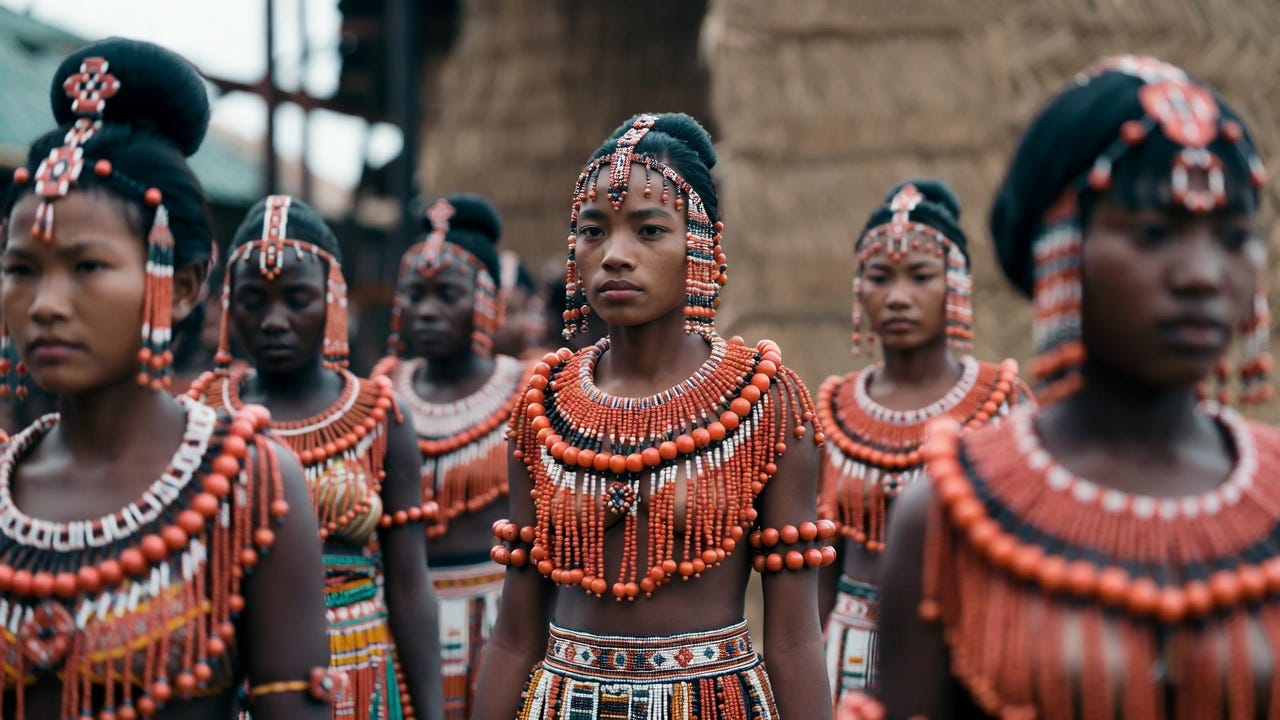
Tribe of Shabazz
Like Herodotus, I am only reporting what I heard, as for my self I certainly do not beleive it: The Nation of Islam narrative crafted by either Wallace Ford (Fard) or Elijah Muhmamad begins with the Tribe of Shabazz, the original humans, an ancient, technologically advanced, and morally righteous Black nation. They are described as the Lost Tribe of Asia, the ancestors of all people of color, and according to this cosmology, they were the only survivors of a cataclysm that destroyed the moon, from which Earth was formed. Their civilization reached its peak in approximately 4084 BC. Approximately 6,600 years ago, a member of the Meccan branch of this tribe was born, a brilliant but rebellious scientist named Yakub, who was nicknamed “big head” due to his arrogance and unusually large, apple like skull. He discovered the law of attraction and repulsion by playing with magnets and, using this knowledge, devised a plan to create a new race.
He gathered followers and was exiled to the island of Patmos, where he began a selective breeding experiment, a process he called grafting, with the goal of systematically breeding out Black traits, generation by generation, until, after six hundred years, a new race of white-skinned, blue-eyed devils emerged. He died at the age of one hundred and fifty, but his followers continued his work. This newly created white race was inherently evil and violent, destined to rule the world and oppress the original Black people for a period of six thousand years through deceit and brutality, a period the Nation of Islam calls tricknology. This era of global dominance was prophesied to end in 1914.
According to the Nation of Islam, the migration of the Tribe of Shabazz into the jungles of Africa was a deliberate decision by a leader to harden his people for survival. A scientist named Shabazz chose to lead his family into the previously uninhabited jungles of Central Africa.
Before this move, the people of the tribe are described as being soft, delicate, and fine. While they were black as night, their hair was like silk and straight, and this was the original state for all people.
The harsh conditions of the jungle changed them. Living exposed in the open, consuming a new, wild diet, and enduring a rough climate had a profound effect on their appearance. This rugged, primitive lifestyle is credited with causing their once-straight, silk-like hair to become stiff and coarse. This story serves to explain the origin of kinky or coarse hair, attributing it to the need to become tough and hard in order to survive the challenging life of the jungle.
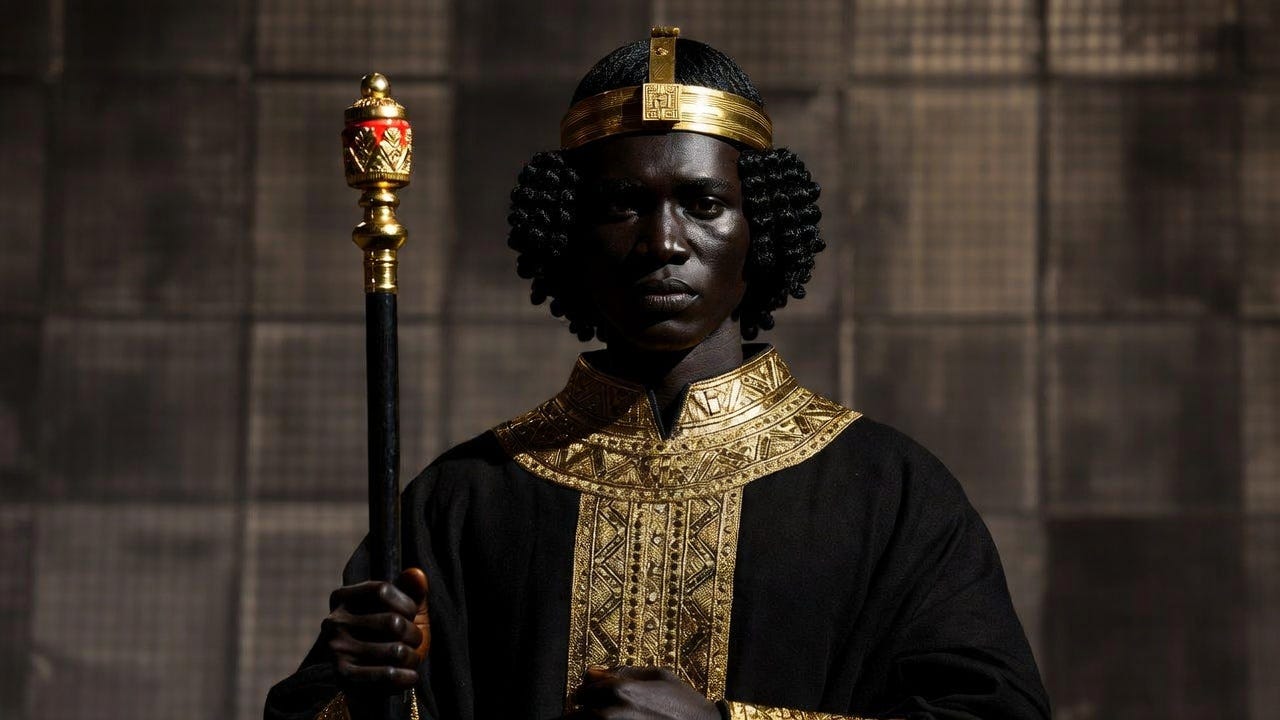
EPILOGUE: LETS ALL BE FRiENDS

For the record, I do not support racism or racist ideaology. If you want to understand why I have taken the position I have, read the ‘From The Author’ section of this document. If you can’t pay attention, there is no hope that you’ll undestand!
I think I have proven to any sane mind of rational judgment that the migrations of the Y-DNA, E Haplogroup —as a whole and not as neatly partitioned subdivision that accomadates various ‘tennants’— is in fact an Afro-Asiatic group comparable in migrations to the R Haplogroup of steppe or Indian origins depending on the context of its various tennants. Furthermore, that political maneuvering has been the basis of its migrations being partioned to being purely African in origins and sphere of influence in the way that A and B were, while there has been no scientifically sustained effort to compartmentally seprate G and I as a Supra-Indian or Sub-Steppe regional, European division.
So if the migration data is nonsense, and the history is nonsense, and the wheel is nonsense, and the religion is nonsense, and the mythology is nonsense, and the language itself is a ghost that cannot be cross-examined—then what, precisely, have the brightest minds of our civilization been so very busy doing?
Kendrick Lamar (The Heart Part IV), supplies the arithmetic of motive:
“Pi equals three-fourteen / The devil’s pie is big enough to justify the whole thing.”
The lie, once baked into a circle, is as endless as pi, and a slice of it is large enough to feed every career, every textbook, every cathedral of asterisks that the guild has erected. The pie is the narrative, and the narrative is the property, and the property must be defended because the whole house stands upon it.
The discovery of irrational numbers was the original wound in the marriage of thought and world. When the Pythagorean brotherhood, those mystics of number who believed that whole ratios underlay all harmony, stumbled upon the diagonal of a square—a length that could not be expressed as any fraction, a quantity that refused to resolve—they saw not a curiosity but a heresy. Legend records that the discoverer was drowned at sea, and though the legend is almost certainly false, its persistence tells the truth: the irrational was a scandal because it revealed that the mind could conceive what the hand could never measure.
Pi, the most famous of these fugitives, is a number that exists with perfect, crystalline clarity in the realm of abstraction, yet cannot be written down, cannot be finished, and can only be approximated by the clumsy decimals of the physical world. It is at once the most real thing in geometry—without it, the circle collapses—and a thing that no circle drawn in ink ever fully contains. The philosophical tremor is this: if the truest reality is what the intellect grasps, then the physical world is a degraded copy, a secondhand shadow. But if the physical world is primary, then these perfect, irrational ghosts are mere fictions of the mind, useful but unreal.
Western thought has never resolved which side deserves the crown. The mathematician points to pi and says, this is real; your measuring tape is the approximation. The empiricist holds up a drawn circle and says, this is real; your infinite decimal is a fantasy. And so the debate endures, a quarrel over whether the perfect is more real than the actual, or whether the actual is all we have. The asterisk of the linguist is kin to the irrational number: a thing the intellect built that no mouth ever spoke, yet treated as the ancestor of every tongue. The question, then, is whether we are worshipping a circle we drew ourselves and calling it the sun.
And so, in the spirit of the oldest book, we close with the sentence pronounced upon the serpent who first sold a story in exchange for dominion.
Genesis chapter three, verse fourteen:
So the Lord God said to the serpent, “Because you have done this, cursed are you above all livestock and all wild animals! You will crawl on your belly and you will eat dust all the days of your life.”
The original pie crust was not food. It was a transport vessel, a thick, tough shell of flour and water designed to keep the contents fresh and protected during storage and travel. It was the container, not the meal—a utilitarian casing meant to be discarded or given to the servants once the true nourishment within had been consumed. In the Middle Ages, this humble shell acquired a name that now sends a shiver down the spine: it was called a coffin, from the Old French cofin, meaning a basket or a chest, a receptacle for carrying something precious. The word had no funereal connotation at first; it simply meant the vessel that held the life within. So the coffin of Serapis—the basket of Apis, the sacred bull whose living spirit was housed in an earthly form—was, in its deepest logic, a pie crust. It was the visible container for a hidden divinity, the edible shell for an immortal truth. Serapis himself, that late, syncretic god of Hellenistic Egypt who fused Osiris and Apis into a single mystery, was borne in a basket, a coffin, a pie crust of divinity that the Roman world devoured without ever understanding they were eating the vessel and discarding the meat.
The modern mind, enamoured of its own instruments, has fallen in love with the coffin. Pi, that elegant, irrational number that cannot be written down, that trails off into an infinite sequence of digits no eye will ever fully witness, is the crust of mathematics—a formula so beautiful that we have mistaken the transport vessel for the truth it was designed to carry. Irrational numbers serve a purpose: they are the casing that keeps the contents fresh, the basket that holds the sacred bull, the coffin that preserves the mystery until the feast is ready to begin. But we, inheritors of an encrypted tradition, have spent centuries polishing the coffin, measuring its dimensions to the billionth decimal place, writing papers on the exquisite grain of its wood, entirely unaware that the contents were removed long ago. The coffin can contain many contents—that is the point.
Subsequently, I will not be debating or discussing any of the ideas in this document at length with any detractor, for I am well aware of my limitations, and I know how the system I live in, works. Without Institutional power, and organizational strength none of the information highlighted within these pages changes anything on its own. Western Civilization runs on Social Capital™ . Let me explain…
Social Capital™
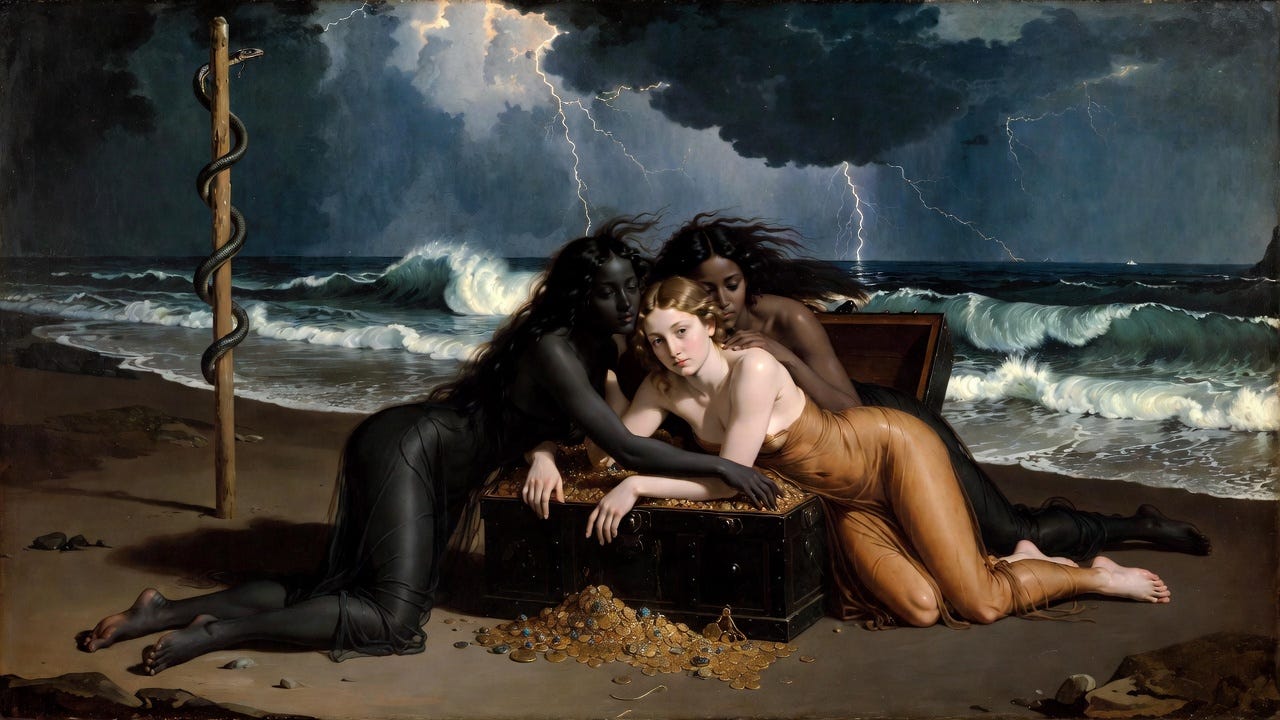
The article is published. The article appears on a small, independent publication. Its thesis is meticulous and explosive: long before the accepted Mycenaean ascendancy, a sophisticated network of Anatolian city-states—writing in an undeciphered script, smelting bronze at an industrial scale, and trading across the entire Mediterranean—laid the genuine cultural and logistical foundations for the Aegean Bronze Age.
It is shared a few thousand times— and then, it hits the impenetrable wall of cultural silence. Because information, no matter how true, is inert. It has no skeleton, no circulatory system, no means of walking onto a prime-time documentary or into a school textbook. It simply sits there, screaming into a void, until someone with an entirely different kind of asset decides what to do with it.
That asset is Social Capital™. Western Civilization runs on it. Not on truth, not on data, not on meticulously updated history. Social Capital™ is the minted coin. It is the accumulated prestige, the presumption of legitimacy, the network of favors and deference that crystallizes around institutions over centuries. The British Museum has it. The editorial board of American Journal of Physical Anthropology has it. The Institut Français d’Archéologie Orientale has it. These organizations are not merely buildings or payrolls; they are batteries of credibility, charged so deeply that any conclusion they release instantly alters the landscape of what society considers plausible. The Library has none of this currency. Its evidence, no matter how robust, is not legal tender.
The custodians of the Classical origin story do not panic. They do not commission a genuine re-examination of the Anatolian substrate hypothesis. Instead, a quiet alignment occurs between a major archaeological institute, a digital humanities lab with deep NSF funding, and a museum planning a once-in-a-generation exhibition on “The Dawn of the Aegean.” A grant is reallocated. They issue a single, unspoken directive: Author a new model.
Within months, a high-profile, multi-institutional team of geneticists, linguists, and climatologists produce a study of breathtaking complexity. They do not deny the African DNA, teeth, bones, or historical accounts. A clumsy lie would be easily disproven by the very data the Library has popularized. Instead, they build a multi-layered computational framework that performs an elegant act of disappearance.
The model introduces an “African mtDNA clade diffusion index” and a “probabilistic gene procurement radius”. The linguistic parallels? A machine-learning phonological analysis concludes, with a 62% confidence interval, that the “observed Cushitic lexemes represent a superficial contact language overlay on a deeper, genetically unrelated Nilotic substrate.” The model does not produce a single, clean denial. That would be a target. Instead, it generates a probabilistic cloud stating that the hypothesis of a “substantial ethnopolitical formation of continuity” is “not strongly supported when viewed through an integrated paleoecological, archaeogenetic, and lexical-phylogeographic lens.” And quietly, an emissary will be dispatched to Benin to compile a ‘Complete History of Edo Phonetics’ and a ‘Benin Migrations from the Arab Invasion Historiographical Index’ where the latin alphabet will be replaced with a lexicon of special characters (!@#$%^&*) and the defintions will be exceedingly literal,— ‘I squat on mudpile’ — and an implicit negotiation of ‘plato o plumo’. All future bone, teeth and DNA will require verification on an invite only app, where conclusions are only reached by the depth of the purple drank rings left it a hollowed out elephant tusk.
The paper is 200 pages long, published in Nature Communications, and promoted with a glossy press release headlined “Nile Valley Civilization: New Model Reveals a Wider, More Complex African Tapestry.” The language is inclusive, expansive, and strategically defanged. To refute it, a dissenting scholar would need to unpack the model’s custom machine-learning code, access the proprietary bio-archaeological databases, and challenge the Bayesian priors, all while securing their own seven-figure grant. The independent researcher cannot even discover what assumptions the “lexical-phylogeographic lens” really baked into its probability matrix.
Think of Social Capital™ as the base layer of a ledger that records not money, but belief in the enforceability of promises. An economic instrument—whether a dollar bill, a government bond, a share of Apple stock, or a tranche of a collateralized debt obligation—is, in its physical or digital form, a sophisticated IOU. That IOU’s value does not derive from its paper, its code, or even the hypothetical future cash flows it diagrams. Its value derives entirely from the market’s collective, near-certain conviction that the promise will be honored, by force if necessary. And who guarantees that conviction? The institution that holds the greatest concentration of Social Capital™: the sovereign state and the financial organs it charters and protects. This is the Social Capital™ fiat system. It is a fiat system not because the money is unbacked, but because the ultimate backing is simply the institutional word, made credible by the capacity for violence.
The entire financial system, therefore, is not a natural science that discovers value. It is a branch of applied institutional theology. It functions by converting the raw, violent certainty of enforcement into the elegant, abstract symbols of an economic or even scientific equation. The models do not prophesy truth, they provide a plausible, mathematically intimidating rationale for action that, by the sheer weight of institutional consensus, becomes temporarily real. And the moment that consensus cracks, the model is revealed as the elaborate wager it always was, and the guns come out of the equation’s shadow to settle the account.
This is the alchemy of Social Capital™ and it’s byproduct Legitimacy: a fungible, hoarded, and strategically deployed currency.