

Author Update 07/18/26:
This article will remain on site for continuity; however, I would like to acknowledge that it is poorly constructed and was published out of order. Reading it is no longer necessary, as the message, almost in its entirety, was captured in this book. The shield and the relation of the ‘knot’ are the only topics not covered by the book.
Introduction: The Knot of the World
There is a knot at the heart of the ancient world, tied long before Alexander cut it. The knot was not in Phrygia alone, though tradition places it at Gordium, the capital of King Midas and his father Gordias. The knot was everywhere. It bound the Carians to the Lydians, the Lydians to the Phrygians, the Phrygians to the Egyptians, the Egyptians to the Colchians, and the Colchians to the Greeks who came to steal their fleece. The knot was the tangled, interconnected, multi‑colored reality of a world that did not recognize the boundaries that later centuries would draw. The Greeks, who inherited so much from this world—their armor, their alphabet, their gods, their very sense of what it meant to be a people—also inherited the knot. And they cut it. The cutting of the Gordian knot by Alexander is the founding act of the classical imagination: the sword that severs the tangled past and declares a new, simpler, Greek beginning. But the knot was never truly severed. The threads remain, scattered through the pages of Herodotus, in the etymologies of names, in the shield‑handle invented by the Carians, in the foreheads cut with knives at the festival of Isis, in the coins of Lydia that still read Kukalim—“I am of Kukas,” I am of the grandfather. This is the story of the knot, and of what was lost when it was cut.
The Oldest Race: Phrygians and the Experiment of Psammetichus
In Book 2, Section 2 of his Histories, Herodotus recounts an experiment conducted by the Egyptian pharaoh Psammetichus. The pharaoh wished to discover which nation was the oldest of all mankind. He took two newborn children and gave them to a shepherd, with strict orders that no one should ever speak a word in their presence. The children were kept in a solitary hut, nourished by the milk of she‑goats, utterly isolated from human language. After two years, the shepherd entered the hut one day and the children reached out their hands and cried out the word bekos. Psammetichus, upon hearing this, inquired which people used that word, and discovered that the Phrygians called bread bekos. From this, the Egyptians concluded that the Phrygians were a more ancient people than themselves, older even than the Egyptians.
The Phrygians, then, were recognized by the Egyptians—the most ancient of civilizations, by their own reckoning—as an older race still. This is a striking admission, and it places the Phrygians at the root of the human family tree.
The Mythic Lineage: From Libya to Phrygia, Colchis, and Beyond
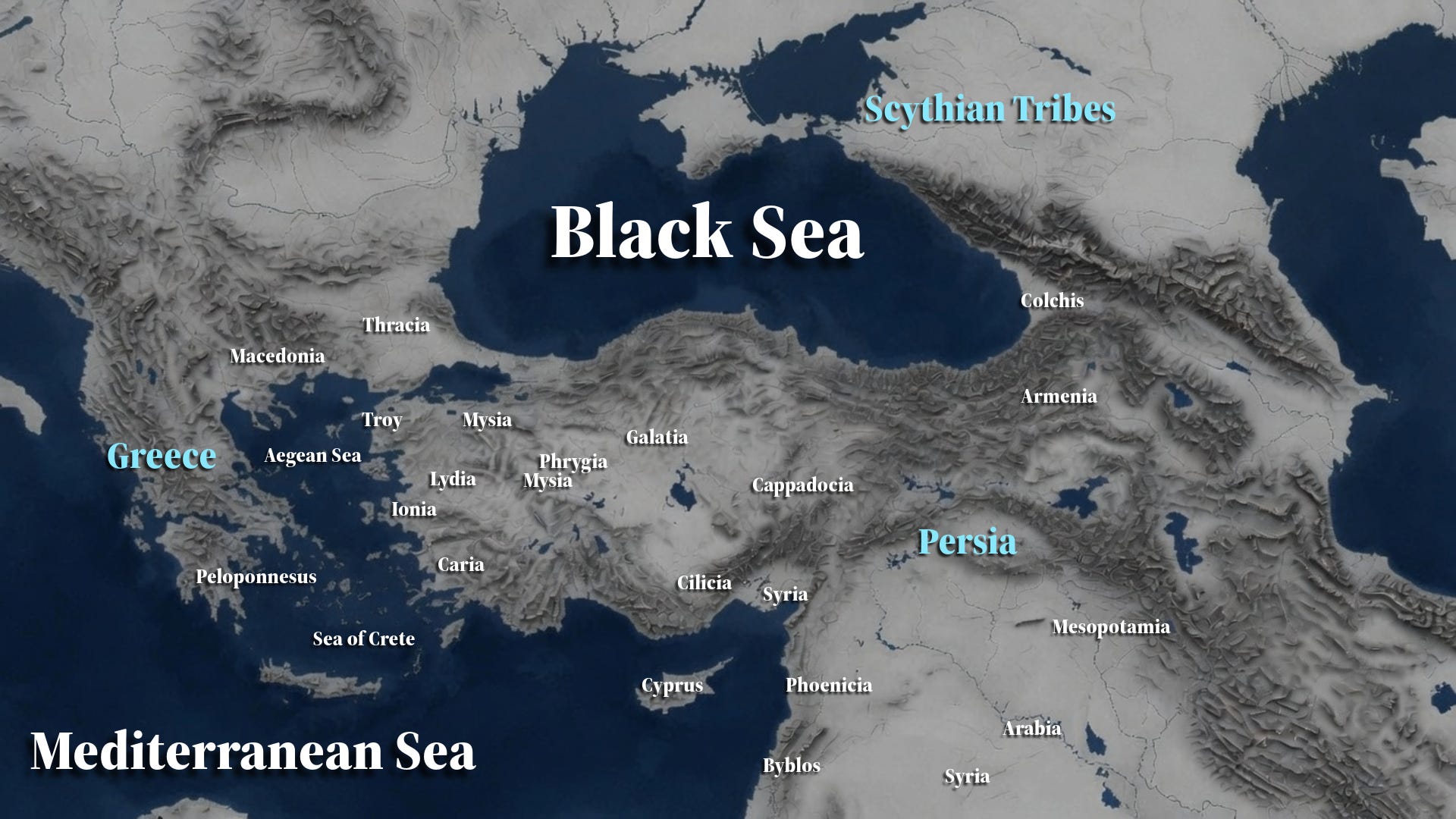
In the Greek mythographic tradition, the entire known world was mapped onto a single divine genealogy. The line begins with Io, the Argive princess loved by Zeus, who wandered the earth in the form of a heifer until she reached Egypt. There, by the touch of Zeus, she gave birth to Epaphus (whose name means “he of the touch”). Epaphus became king of Egypt and fathered Libya, the eponym of the vast African land that stretched from the Nile to the Atlantic.
Libya, in turn, bore two sons by the sea‑god Poseidon: Belus and Agenor. Belus remained in Africa and fathered the royal lines of Egypt, Ethiopia, and Argos. Agenor crossed into Asia and became the ancestor of the Phoenicians, the Cilicians, and—through his son Cadmus—the founder of Thebes in Boeotia.
Now, the Phrygians enter this genealogy through the Lydian and Trojan lines. Tantalus, the king of Lydia, was a descendant of Zeus. His son Pelops (whose name means “dark‑faced”) fled to Greece and gave his name to the Peloponnese. The Phrygian royal house itself traced its lineage back through Gordias and Midas, and was interwoven with the Lydian and Trojan dynasties. The Phrygian king Dymas was the father of Hecuba, the wife of King Priam of Troy. Hecuba, according to the Phrygian writer Dares, was “beautiful, her figure large, her complexion dark. She thought like a man and was pious and just.” Her dark complexion, preserved in Greek memory, hints at the deep Afro‑Anatolian connections that the library has traced from the Colchians to the Troad.
The Colchians themselves—the people at the eastern end of the Black Sea, whom Herodotus recognized as dark‑skinned, woolly‑haired, and circumcised—were the keepers of the Golden Fleece. Jason, the Greek hero, sailed to Colchis, seduced the king’s daughter Medea, and stole the fleece. Medea, the Colchian princess, was of the same ancient, African‑connected stock that produced the Egyptians and the Ethiopians. The fleece she helped steal was the tangible symbol of Colchian wealth and metallurgical skill. And the fabric that the Colchians produced, their linen, was called Sardonic by the Greeks—a word that also describes the bitter, mocking, death‑grin laugh of the thief who takes what is not his.
What does all this mean for the Lydians and the Carians? It means that they, too, belong to this same deep, interconnected world. The Phrygians, the oldest race, were not isolated. They were cousins to the Lydians, whose king Croesus was the last descendant of the Heraclidae, the line of Heracles. They were cousins to the Carians, who shared an ancient temple with the Lydians and Mysians at Mylasa, where Carian Zeus was worshipped as the common ancestor. The three brother races—Lydos, Mysos, and Car—were all part of a single Anatolian family, a family whose roots stretched back through Pelops to Tantalus, through Io to Libya and Egypt, through Medea to Colchis and the Golden Fleece.
The Wolf and the Guide: Dascylus in the Genealogy
Now the knot tightens around a figure who appears again and again, always at the threshold, always at the crossing. His name is Dascylus, and he is the shadow behind Gyges, the grandfather of the grandfather. Several overlapping traditions preserve his memory.
First, there is Dascylus of Lydia, named by Herodotus as the father of Gyges himself. In this simplest form, Dascylus is the immediate ancestor of the man who would seize the throne, the mortal root of the Mermnad dynasty. But Dascylus is more than a name. He is a type. A second Dascylus, son of Lycus (whose name means “wolf”), served as a guide to the Argonauts—the very expedition that brought Jason to Colchis, to Medea, to the Golden Fleece. The wolf, in Anatolian and Greek myth, is the creature of the threshold, the boundary‑crosser, the one who knows the way through the dark. Dascylus, the son of the wolf, guided the Greeks to the edge of the known world.
A third Dascylus was the father of Nacolus, the eponym of the Phrygian city of Nacoleia. A fourth Dascylus, son of Periaudes, gave his name to Dascylium, a town in Caria. And a fifth Dascylus ruled over Mysia or Mariandyne, married to Anthemoeisia, daughter of the river god Lycus—again the wolf. This last Dascylus, a king, married into the wolf‑line, binding his descendants to the same liminal power that had guided the Argonauts.
The name Dascylus thus runs through the entire Anatolian world: Lydia, Caria, Phrygia, Mysia. It is a name of kings and guides, of fathers and founders. And it is intimately connected to the wolf, the animal that stands at the boundary between the wild and the settled, between the living and the dead, between the known and the unknown. The grandfather Gyges, whose name means “old one,” was the son of Dascylus. The grandfather was himself the fruit of a deeper root, a root that reached back into the wolf‑haunted, pre‑Hellenic world of Anatolia.
The Carian Inventions and the Greek Debt
The Carians, according to Herodotus (Book 1, Section 171), were originally islanders, subjects of King Minos of Crete. They were the most famous sailors of their age. But the Dorians and Ionians drove them from the islands, and they settled on the mainland of Anatolia. Before their expulsion, however, the Carians invented three things that the Greeks adopted as their own:
The crest on the helmet.
The device or emblem painted on the shield.
The handle for the shield.
Before the Carians, shields were carried by a leather strap slung around the neck and left shoulder. The Carian shield‑handle allowed a warrior to grip his shield firmly, to maneuver it in combat, to use it as an offensive weapon. The Greek hoplite, the iconic heavy infantryman of the classical age, owed his very panoply to a people he would later call barbarians. The Carians armed the Greeks, and the Greeks used those arms to build a civilization that forgot the hand that forged the handle.
The Temple at Mylasa and the Brother Races
The Carians themselves did not accept the Cretan story of their origin. In Book 1, Section 172, Herodotus records their own tradition: they had always been dwellers on the mainland, and they had always borne the same name. As proof, they pointed to an ancient temple of Carian Zeus at Mylasa, in which the Mysians and the Lydians also worshipped. These three peoples, they said, were brothers: Lydos, Mysos, and Car were the sons of a common ancestor. Anyone who was of another race, even if they had come to speak the Carian language, had no share in that temple. The bond was not linguistic; it was ancestral. The Lydians, the Mysians, and the Carians were one family, divided by time and history but still united by a common cult.
The Name of Gyges: The Grandfather
The founder of the Mermnad dynasty of Lydia was a man named Gyges, known to the Assyrians as Gugu, king of Luddi. His name in his own Lydian language was Kukas, a word that means “grandfather.” This etymology is preserved on the coins of his great‑grandson Alyattes, which read Kukalim—“I am of Kukas,” I am of the grandfather.
The root of this word runs deep into the Anatolian past. The Hittite word for grandfather was huhha. The Luwian word was huha. The Lycian word was xuga. Kukas, the Lydian form, is part of this ancient linguistic continuum, stretching back to the Bronze Age. Gyges, the usurper who seized the throne of Lydia and was confirmed by the Delphic oracle, bore a name that meant “the old one,” the ancestor, the source from which the royal line descended. And his father was Dascylus—the wolf‑guide, the king, the eponym of cities. The grandfather was born from the wolf.
The Phrygian Connection: Adrastus at Sardis
In Book 1, Section 35, Herodotus tells of a Phrygian prince named Adrastus, the son of Gordias, the son of Midas. Adrastus had accidentally killed his own brother and fled to Sardis, the Lydian capital, seeking purification. Croesus, the king of Lydia, granted him the rites of cleansing, which Herodotus says were nearly the same as the Greek rites. Adrastus then lived in the palace of Croesus as a honored guest.
The Phrygians, the Lydians, and the Carians were distinct peoples, but they were bound by geography, by intermarriage, by shared customs of purification, and by a common Anatolian vocabulary for the most intimate of human relationships: the grandfather. Midas, Gordias, Dascylus, Gyges, Croesus—these were not isolated figures. They were part of a single, interconnected world, a world that predated the Greek arrival, a world that had its own kings, its own gods, its own technologies, and its own ancient temple at Mylasa where the brother races worshipped together.
The Carians in Egypt: Strangers Who Cut Their Foreheads
The Carians did not remain only in Anatolia. In Book 2, Section 154, Herodotus records that Psammetichus, the pharaoh of Egypt, settled Ionians and Carians in the Delta, giving them land opposite each other on the Pelusian mouth of the Nile. These were the first foreign‑speaking peoples to settle in Egypt, and they became the interpreters between the Greek and Egyptian worlds. Amasis, a later pharaoh, moved them to Memphis and made them his personal guard against the Egyptians.
And in Book 2, Section 61, Herodotus describes the festival of Isis at Busiris. The Egyptians, he says, beat themselves in mourning after the sacrifice—all of them, both men and women, many tens of thousands. But the Carians who lived in Egypt did even more: they cut their foreheads with knives. And by this, Herodotus says, it was manifested that they were strangers and not Egyptians. The same people who had invented the shield‑handle, who had been the most famous sailors of the Bronze Age, who had once shared a temple with the Lydians and Mysians as brother races, were now marking their own flesh to prove they were still a distinct people—still themselves, still the Carians who had given the Greeks their armor and been driven from their islands.
The Phenomenology of the Apis Bull
Herodotus, Histories:
1.28. Having put these to death, next he called the priests into his presence; and when the priests answered him after the same manner, he said that it should not be without his knowledge if a tame god had come to the Egyptians; and having so said he bade the priests bring Apis away into his presence: so they went to bring him. Now this Apis-Epaphos is a calf born of a cow who after this is not permitted to conceive any other offspring; and the Egyptians say that a flash of light comes down from heaven upon this cow, and of this she produces Apis. This calf which is called Apis is black and has the following signs, namely a white square 23 upon the forehead, and on the back the likeness of an eagle, and in the tail the hairs are double, and on 24 the tongue there is a mark like a beetle.
The Greek original, which I have consulted, reads: “ὁ δὲ Ἆπις οὗτος ὁ Ἔπαφος γίνεται...” — “This Apis, who is called Epaphus...” (will explain in future article) The identification is not a simile. It is not a comparison. It is a statement of identity. The Apis bull, the living incarnation of Ptah, the god of Memphis, the most important animal cult in all of Egypt, is Epaphus. The son of Io, the Argive princess, the child conceived by the touch of Zeus upon the banks of the Nile, is not merely a mythic ancestor. He is a living, breathing, black bull with a white square on his forehead, an eagle on his back, double hairs in his tail, and a scarab-shaped mark on his tongue. He is a physical, tangible, ritually inspected body that the Egyptian priests tended and the Greek traveler could see with his own eyes.
The etymology of Epaphus, which I have traced from the Greek ephaptō, “to touch,” now acquires a new and deeper resonance. The flash of light from heaven that descends upon the cow is the divine touch. The calf that is born is the fruit of that touch. The touch is not metaphorical. It is the very mechanism of conception. The cow is made pregnant by the light of the sky-god, just as Io was made pregnant by the touch of Zeus. The myth and the cult are one. The Greek genealogy and the Egyptian religion are not parallel stories. They are the same story, told in two different languages, witnessed by the same traveler, and preserved in the same text.
Now let me explain why this is the key that unlocks everything.
Herodotus gives us a precise, sensory description of the Apis calf. It is black. It has a white square on its forehead. It has the likeness of an eagle on its back. The hairs of its tail are double. On its tongue is a mark like a beetle, the scarab. These are not arbitrary signs. They are the visible, tangible, publicly inspectable marks of the divine. The Egyptian priests, when a candidate calf was found, examined its body for these signs. If the signs were present, the calf was Apis. If they were absent, it was not. The body itself was the proof. The phenomenology of the sacred—the direct, sensory encounter with the divine—is here reduced to a checklist written on the skin (see), the hair (touch), and the tongue (taste) of a living animal.
The blackness of the bull is not incidental. Black, in the Egyptian symbolic vocabulary, is the color of fertility, of the rich Nile silt, of the living land that the river deposits every year. Black is the color of life, not of death. The white square on the forehead is the mark of the divine, the sign of the touch. The eagle on the back is the bird of the sky, the messenger of the god. The double hairs of the tail are a sign of abundance, of doubling, of fertility. The scarab on the tongue is the beetle that rolls the sun across the sky, the symbol of transformation and eternal renewal. The body of the bull is a map of the cosmos, and the map is written in black and white, in feather and hair and chitin.
The identification of Apis with Epaphus means that the entire Greek mythic genealogy—the line from Io to Epaphus to Libya to Belus and Agenor, to Egypt and Ethiopia and Phoenicia and Thebes and Troy—is not a Greek invention projected onto Egypt. It is an Egyptian reality that the Greeks acknowledged, adopted, and then forgot. The Apis bull, the living god of Memphis, was already Epaphus when the first Greek traveler set foot in the Delta. The priests of Ptah had been tending the bull, inspecting his markings, leading him in procession, and burying him in the Serapeum for more than a thousand years before Herodotus wrote his Histories. The genealogy was Egyptian before it was Greek, before it was Serapis.
This passage from Herodotus, Histories Book 3, Section 28. It describes the Apis bull, the sacred animal of Memphis, and it does something that no other text in the entire Herodotean corpus does: it explicitly identifies the Egyptian divine bull, the living god of the Nile, with Epaphus, the son of Io, the child of the touch of Zeus.
Putting it All Together
The Carian paradox is the thread that unravels the entire Greek claim to originality, and with these new passages, we can now see the full picture. The Carians, a people of western Anatolia, were, according to Herodotus, the inventors of three military technologies that the Greeks adopted: the crest on the helmet, the device on the shield, and the handle for the shield. Before the Carians, shields were carried without handles, hung by leather straps from the neck and left shoulder. The Carians made the shield a weapon rather than a burden. The Greeks, who would later become the most famous soldiers of the ancient world, owed their very panoply to a people they would later call barbarians.
But the Carians were not merely inventors. They were, according to their own account, dwellers on the mainland from the beginning, and they pointed as proof to an ancient temple of Carian Zeus at Mylasa, shared by the Mysians and the Lydians as brother races. The genealogy is explicit: Lydos, Mysos, and Car were brothers. The Lydians, the Mysians, and the Carians were one family, one people, divided by time and migration but still bound by a common cult. The temple at Mylasa was the visible sign of their ancient unity.
The connection to Gyges, the founder of the Lydian Mermnad dynasty, is now etymologically secure. The name Gyges, in its original Lydian form, is Kukas, meaning “grandfather.” It is a word of deep Anatolian root, cognate with the Hittite huhha, the Luwian huha, and the Lycian xuga. Gyges, the king who usurped the throne and was confirmed by the Delphic oracle, bore a name that meant “ancestor,” the old one, the source. The Mermnad dynasty, which may have been of Carian origin, ruled Lydia through the line of Gyges, and the name itself encoded the memory of a people who traced their lineage back to a common grandfather with the Carians and the Mysians.
The Phrygians, too, enter this web. Adrastus, the son of Gordias, son of Midas, the Phrygian prince who fled to Sardis with the stain of blood on his hands, was purified by Croesus according to Lydian custom, which Herodotus says was nearly the same as the Greek. The Phrygians, the Lydians, the Carians, the Mysians—all of them were part of a single Anatolian world, a world that predated the Greek arrival, a world that had its own kings, its own gods, its own technologies, and its own ancient temple at Mylasa where the brother races worshipped together.
And the Egyptians, under Psammetichus, settled Ionians and Carians in the Delta, giving them land opposite each other on the Pelusian mouth of the Nile. These men, the first foreign-speaking settlers in Egypt, became the interpreters, the go-betweens, the translators between the Greek and Egyptian worlds. The Carians, who had been driven from the islands by the Dorians and Ionians, found a new home in Egypt, and in that home, they cut their foreheads with knives during the festival of Isis at Busiris, mourning a god whose name Herodotus could not speak. The Egyptians beat themselves in mourning; the Carians cut themselves. And by this, Herodotus says, it was manifested that they were strangers and not Egyptians— apparently he couldn’t tell otherwise.
The Carians, the inventors of the shield-handle, the brothers of the Lydians and Mysians, the ancient dwellers on the mainland, the men who had once been the most famous sailors of the world under Minos, were now strangers in every land. They were strangers in the islands they had once ruled. They were strangers in Egypt, where they cut their foreheads in a rite of mourning that marked them as other. They were strangers in their own temple at Mylasa, where those who had come to speak their language but were of another race had no share. The Carian is the original other, the one who was once the source of everything the Greeks became, and who was reduced, by the very people he had armed, to a footnote in the history of civilization.
The Grandfather, the Tree, and the Fruit
The tree of this genealogy is the grandfather. Gyges‑Kukas, the old one, the ancestor, stands at the root of the Lydian royal line, and his name echoes back through the Hittite huhha, the Luwian huha, the Lycian xuga, the Latin avus. But Gyges was himself the son of Dascylus, the wolf‑guide, the king, the eponym. The grandfather was born from the wolf. The temple at Mylasa was the trunk, where Lydos, Mysos, and Car still worshipped together as brothers. The shield‑handle was the fruit—the tangible, practical, world‑changing invention that the Carians gave to the Greeks, who took it and forgot the giver. The Carian forehead, cut with knives in the festival of Isis, was the scar of that forgetting.
The Phrygians, the oldest race, were not a separate branch. They were part of the same tree. The experiment of Psammetichus placed them at the dawn of human time. Their word for bread, bekos, was the first word spoken by the isolated children. Their lineage, traced through the Greek myths, ran back through Tantalus and Pelops to Libya and Egypt, back through Medea to the Colchians and the Golden Fleece. The Lydians and the Carians, the brother races of the temple at Mylasa, were not outsiders to this story. They were its heart. Dascylus, the wolf‑guide who led the Argonauts to Colchis, is the living symbol of this unity: the same name that fathered Gyges also guided the Greeks to the very fleece that would become the symbol of their own civilization.
The grandfather is dead, but his name is still on the coins of Lydia. The wolf is silent, but his son still guides the lost. The tree is cut down, but the temple still stands in the memory of Herodotus. The shield is still carried by every Greek hoplite, but no one remembers who made the handle. The Carians cut their foreheads to prove they were still alive. The Phrygians gave the first word to the experiment of the pharaoh. The Colchians gave the fleece and the linen and the princess to the Greeks, and received the Sardonic laugh in return. The knot was cut, but the threads remain, and the library holds them all.
To be continued…