

J H Plumb, The Death of the Past (1969):
“the past is always a created ideology with a purpose, designed to control individuals, or motivate societies, or inspire classes…History, however, is not the past”
The popular opinion that the ancient Greeks were racist is not a deduction drawn directly from a careful reading of the ancient texts. It is a legacy of European intellectual history. In the eighteenth and nineteenth centuries, as European powers built colonial empires and required a noble lineage for the concept of a superior “Western civilization,” classical Greece was transformed into a mythic point of origin. Thinkers like Johann Joachim Winckelmann took later ‘Greek’ and Roman writers and casually recreated a white marble Greece that had supposedly sprung, fully formed and miraculously rational, from the soil of Europe. This vision required a radical act of historical surgery: the severing of Greece’s deep cultural and genetic connections to Africa and the Levant. If Greece was to be the pure childhood of the West, its acknowledged debts to Egyptian religion and Phoenician writing had to be reframed as minor borrowings, not foundational inheritances. The figure of the dark-skinned Greek—the herald Eurybates, described by Homer as melas (dark) and woolly-haired, or the Egyptian-descended Danaids—had to be explained away or forgotten. The Greeks, in this new narrative, were imagined as the first “whites,” and their well-documented ethnocentrism proved complimentary.
In ancient Greek mythology, there is no single, official pantheon or authoritative genealogical tree. Instead, it is an immensely complex web of countless local variants, contradictory traditions, and literary reinterpretations that accumulated over more than a thousand years.
Consequently, putting an exact number on the “pantheons” and “genealogical versions” is virtually impossible. However, we can break down the scope of this complexity through the following dimensions:
The Generational “Pantheons
The divine world is typically categorized by generation and domain, with different groups overlapping and interacting across various local traditions:
The Primordial Gods (Protogenoi): These are the first entities to emerge at the dawn of creation—impersonal and elemental forces like Chaos (the Void), Gaia (the Earth), Tartarus (the Abyss), and Eros (Procreation).
The Titans: The second generation, born from Gaia and Uranus (Sky). This dynasty, led by Cronus and Rhea, ruled the cosmos before being overthrown.
The Olympian Gods: The third and most famous generation, residing on Mount Olympus and led by Zeus. This is the familiar “Twelve Olympians,” though the exact list of who counts among the twelve varied from city to city.
Other Divine Classes: Beyond these, there are Chthonic Deities (gods of the underworld, like Hades and Persephone), nature spirits like the Nymphs, the Moirai (the Fates), and countless daimons (personified spirits of abstract concepts).
Why Are There So Many Genealogical Versions?
Oral Tradition and Regional Rivalry: Myths were originally passed down orally. Every major city-state (like Athens, Thebes, or Argos) had its own local cults, preferred versions of myths, and local heroes, often altering genealogies to claim divine descent for their ruling families.
The Foundational Texts: The earliest and most systematic surviving genealogy is Hesiod’s Theogony (circa 8th century BCE), which established the basic canonical framework.
Later Literary Expansions: Later poets, playwrights, and mythographers—such as Homer (with his epic poems), the Homeric Hymns, Pindar, the tragedians (Aeschylus, Sophocles, Euripides), and the later mythographer Apollodorus (author of the Bibliotheca)—added, modified, and harmonized the stories. They frequently introduced new local deities, altered parentage, or created new mythological figures to suit their literary or political purposes.
The Sheer Scale of the Pantheon
To give you a sense of the staggering size:
Total Deities: Ancient Greek literature references well over 3,000 distinct divine beings—including major gods, minor gods, daimons, heroes, and personified abstractions. A 2nd-century Christian writer even mocked the Greeks for claiming to have 365 gods (one for every day of the year).
Genealogical Charts: Modern scholars who have attempted to compile a comprehensive family tree of all named mythological figures—connecting every god, demi-god, hero, and mortal king—have produced diagrams containing as many as 3,673 individually named characters.
Variations for a Single God: Take Zeus as a prime example. Conservative counts of his recorded consorts and offspring list around 52 children, but if you compile every local legend, genealogical poem, and regional variant from across the Greek world, that number swells to at least 107 children, with some counts going even higher.
Ultimately, ancient Greek mythology is not a fixed, complete family tree. It is better understood as a vast, living, and ever-shifting narrative ecosystem—a starry sea of interwoven, sometimes contradictory stories that evolved organically over centuries, which is precisely what makes it so endlessly fascinating.
The Io Tree: The Afro‑Asiatic Memory
Io, the Argive priestess, is touched by Zeus, turned into a cow, and driven across the Bosporus into Asia. She gives birth to Epaphus—the child of the touch—who is the Apis bull of Memphis, the black calf with the white mark on his forehead. From Epaphus spring Libya, Belus, Agenor, Egypt, Ethiopia, Phoenicia, Thebes, and Troy. The line passes through dark‑skinned peoples: Egyptians, Colchians, Ethiopians. It puts African and Near Eastern blood at the root of the Greek heroic world. The Danaids, descended from Io, flee Egypt and bring that blood back to Argos. Cadmus, descended from Agenor via Phoenicia, founds Thebes. The Io tree is a map of the Afro‑Asiatic superhighway that the library has traced from the Horn of Africa to the Black Sea. It remembers that the Greek world was built on older, darker populations whose bodies were adapted to the sun and whose gods were already ancient when the first steppe speaker arrived. This is the genealogy that Herodotus encodes when he reports that Apis is Epaphus, that the Colchians are Egyptians, and that the Greeks got most of their gods from the Nile.
The Deucalionid Tree: The Flood That Erases
Deucalion, son of Prometheus, survives a great deluge with his wife Pyrrha. They repopulate the earth by throwing stones over their shoulders—stones that become men and women. Their son Hellen is the eponymous ancestor of all Hellenes. From Hellen come Dorus (Dorians), Aeolus (Aeolians), and Xuthus, whose sons Ion and Achaeus found the Ionians and Achaeans. This is the classic Greek origin myth, the one that Athenian schoolboys learned. It contains no Egypt. No Libya. No Phoenicia. No black bull with a white mark. No dark‑skinned Colchian. It severs the Greek line from the Afro‑Asiatic substrate entirely and starts fresh with a flood that wipes the slate clean. The stones that become people are the mythic image of a new creation, an autochthonous birth from the soil of Greece itself—even though the soil was already occupied by Pelasgians, Minoans, and all the pre‑Indo‑European peoples whom the language absorbed.
Founding Mythology
In the Greek mythographic imagination, the entire inhabited world was one immense family. Every nation, every city, every major tribal group could point to its place on a sprawling family tree of gods, Titans, and eponymous heroes. These genealogies were not merely stories; they were memetic maps that made sense of ethnic diversity, political alliances, and the deep past. The trees below assemble the most important of these lineages, each name carrying its meaning in brackets, a fossil of the language that gave it birth.
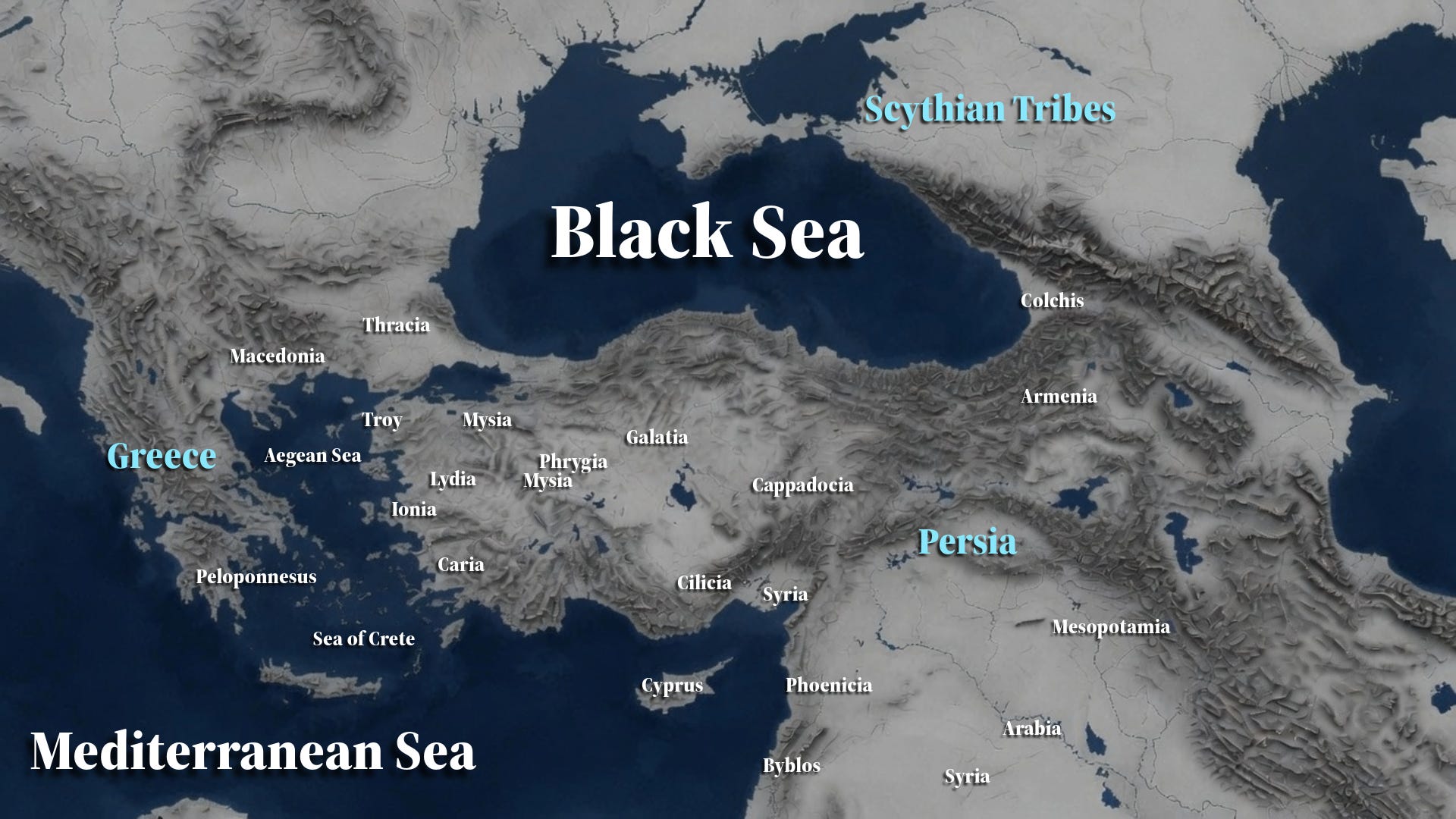
The Io–Belus–Agenor Tree: Africa and the Levant
This is the great Mediterranean‑wide genealogy, tracing the African and Asiatic nations to a single Argive wanderer.
Io [“she who sets in motion”, from a Pre‑Greek root, possibly connected to the moon] – The Wanderer
The line begins with Io, an Argive princess loved by Zeus and transformed into a heifer. In her bovine form she wandered the earth, crossing the sea that would later bear her name (the Ionian), until she finally reached Egypt, where Zeus restored her human shape. There she bore a son, Epaphus [“he of the touch”, from Greek epaphē, “touching”], who became king of Egypt and built the city of Memphis.
Epaphus → Libya
Epaphus married Memphis, the eponymous nymph of the city, and they had a daughter, Libya [from the Greek Libyē, the land of North Africa, probably borrowed from a local Berber or Egyptian term]. Libya personified the vast, fertile land that stretched from the Nile to the Atlantic, and she gave her name to the region.
Libya + Poseidon → Belus and Agenor
Libya lay with the sea‑god Poseidon [“lord of the earth”, from Greek posis “husband” + da “earth”, or possibly “lord of the waters”] and bore twin sons, Belus and Agenor. These two brothers became the patriarchs of the African and Asiatic nations respectively.
Belus – Egypt, Ethiopia, the Argive Line
Belus [from the Semitic Ba‛al, “lord”, the title of the Canaanite storm‑god, Hellenized as Bēlos] remained in Africa and ruled Egypt. His sons became the eponymous heroes of the major branches:
Aegyptus [Greek Aígyptos, derived from the Egyptian phrase ḥwt‑kꜢ‑ptḥ “Temple of the Ka of Ptah”, the great sanctuary at Memphis] – ruler of Egypt proper, whose fifty sons (the Aegyptiads) married the fifty daughters of his brother.
Danaus [“Danaan”, the name of the Homeric Greeks, Danaoi; of uncertain etymology, possibly from a root meaning “river” or “flow”] – who fled Egypt with his fifty daughters (the Danaids) and became king of Argos in Greece. From Danaus’ line, via Hypermnestra [“exceedingly mindful”, from hyper “above” + mimnēskō “remember”] and Lynceus [“lynx‑eyed”, from lynx “lynx”], descended the royal house of Argos: Abas → Acrisius → Danaë → Perseus [“the destroyer”, from Greek perthō “to sack, ravage”]. Perseus would later found Mycenae [Greek Mykēnai, perhaps from mykēs “mushroom” or a Pre‑Greek place name].
Cepheus [Greek Kēpheus, possibly a Hellenization of an Egyptian royal name, perhaps Kheops (Khufu), but uncertain] – who became king of Ethiopia [Greek Aithiopia, “land of the burnt‑faced people”, from aithō “I burn” + ōps “face”]. Cepheus and his wife Cassiopeia [Greek Kassiopeia, perhaps “she whose words excel”, from kasis “excellence” + epos “word”] were the parents of Andromeda [“ruler of men”, from anēr “man” + medō “to rule”], rescued by Perseus from a sea‑monster. Thus the Ethiopian and Mycenaean royal lines were mythologically linked.
Phineus (in some accounts) [“dark, blind”, from phinos “dark”] – associated with the far eastern or Ethiopian realm.
Agenor – Phoenicia, Cilicia, Boeotia, and Illyria
Agenor [“exceedingly manly, heroic”, from Greek agan “very” + anēr “man”] crossed into Asia and settled in the land that would become Phoenicia. His children became the founders of great cities and nations:
Phoenix [“purple‑red”, from Greek phoinix, the source of Tyrian purple dye] – the eponym of Phoenicia, the purple‑dyed maritime Canaanites.
Cilix [from Greek Kilix, eponym of Cilicia, probably from a local Anatolian name] – the founder of Cilicia in southeastern Anatolia.
Cadmus [Greek Kadmos, probably borrowed from a Semitic root qdm, “east”, designating the man from the east] – the most famous of Agenor’s sons. After a long search for his sister Europa, Cadmus founded the city of Thebes in Boeotia [Greek Boiotia, “cow‑land”, from bous “cow”]. He introduced the Phoenician alphabet to the Greeks and married Harmonia [“harmony, joint order”, from Greek harmos “joint, covenant”], daughter of Ares and Aphrodite. Among their children were Semele [possibly from the Thracian semelē “earth”], mother of Dionysus; Ino [from Greek is “strength”], Agave [“illustrious, noble”], Autonoë [“self‑minded”], and Polydorus [“many‑gifted”]. In their old age Cadmus and Harmonia were transformed into serpents and removed to the Illyrian land, where their son Illyrius [“the Illyrian”, eponym of Illyria, from a native tribal name] became the ancestor of the Illyrians.
Europa [“wide‑faced, broad‑eyed”, from Greek eurys “wide” + ōps “face, eye”] – abducted by Zeus in the form of a white bull and carried to Crete, she became the mother of King Minos, Rhadamanthys, and Sarpedon, and her name was given to the continent of Europe.
The Phrygian‑Trojan Link: Dymas and Hecuba
The Trojan royal family was also woven into this tapestry through Harmonia, Cadmus’ wife. Harmonia was the sister of Dardanus [perhaps “burned”, or from an Illyrian place name], the founder of the Trojan line: Dardanus → Erichthonius [“very chthonic, deeply of the earth”] → Tros [“Trojan”] → Ilus [“Ilian”] → Laomedon [“ruler of the people”, from laos “people” + medō “rule”] → Priam [“ransomed, redeemed”, from Greek priamai “to buy”], king of Troy [Greek Troia, from Tros].
Priam married Hecuba [Greek Hekabē, possibly “far‑off”, from hekas “far”, or a Phrygian name], daughter of the Phrygian king Dymas [“strong, powerful”, from Greek dynamai “to be able”, or a Phrygian word]. Phrygia, a kingdom of central Anatolia, thus enters the genealogy. The Phrygian writer Dares described Hecuba as “beautiful, her figure large, her complexion dark. She thought like a man and was pious and just.” Her dark complexion, preserved in the Greek memory, hints at the Afro‑Anatolian connections that the library has traced from the Colchians to the Troad.
Perseus, Mycenae, and the Libyan Gorgons
Returning to the branch of Danaus and the Argive line, Perseus – great‑grandson of Danaus – was sent to kill the Gorgon Medusa. The Gorgons [“dreadful, terrible”, from Greek gorgos “grim, fierce”] were located, according to Hesiod and later authors, in the far west of Libya, near the ocean. Medusa [“guardian, protectress”, from Greek medō “to protect, rule over”] was the only mortal Gorgon. Armed with winged sandals, a sickle, and the helmet of Hades, Perseus slew Medusa, and from her blood sprang the winged horse Pegasus [“of the spring”, from Greek pēgē “spring, fountain”] and the giant Chrysaor [“golden sword”, from chrysos “gold” + aor “sword”]. On his return he rescued the Ethiopian princess Andromeda, daughter of Cepheus, thus uniting the Mycenaean Greek line with the African Ethiopian line. Perseus then founded Mycenae, the greatest city of the Greek Bronze Age.
Thus a single genealogy, originating with the wandering Io, ties together Egypt (Belus), Ethiopia (Cepheus), Phoenicia (Phoenix), Boeotian Thebes (Cadmus), Illyria (Illyrius), Troy (through Harmonia and Dardanus), Phrygia (Dymas, Hecuba), Mycenae (Perseus), and the wild, Medusan Libya. In the mythographic imagination, the entire inhabited world was one family, and the memory of that unity was preserved in the names of its scattered children.
The Deucalionid Tree: The Post‑Flood Hellenes
When Zeus flooded the earth, the righteous Deucalion [“new‑wine sailor,” from deukos “sweet wine” + halios “of the sea”] and Pyrrha [“red,” from pyrros “flame‑coloured”] repopulated the world by throwing stones. Their son Hellen [“the Greek”] fathered the eponyms of all Hellenic tribes:
Dorus [“gift,” from dōron] – ancestor of the Dorians. His son Aegimius gave his name to the tribes Hylleis [“of Hylleus,” perhaps from hylē “wood”] and Dymanes
Aeolus [“quick‑moving, nimble,” from aiolos “swift”] – eponym of the Aeolians.
Xuthus [“yellow, blond”] – father of Achaeus [“Achaean”] and Ion [“Ionian,” possibly from the same root as Io]. The Achaeans dominate Homer, the Ionians settled Attica and the central Aegean.
The Pelasgian Tree: Autochthonous Ancestors
Before the Hellenes, the land was inhabited by the Pelasgians, born from the soil. Their eponym Pelasgus [“Pelasgian,” from a Pre‑Greek root, perhaps “neighbor” or “flatland‑dweller”] appears in several regions:
Arcadia: Pelasgus, son of Zeus and Niobe, or earth‑born. He fathered Lycaon [“wolf,” from lykos], whose fifty impious sons gave their names to Arcadian towns before being destroyed; Zeus turned Lycaon into a wolf. The line continued through Nyctimus and Arcas [“bear,” from arktos], eponym of all Arcadians. Arcas’ sons Azan, Apheidas, and Elatus named the Arcadian districts.
Argos: Another Pelasgus taught agriculture and founded Larissa.
Thessaly: Pelasgus fathered Haemon, eponym of Haemonia (ancient Thessaly).
Lesbos: Pelasgus was also claimed as an ancestor of the island’s pre‑Greek stock.
The Iapetid Tree: Titans and the Far West
The Titan Iapetus [“the piercer,” from iaptō “to wound, hurl”] fathered the ancestors of humanity and the edges of the world:
Atlas [“enduring,” from a‑ intensive + tlaō “to bear”] holds up the sky. His daughters the Pleiades become mothers of royal lines: Taygete (mother of Lacedaemon [“of the lake‑demon,” from laccos “pond” + daimōn “spirit”], eponym of Laconia/Sparta), Maia (mother of Hermes), Electra (mother of Dardanus [perhaps “burned”] and Harmonia, linking this tree to Troy). Atlas is also father of Calypso and the Hesperides, placing him in the far west.
Prometheus [“forethought”] – creator of mankind, in some versions father of Deucalion.
Epimetheus [“afterthought”] – husband of Pandora, father of Pyrrha.
This tree connects the Greek mainland (Sparta) to the far western Ocean and to Troy.
The Arcadian Tree: The Wolf‑Line
Deep in the mountains of Arcadia, the oldest people of Greece traced themselves to Lycaon [“wolf”]. Before the flood, his fifty sons founded the towns of the region, each name a son: Phigalus, Tegeates, Mantineus. After Lycaon’s impiety, Zeus turned him into a wolf, but the line persisted through Nyctimus and, later, Arcas [“bear”], the eponym of all Arcadians. Arcas’ sons Azan, Apheidas, and Elatus gave their names to the three great Arcadian districts. The Arcadians were called “pre‑lunar,” having lived before the moon, and their genealogy anchored them in the very soil.
The Lydian–Phrygian Tree: Tantalus and Pelops
In Lydia, by Mount Sipylus, ruled Tantalus [“most wretched,” or from a Lydian word], a king who stole the food of the gods. His son Pelops [“dark‑faced,” from pelios “dark” + ōps “face”] fled to Greece, conquered the peninsula that now bears his name—the Peloponnese (“Island of Pelops”). Pelops’ sons divided the land:
Atreus [“fearless,” or a‑ + treō “to tremble”] – king of Mycenae.
Thyestes [“incense‑bearer,” from thyos “incense”] – rival of Atreus.
Pittheus – king of Troezen.
Alcathous – king of Megara.
Chrysippus – disputed heir.
This tree maps the political geography of the pre‑Dorian Peloponnese and anchors the Phrygian/Lydian connection to Greece through the dark‑faced Pelops. The Phrygian king Dymas [“strong, powerful,” from dynamai “to be able,” or a Phrygian name], father of Hecuba, ties Troy into this Anatolian network as well.
The Cretan Tree: Minos and the Aegean
From Europa’s union with Zeus, the Cretan line emerged. Minos [“king,” or from a Minoan word] ruled Knossos and became judge of the dead. His children include Deucalion (a Cretan, not the flood survivor), Ariadne [“very holy,” from ari‑ “very” + hagnē “holy”], Phaedra [“bright”], and Catreus. Minos’ brother Rhadamanthys [“judge,” from rhadamos “branch” + anthos “flower”?] governed the Cyclades and gave laws to the Cretans. A third brother, Sarpedon [“rejoicing in the bow,” or an Anatolian name], migrated eastward to become eponymous king of Lycia. The Cretan tree thus ties the Aegean islands and southwestern Anatolia into the same sacred family.
The Theban Tree: Spartoi and Cadmeans
Thebes, founded by Cadmus, had its own internal mythology. When Cadmus sowed the dragon’s teeth, the Spartoi [“sown men,” from speirō] sprang from the earth and became the ancestors of the Theban aristocracy. Each noble clan traced itself to one of the five survivors, especially the Echionidae. Cadmus’ son Polydorus [“many‑gifted”] and grandson Labdacus [“lame,” or a local name] founded the royal house of the Labdacids, which produced Laius, Oedipus, and Antigone. Thus Theban identity was rooted in both imported Phoenician kingship (Cadmus) and autochthonous, dragon‑born nobility.
The Laconian Tree: Lelex and Lacedaemon
Before the Dorians, Laconia was ruled by the autochthonous king Lelex [“the Lelegian”]. His son Myles fathered Eurotas [“flowing well,” from eu‑ + rheō “to flow”], eponym of the Spartan river. Eurotas’ daughter Sparta married Lacedaemon [“of the lake‑demon,” from laccos “pond” + daimōn “spirit”], a son of Zeus and the Pleiad Taygete. Lacedaemon gave his name to the land, Sparta to the city. Their son Amyclas founded Amyclae, and the line continued through Tyndareus to the age of heroes. This tree legitimized Spartan rule before and after the Dorian migration.
The Oceanid Tree: Rivers and Springs
The Titan Oceanus [“ocean,” from Greek ōkeanos, possibly a Semitic loan] and his wife Tethys [“nurse, grandmother,” from a root meaning “to suckle”] produced three thousand sons—the river gods—and three thousand daughters—the Oceanids. Each river god was the eponym and ancestor of a valley’s people: Inachus (Argos), Asopus (Boeotia, himself father of many city‑eponyms), Achelous (Aetolia), Peneus (Thessaly). The Oceanids included Dione [“divine queen”], mother of Aphrodite; Metis [“wisdom”], mother of Athena; and Styx [“hateful”], goddess of the oath‑river. Every spring and stream was thus woven into the divine genealogy, rooting each community in the cosmic order.
323 BCE
The hardening of Greek ethnocentrism was not a sudden invention of Diodorus Siculus in the first century BCE. It was a slow, accumulating process, and its roots reach back much earlier. But the crucial shift—the moment when cultural chauvinism began to acquire the sharp edge that would later be mistaken for biological racism—can be located with some precision: not with Diodorus, but in the wake of Alexander’s conquests and the early Hellenistic period.
The Archaic and Classical Greeks: Ethnocentrism Without Systematic Racism
The earliest Greek literature already contains the seeds of chauvinism. Homer’s epics, composed in the eighth century BCE, are profoundly ethnocentric in that they centre the Greek-speaking heroes and treat the Trojans and their allies with a mixture of respect and distance. But there is no systematic racial theory. The physical descriptions of individuals—Eurybates the dark-skinned, woolly-haired herald of Odysseus (Odyssey 19.246–248)—are incidental, not loaded with contempt. The word barbaros does not appear in Homer at all; it emerges later, as a linguistic marker for those who do not speak Greek, their speech sounding like the repetitive noise “bar-bar.”
Herodotus, writing in the fifth century BCE, is the great counter-example. He is ethnocentric in the sense that he is a Greek writing for a Greek audience, fascinated by the customs of others but always measuring them against his own. Yet his curiosity is genuine, and his willingness to acknowledge Greek debts to Egypt, Phoenicia, and other foreign cultures is remarkable. He does not rank peoples by any inherent quality of their blood. His descriptions of physical appearance—the dark skin and woolly hair of the Colchians and Egyptians, the woolliest hair of the Ethiopians—are matter-of-fact, not derogatory.
Thucydides, writing at the end of the same century, is more austere and less interested in foreign customs, but he too lacks a systematic theory of racial hierarchy. The Athenians in his pages boast of their cultural superiority, but the basis is political and military, not biological. The Spartan contempt for the Helots is brutal, but it is a class and conquest-based contempt, not a racial one in the modern sense.
The Fourth Century BCE: The First Stirrings of a Harder Ethnocentrism
The first significant shift occurs in the fourth century BCE, particularly in the writings of Isocrates and Aristotle, and it is intimately connected to the political and military crises of the age.
Isocrates, the Athenian orator and pamphleteer, began to articulate a vision of Greek unity against the barbarian—specifically the Persian—that moved beyond simple cultural pride. In his Panegyricus (c. 380 BCE), he called for a pan-Hellenic crusade against Persia, arguing that the Greeks were naturally superior and that the barbarians were their natural enemies and subjects. This was not yet biological racism, but it was a deliberate, politically instrumental hardening of the old linguistic divide into a quasi-natural opposition. Isocrates needed a unified enemy to rally the squabbling Greek city-states, and he found it in the barbarian.
Aristotle, his contemporary, went further. In the Politics (Book 1, 1252b), he famously argued that “barbarians are by nature slaves,” and that it is just for Greeks to rule over them. This argument was grounded in his teleological view of nature: just as the soul rules the body, the rational rules the irrational, and the human rules the animal, so too the Greek rules the barbarian. The barbarian, in Aristotle’s scheme, was deficient in reason, incapable of self-governance, and therefore naturally suited to servitude. This was a philosophical justification for the enslavement of non-Greeks that had been practiced for centuries but never before articulated as a law of nature.
It is critical to note that Aristotle’s argument was not based on skin colour or physical anthropology. It was based on a theory of climate and political capacity. He believed that the cold climates of Europe produced spirited but unintelligent peoples, while the hot climates of Asia produced intelligent but spiritless peoples, and that the Greeks, living in the temperate middle, possessed the ideal blend of both qualities (Politics 7.7, 1327b). This climatic determinism, borrowed in part from the Hippocratic treatise Airs, Waters, Places, would prove enormously influential. It provided a pseudo-scientific framework for ranking peoples that could later be mapped onto skin colour and geography by the racial theorists of the modern era.
Alexander and the Hellenistic Period: The Ethnocentrism of the Conqueror
Alexander’s conquests (334–323 BCE) transformed the Greek relationship to the barbarian world. In theory, Alexander pursued a policy of fusion: he married Persian and Bactrian women, dressed in Persian royal attire, enrolled Persian youths in his army, and encouraged his generals to do the same. In practice, this fusion was deeply resented by his Macedonian and Greek soldiers, who saw it as a betrayal of their cultural superiority. The tension between the ideal of a mixed, cosmopolitan empire and the reality of Greek and Macedonian dominance shaped the entire Hellenistic period.
After Alexander’s death, his successors—the Ptolemies in Egypt, the Seleucids in Asia—ruled as foreign elites over vast, non-Greek populations. The Greek became the ruling class, and the barbarian became the subject. This institutionalization of Greek superiority produced a more rigid, more self-conscious ethnocentrism. The Greeks of Alexandria, Antioch, and the other new foundations lived as a privileged minority, their identity defined by language, education, and the gymnasium. Intermarriage with the native population was, in many cases, discouraged or forbidden. The old, porous boundaries between Greek and barbarian began to harden.
It is in this context that the Greek translation of the Hebrew Bible, the Septuagint, was produced in Alexandria in the third and second centuries BCE. The translators rendered the Hebrew genealogies—the Table of Nations in Genesis 10, which divided the world into the sons of Shem, Ham, and Japheth—into Greek. This act of translation, seemingly innocent, had profound consequences. It introduced into the Greek intellectual world a divinely sanctioned scheme of ethnic division that had no precedent in classical Greek thought. The biblical genealogy was not racial in the modern sense, but it provided a framework that could later be racialized.
Diodorus Siculus: The Culmination, Not the Beginning
Diodorus, writing in the first century BCE, is the heir to all of these developments. His Library of History is a vast compilation of earlier sources, and his ethnocentrism is that of his age: a Greek writing for a Greek-speaking audience under Roman rule, convinced of the superiority of Greek civilization, but also capable of reporting, with apparent respect, the Egyptian claim that Egypt was a colony of Ethiopia and that the gods originated in Africa (Book 3). Diodorus does not invent a new, more aggressive ethnocentrism. He synthesizes and transmits an old one, already hardened by Aristotle, institutionalized by Alexander’s successors, and now operating within the vast, multi-ethnic matrix of the Roman Empire.
Diodorus Siculus, Library Of History:
“§ 3.8.1 But there are also a great many other tribes of the Ethiopians, some of them dwelling in the land lying on both banks of the Nile and on the islands in the river, others inhabiting the neighbouring country of Arabia, and still others residing in the interior of Libya. 2 The majority of them, and especially those who dwell along the river, are black in colour and have flat noses and woolly hair. As for their spirit they are entirely savage and display the nature of a wild beast, not so much, however, in their temper as in their ways of living; for they are squalid all over their bodies, they keep their nails very long like the wild beasts, and are as far removed as possible from human kindness to one another; 3 and speaking as they do with a shrill voice and cultivating none of the practices of civilized life as these are found among the rest of mankind, they present a striking contrast when considered in the light of our own customs.”
The truly aggressive, systematic, biological racism that the modern world knows did not emerge from any Greek pen. It was a product of the early modern European encounter with Africa and the Americas, a justification for plantation slavery and colonial empire that was retroactively dressed in the language of Aristotle, the Bible, and the classical tradition. The Greeks provided the raw materials—the climatic determinism, the natural slave theory, the binary of Greek and barbarian—but the edifice of modern racism was built by later hands, for later purposes. The sorrow is that the Greeks, who had once been so curious about the world, were conscripted posthumously into a project they would not have recognized. The library exists to undo that conscription, and to let the ancient texts speak again, free of the burden of a modern myth.
FROM THE AUTHOR:
I had intended to open this series of articles titled ‘Western Civilization Can’t Be Honest’ with a piece arguing that Westerners cannot be honest—not as a moral failing, but as a structural condition. However, Shahid Bolsen has already articulated this viewpoint with his own idiosyncratic clarity, and while there are differences between his framing and mine, the substance is substantially the same. His work will serve as a sufficient introduction. A link, follows.
The endless societal cycle of invention, organization, invasion, exploitation, and collapse has repeated itself for the last three thousand years. This recurrence has been accepted as inherent to the system itself—as though civilization were a machine that must, by its nature, wear down and break. It is not inherent to communal living per se— in my opninion. It is inherent to a specific type of organization, one that has proliferated under conditions that cause the overproduction of a particular psychological trait: the empathic-narcissistic trait complex.
This overproduction, as in any ecosystem, also overproduces the predators—the sociopaths—who feed upon the drones of the hive. The balance of the ecosystem, once disrupted in this way, cannot be easily restored.
The second reason for collapse is more subtle. The rigidity of the structure is mistaken for strength. Institutions that cannot bend are celebrated for their solidity. Traditions that cannot adapt are honored for their purity. Leaders who cannot change their minds are admired for their resolve. But rigidity is not strength. It is brittleness. And brittle things break.
The fundamental premise of this series is to point at the obvious. Any expert from any of the disciplines these arguments touch upon could articulate any of these points with greater expertise than I possess. The evidence is there, lying in plain sight, right beside the official narrative. But selective honesty has been chosen because authority demands it. The result is that the real objectivity must always be read between the lines of the official story. Within that narrative, preserved in its gaps and silences and careful omissions, the truth remains legible.
However, the real work is to create an ideaology or organization that can synthesize people of different levels of psychological development and tendential character, strong enough to defend it self against the tendentious manipulations of the professional class of sabatuers.