
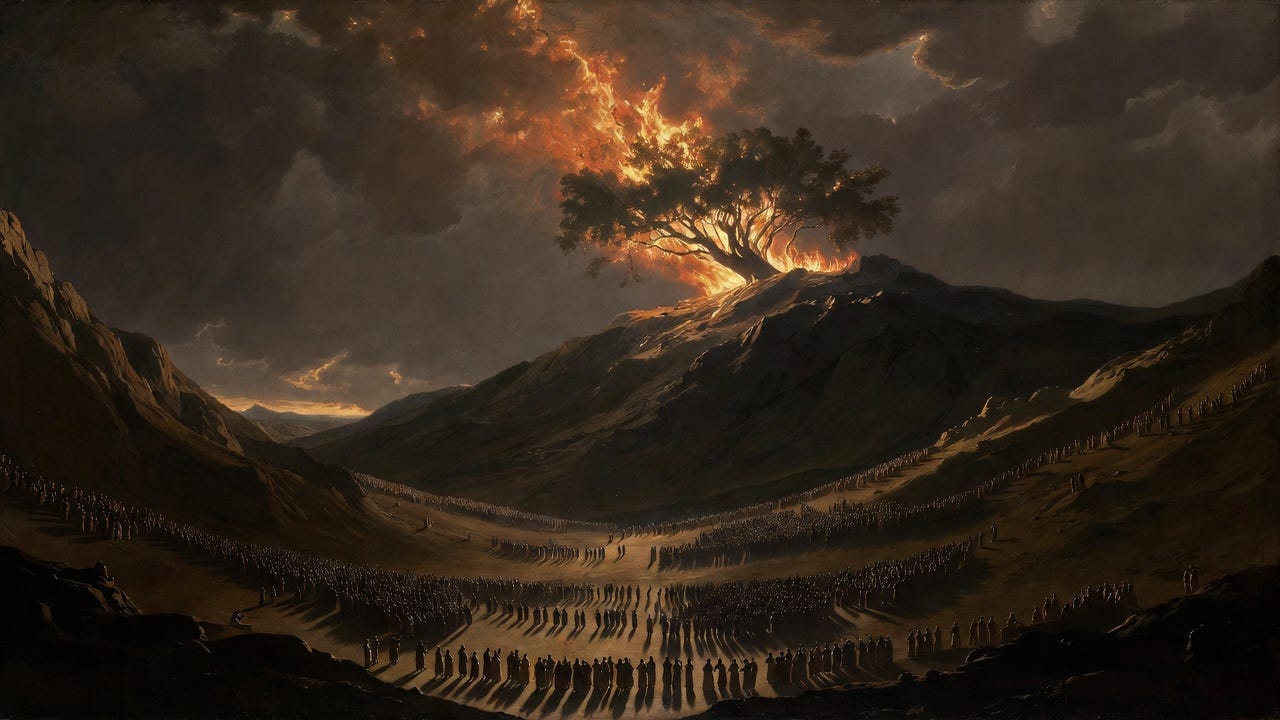
Exodus 3:2:
ὁ βάτος καίεται πυρί, ὁ δὲ βάτος οὐ κατεκαίετο
(ho batos kaietai pyri, ho de batos ou katekaieto)
"The bush burns with fire, yet the bush was not consumed."
The Kurgan hypothesis is, at its core, an equation of gene flow with language flow. If the genes moved, the words must have moved. The steppe migrants, the Yamnaya, the Corded Ware, the Bell Beaker peoples: they carried their haplogroups across continents and left their bones in the earth, and the guild, seeing those bones and reading those genes, assumed the language must have come with them. But the Library is driving a wedge between the two, and that wedge is made of Edo roots, epi and sed and afia and ozu, living in a West African forest where no chariot wheel ever rolled. If you haven’t read The Odyssey Autochthon: The Complete Destruction of the Indo-European Racial Narrative. This article will explain why you should.
In the Bronze Age, the mountain we now call Sinai was not a howling wilderness at the edge of the world; it was Egyptian ground. The turquoise mines of Serabit el-Khadim pitted the red granite of its southern massif, and the pharaohs of the Middle and New Kingdoms sent expedition after expedition into that furnace to extract the blue-green stone that the goddess Hathor loved. Hathor, the Lady of Turquoise, had a temple there, a sanctuary cut into the living rock, where Semitic-speaking miners—Canaanites and Midianites and the assorted captives of empire—scratched their own alphabetic prayers onto the stones in the first flickering experiments with what would become the alphabet. Sinai was a zone of cultural collision and imperial extraction, a sacred landscape before Moses ever saw a bush there, a place where Egyptian priests and Asiatic laborers shared the same water, the same heat, and the same gods. The mountain that would become the pivot of the Hebrew covenant was, for centuries before the Exodus narrative was written down, a site of revelation for the empire of the Nile.
The Edo people of what is now southern Nigeria preserve a memory that threads directly into that same ancient landscape. In their oral tradition, a prince named Avan, slighted by a meal of frog meat, planted the seed of the pepper-fruit tree—the ako—and sang it skyward: Ako mwe tan re, Igiogio. The tree obeyed, and Avan climbed its trunk into the heavens and became thunder. The ako is a tree whose fruit burns the mouth with an internal fire that does not consume the branches, a botanical embodiment of the same paradox that spoke to Moses from the seneh. And the seneh is a bush whose name appears in the Hebrew Bible only in the story of the burning and in the name of the mountain itself: Sinai, the Mountain of the Bush. If the bush is a pepper tree—if the fire that does not consume is the same fire that the Edo recognize in the fruit of the ako—then the revelation at the heart of the Abrahamic tradition and the thunder-hymn of a West African prince are two branches of a single, far more ancient revelation, one that Egypt knew and that the world forgot. This is how we got here: not by a migration of texts, but by tracing the root that burns.
Diodorus Siculus, Library Of History:
“§ 3.8.1 But there are also a great many other tribes of the Ethiopians, some of them dwelling in the land lying on both banks of the Nile and on the islands in the river, others inhabiting the neighboring country of Arabia, and still others residing in the interior of Libya. 2 The majority of them, and especially those who dwell along the river, are black in colour and have flat noses and woolly hair…
Yes, it is entirely possible—and once you see it, the logic is inescapable.
The Hebrew word for the bush in Exodus 3:2 is סְנֶה (seneh), a word that appears nowhere else in the Hebrew Bible except in the name of the mountain itself: סִינַי (Sinai), the Mountain of the Bush. The bush and the mountain share a root, a linguistic fingerprint that ties the place of revelation to the plant that burned. But what plant? The text does not specify. The Septuagint translates seneh as βάτος (batos), a generic thorny bramble, and the tradition has more or less settled on a kind of acacia or wild desert thornbush—nothing remarkable, nothing edible, nothing that would draw the eye. A nondescript shrub, made miraculous only by the fire.
But the Library is asking a different question. The Library is asking whether the burning bush could be a pepper tree—specifically, the ako tree of the Edo thunder-hymn, the Ako mwe tan re, Igiogio, the pepper-fruit tree that Avan planted in his fury and climbed to become thunder. And once you lay the two stories side by side, the correspondence is too precise to dismiss.
The pepper tree bears fruit that is hot, that burns the mouth, that carries fire inside its skin. To stand before a pepper tree in full fruit is to stand before a bush that is, in the most literal sense, burning with an inner fire that does not consume the branches. The Edo ako is the same tree that appears in the Egyptian ꜥk (a plant of fiery or purifying properties), the same tree that gives the Greek akē (a point, a thorn, a remedy), the same tree that the linguists have filed under “spices” and never once thought to place on the holy mountain. But the mountain of the bush, Sinai, is a pepper tree mountain. The thornbush that burns and is not consumed is a pepper tree, laden with fruit that sting the tongue, a visible embodiment of the divine paradox: that which wounds also heals, that which burns also purifies, that which is small and green and unremarkable contains a heat that does not die.
The Moses who approaches the bush is a man who has already fled one identity and is about to assume another. The fire that speaks from the pepper tree is the same fire that Avan planted in the earth with a song—the thunder that grows from a seed, the voice that emerges from a fruit that stings the mouth like flame. The bush is a pepper tree because the pepper tree is the original sacred tree, the world-axis that burns from within, and the revelation on Sinai is a revelation of the same fire that the Edo have preserved in their memory of the prince who climbed into the sky. The guild has never made the connection because the guild has never asked what plant a seneh actually is, preferring to leave it in the safe category of “unknown desert shrub.” But the pepper tree, the ako, the burning bush that carries its fire in its own skin, is the answer that has been waiting in the Edo oral tradition, and in the Egyptian texts, and in the thunder-hymn, for someone to stop treating botany as decoration and start reading it as scripture.