



From The Author
The preceding essay, The Fertile Crescent: The Truer Story of the Old World Mullatos and Mestizos, traced the slow migration of pastoralist clans—bearers of the J haplogroup, descending from the highlands above the Caucasus and the shores of the Aegean—into the agricultural heartlands of the Levant and the Near East. It argued that their eventual dominance was not a simple tale of superior weaponry or innate ferocity. The tipping point was climatic: a three‑hundred‑year drought, which withered the crops of the settled farmers, emptied their granaries, shattered their fragile bureaucracies, and left the old urban order gasping. Into that vacuum, the pastoralist raiders—already adapted to scarcity, already mobile, already organized for predation—simply stepped. The drought was the door; the pastoralists were the wind that blew through it. This companion piece turns from the how of that transformation to the where: the mutual ecosystem of trade, language, cult, and kinship that had been maturing for millennia and that formed the deep, already‑ancient, already‑mixed background of the biblical world. In exitu Israel de Aegypto…
The Greek Question
The modern mind has placed Greece and the Bible in separate rooms. On one side, classical civilization—white marble, philosophy, the secular cradle of democracy. On the other, biblical faith—desert prophets, Semitic tongues, the sacred cradle of revelation. The wall between them seems so natural that it startles most people to learn that the New Testament was written entirely in Greek, that the Septuagint—the Greek translation of the Hebrew scriptures—was the Bible of the early Church, or that the basic vocabulary of Christian theology (Logos, hypostasis, ousia, kerygma) is not Hebrew but the technical language of Greek philosophy. The intertwining is not a minor detail.
The Renaissance recovered classical Greece as a model of humanism, art, and politics, but it did so by constructing a “pure” Greece, scrubbed of its oriental and Semitic entanglements. The Greece of Winckelmann and the neoclassicists was a white ideal, a dream of rational beauty that had sprung fully formed from European soil. Its Egyptian, Phoenician, and Near Eastern roots—the very roots that Herodotus had openly acknowledged—were denied or minimized. This idealized Greece could not be allowed to mingle with the biblical narrative, because the biblical narrative was Semitic, African, and Asiatic. The racial and cultural hierarchies of the modern West demanded a separation: classical Greece belonged to Europe, and the Bible belonged to a different, more primitive strand of antiquity, one that could be cordoned off as “Oriental” and handled by a separate guild of scholars.
Academic and theological compartmentalization solidified in the nineteenth century. Biblical studies became a discipline largely housed in seminaries and theology faculties, while classical studies migrated to the secular humanities. The biblical scholars learned Hebrew and Aramaic; the classicists learned Greek and Latin. The bridge between them—Hellenistic Judaism, the Septuagint, Philo of Alexandria, the cultural world of the Greek-speaking Diaspora—fell into a no man’s land.
The very word “Christ” is a Greek translation of the Hebrew “Messiah,” and the term “gospel” (euangelion) was a Greek imperial term for good news of a military victory or an emperor’s accession. Why, then, do modern people not associate Greece with the Bible? Because there has been a long campaign of forgetting.
The Classical Greek Divide: Let There Be Light
The ancient sources present us with a Greece that was never one thing. Homer, in the Iliad, scatters the Pelasgians among the allies of Troy and places them on the plain of Thessaly, while Herodotus, in the first book of his Histories, draws a sharper line. He tells us that the Lacedaemonians belong to the Dorian race and the Athenians to the Ionian, and he adds that the Ionian is in truth the old Pelasgian stock, a people who have never migrated, while the Dorian is the Hellenic race, “very exceedingly given to wanderings.” This division—Dorian and Pelasgian, wanderer and rooted, Greek and pre‑Greek—is the oldest philosophical map of the Greek soul. It is not a clean map. It leaks at every border. But it works brilliantly as a memetic device, a way of thinking about origins that the Greeks themselves found indispensable, and we would be foolish to discard it. When an ancient writer thought something important enough to mention, the mention itself is data, even if the fact is a phantom. We rarely get new data; we get new readings of the old. So let us read the old map again, and trace its lines eastward, to Mesopotamia and Egypt.
Herodotus believed that the Pelasgians spoke a barbarian tongue, a language that was not Greek, and he conjectured that they were the original inhabitants of the land. He found their remnants at Creston above the Tyrrhenians, at Plakia and Skylake on the Hellespont, and elsewhere in the Aegean, always speaking the same foreign speech. To connect the Pelasgians to Egypt, we need only follow the trail that Herodotus himself laid down. In his second book, he tells us that the Colchians of the Black Sea coast were Egyptian in origin, for they were dark‑skinned and woolly‑haired, and they alone, along with the Egyptians and Ethiopians, practiced circumcision from the first. Now, the Pelasgians are not the Colchians, but they belong to the same pre‑Greek stratum, the same barbarian‑speaking world that encircled the early Hellenic settlements. And there is a name that bridges the two: the Peleset. The linguistic echo between Pelasgian and Peleset is not definitive, but it is suggestive, and when we add the testimony of Herodotus that the oldest oracle in Greece, Dodona, was founded by a black dove from Egyptian Thebes—that is, an Egyptian priestess—we begin to see a pattern. The Pelasgians, in this reading, were the scattered remnants of an Afro‑Asiatic expansion, an Egyptian diaspora that had washed up on the shores of the Aegean long before the first Greek speaker kindled a fire on a hearth. Their customs—circumcision, the worship of a stellar goddess, the building of sacred precincts—were the customs of the Nile, translated into the cool air of the north.
The Dorians, by contrast, were the sons of the flood. Their name is Hellenic, and their ancestor is Hellen, the son of Deucalion. Deucalion is the Greek Noah. He and his wife Pyrrha, warned by his father Prometheus, built a chest and survived the great deluge that Zeus sent to destroy the Bronze Age race. When the waters receded, they repopulated the earth by casting stones behind them, and from those stones sprang the new men and women. Hellen was the father of Dorus, Aeolus, and Xuthus, and Dorus was the father of the Dorians. The flood story that Deucalion carries is not an indigenous Greek invention. It is the same flood that Utnapishtim survived in the Epic of Gilgamesh, the same flood that Atrahasis escaped in Babylon, the same flood that Noah rode out in Genesis. It is a Mesopotamian memory, carried westward by the very wanderings that Herodotus ascribes to the Dorian race. The Dorians, then, are the inheritors of a post‑diluvian legal tradition that originated between the Tigris and Euphrates. Their customs—the rigid laws of Lycurgus at Sparta, the communal messes, the iron currency, the prohibition against writing down the constitution, the entire apparatus of a state designed to freeze time—are a distant echo of the law codes of Hammurabi and the order that was imposed after the waters receded, when the world had to be rebuilt from scratch and every misstep threatened a return to chaos. Herodotus records that some say Lycurgus brought the Spartan constitution from Crete, and others from the Delphic oracle, but the deeper genealogy is mythic: the Dorians were the children of the deluge, and their customs were the customs of the survivors.
In Book 1, Section 7, he writes: “Now the supremacy which had belonged to the Heracleidai came to the family of Croesus, called Mermnadai, in the following manner:—Candaules, whom the Hellenes call Myrsilos, was ruler of Sardis and a descendant of Alcaios, son of Heracles: for Agron, the son of Ninos, the son of Belos, the son of Alcaios, was the first of the Heracleidai who became king of Sardis.”
Thus the two currents that fed classical Greece are a northern stream, Dorian and Mesopotamian, carrying the memory of the flood and the iron discipline of the lawgiver, and a southern stream, Pelasgian and Egyptian, carrying the memory of the Nile and the dark‑skinned priestesses who first taught the Greeks how to speak to the gods. Homer and Herodotus together give us this double inheritance. It is a mythographic truth, not a demographic one. The Dorians were not, in any literal sense, Babylonians, and the Pelasgians were not literally Egyptians. But the stories they told about themselves, and the stories that others told about them, encode a deeper reality: that the Greek world was born from the collision of two great river valleys, the Euphrates and the Nile, and that the sea between them was not a barrier but a bridge. The Pelasgian is the Egyptian memory, the black dove, the circumcised initiate. The Dorian is the Mesopotamian memory, the flood‑survivor, the law‑giver. When the Dorians overran the Peloponnese at the end of the Bronze Age, they were the final wave of wanderers who had been set in motion when the waters dried, and the Pelasgians they found there were the last remnant of an older, darker world. Their meeting was not tidy. It never is. But it was the forge in which the Greek miracle was hammered out, and we can still hear the ring of the hammer in Homer’s hexameters and Herodotus’ prose.
Dorian Pentopolis (Hexapolis)
Originally, there were six cities. The Dorian Hexapolis—the same five listed above, plus Halicarnassus—formed a religious league centered on the temple of Apollo Triopios, a sanctuary on the Cnidian peninsula near the coast. Each year the member cities gathered to celebrate the Triopian games and offer a bronze tripod to the god. But in the sixth century BCE, a citizen of Halicarnassus named Agasicles, having won the contest, took the tripod home and hung it on his own wall instead of dedicating it. Herodotus, in the first book of his Histories (1.144), records the consequence: “For this offense the other five cities—Lindus, Ialysus, Camirus, Cos, and Cnidus—excluded the sixth city, Halicarnassus, from the league.” The Hexapolis shrank to a Pentapolis.
This expulsion was not merely a matter of ritual propriety. It crystallized a Dorian identity that Halicarnassus, with its heavy admixture of Ionian and Carian influences, could no longer fully represent. The five remaining cities were all founded, according to tradition, by Dorian settlers from the Argolid during the migrations that followed the fall of the Mycenaean palaces. They spoke a Dorian dialect, observed the three Dorian tribes (Hylleis, Dymanes, Pamphyloi), and maintained the conservative, disciplined ethos that the Greeks associated with the Dorian character. By cutting away the one city that had diluted its Dorian purity, the Pentapolis became the definitive expression of Dorianism on the Asian coast—a counterweight to the Ionian Dodecapolis to the north and the Aeolian cities to the northwest.
Lindus
Ialysus
Camirus
Cos
Cnidus
Halicarnassus- Herodotus Home
Why the Greeks Never Mention the Canaanites?
The Greek silence on the Canaanites is not a mystery; it is a translation error that hardened into a fact. The Greeks did not ignore the Canaanites; they simply called them something else. By the time Greek merchant‑scholars first began writing down their observations of the Levantine coast, the great Bronze Age cities of Canaan—Ugarit, Hazor, Megiddo—had already been destroyed, absorbed, or transformed by the upheavals of the Sea Peoples and the subsequent Iron Age recovery. The coastal survivors of that collapse were a people who called themselves Kenaʿani, but the Greeks, encountering them through the filter of the Aegean trade network, fastened instead on the single most conspicuous feature of their commerce: a purple dye so vivid and so valuable that it came to define an entire people. They called them Phoinikes—the Purple People—and the name stuck so firmly that the older ethnonym simply vanished from the Greek lexicon. The word “Canaanite” appears in the Hebrew Bible, in Egyptian annals, in Akkadian records, but never in Homer, never in Herodotus, never in Thucydides. The Greeks were looking at Canaanites every time they docked at Tyre or Sidon; they just never knew it, because the label they used had been dyed a different color. Modern scholarship has, with characteristic pedantry, sometimes treated this as evidence that the Phoenicians and the Canaanites were different populations, a neatly bifurcated taxonomy that allows the West to claim the alphabet and the purple without any uncomfortable genealogical entanglements with the Hamitic, African‑adjacent world that Genesis so explicitly describes. It is a lovely trick, and it has worked for over two thousand years.
The Phoenician Impact on Greek Culture
The debt that Greek civilization owed to the Phoenicians was so overwhelming, and so openly acknowledged by the Greeks themselves, that only a sustained campaign of selective forgetting could have reduced it to a footnote in the Western imagination. Begin with the letters on this page. The Greek alphabet was not a native invention; it was a direct adaptation of the Phoenician abjad, a system of twenty‑two consonants that the Greeks encountered through their trading contacts with the Levantine coast. Herodotus, that incorrigible collector of uncomfortable facts, states the matter plainly: the letters were Phoinikeia grammata—Phoenician letters—and the Greeks who adopted them were, by their own admission, latecomers to the technology of writing. The very word “alphabet” derives from the first two letters of that borrowed system: aleph and bet, the ox and the house, transformed into alpha and beta.
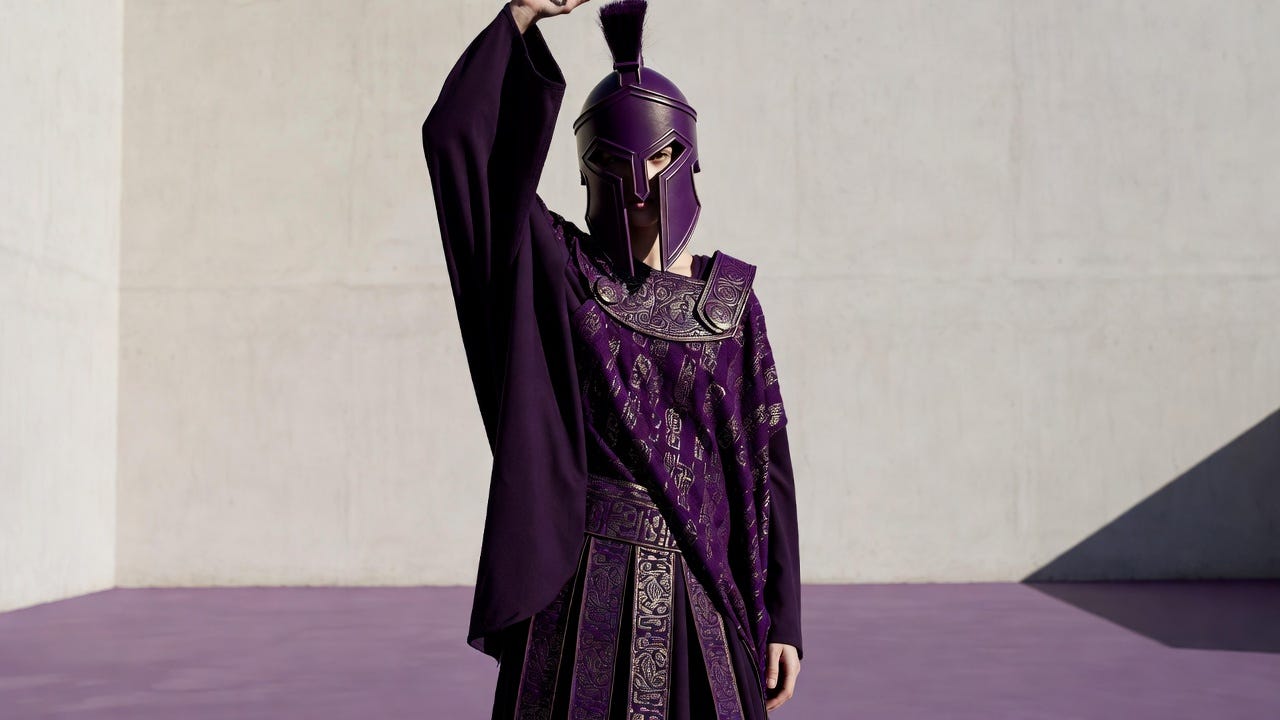
Then there is the color purple. The dye extracted from the murex snail, a process perfected in the vats of Tyre and Sidon, produced a hue so stable and so brilliant that it became, across the entire Mediterranean, the unquestioned mark of royalty and divine authority. The Greek word porphyra, the Latin purpura, the English “purple”—all trace back to the Phoenician trade. When the kings of Mycenae, of Athens, of Macedon, and eventually of Rome draped themselves in purple robes, they were wrapping themselves in a color that had been invented by Canaanite craftsmen and distributed by Canaanite merchants. The cloth was a statement of power, and the power was Phoenician before it was ever Greek or Roman.
The myths, too, were imports. Europa, the Phoenician princess carried across the sea by Zeus in the form of a bull, gave her name to an entire continent, and her home, according to the legend, was Tyre. Cadmus, her brother, traveled to Greece searching for her and, in the process, taught the Greeks the alphabet—a myth that, in its own way, encodes the historical transmission of writing from the Levant to the Aegean. Adonis, the dying and resurrected lover of Aphrodite, is a Hellenization of the Canaanite Tammuz. Heracles, that most Greek of heroes, was, in his original form, a Hellenic reworking of the Phoenician Melqart, the god of Tyre and its far‑flung colonies. Even the architecture of the early Greek temples, with their cedar‑roofed colonnades and their gold‑and‑ivory cult statues, owes a direct debt to the Phoenician sacred precincts that the Greek travelers had seen at Sidon and Byblos. The Greeks, to their credit, remembered all of this. Herodotus, Pausanias, and a host of lesser‑known writers recorded the borrowings with a frankness that borders on the embarrassing. The erasure came later, when Greek civilization was re‑imagined as a self‑generated miracle of European genius, a fantasy that the Romans, the Renaissance, and the Enlightenment all found too useful to question. The Phoenicians, the Canaanites, the Africans who had provided the alphabet, the purple, and the gods themselves, were quietly removed from the genealogy, leaving behind only the faintest trace—a word, a color, a princess on a bull—as evidence of a debt that the West has still not fully acknowledged.
Purple Label: The First Designer Cult
The Greeks did not merely borrow the color purple; they absorbed it so thoroughly into their own symbolic vocabulary that its foreign origin became invisible. The explanations for this adoption are multiple, layered, and mutually reinforcing.
First, the raw economics of scarcity. Tyrian purple was obscenely expensive to produce. Each murex snail yielded a single drop of dye; thousands of snails were required to color a single garment. The process was labor‑intensive, malodorous, and required a level of technical expertise that was concentrated in the Phoenician coastal cities. The cost of a purple robe was, quite simply, prohibitive to all but the wealthiest individuals. In a world without modern credit or liquid capital markets, the ability to acquire and display purple cloth was an unambiguous signal of economic power. The Greeks, who were acutely sensitive to the language of status, recognized this immediately. Purple was not merely beautiful; it was a public declaration that the wearer could command resources that were beyond the reach of ordinary men. The transition from economic signal to political symbol was almost automatic. The king who could afford purple was the king who could afford armies, fleets, and tribute. The color became a metonym for the power that purchased it, and the power, in its original form, was Phoenician commercial supremacy.
Second, the sacred dimension. The Phoenicians did not stumble upon the purple dye by accident; they embedded it within a religious framework that connected the color to the divine. The murex was associated with Astarte, the great goddess of Tyre and Sidon, who was herself a local manifestation of the same celestial Aphrodite whose oldest temple, at Ascalon, Herodotus identified as the source of the cult. The dye vats were located within temple precincts; the production of purple was, at its origin, a sacred industry, supervised by priests and dedicated to the goddess. When the Greeks adopted the color, they adopted the association as well. The purple robe of the Greek king was not merely a secular garment; it was a remnant of the old Near Eastern institution of divine kingship, in which the monarch was the earthly representative of the god. The color that had once belonged to Astarte now belonged to Zeus, to Apollo, to the Olympian order, but the chain of transmission was unbroken.
Third, the psychology of prestige and the anxiety of influence. The Greeks, for all their acknowledged debt to the Phoenicians, were acutely aware that they were latecomers to the Mediterranean world. The Phoenicians had been sailing the sea, founding colonies, and trading in luxury goods for centuries before the first Greek polis minted a coin or raised a temple. The adoption of purple, like the adoption of the alphabet, was an act of strategic emulation. To wear purple was to participate in the prestige of the older, richer, more sophisticated civilization. It was a form of cultural aspiration, a claim to belong to the same exclusive club that had been dominated for so long by the Canaanite merchants. And yet, as with all such borrowings, the Greeks could not simply acknowledge the debt and move on. The very act of emulation required a corresponding act of erasure. The more thoroughly purple became associated with Greek and later Roman royalty, the more uncomfortable it became to remember that the color had been invented by a people whom the Greeks otherwise marginalized. The symbol was retained; the memory of its origin was quietly discarded.
Finally, the biological and sensory impact of the color itself. Purple is not a common hue in the natural world. It is rare in minerals, rarer still in plants, and almost nonexistent in the fur or feathers of animals. To encounter a deep, saturated purple in the ancient Mediterranean was to encounter something that felt, almost viscerally, unnatural, otherworldly, superhuman. The color demanded explanation, and the explanation that presented itself was that purple was the color of the gods, or at least of the mortals whom the gods had chosen to elevate. The psychology of color perception, the sheer physical rarity of the dye, and the economic logic of scarcity combined to produce an effect that no single factor could have achieved alone. The Greeks continued the purple tradition because purple was the most efficient technology of status ever invented—efficient because it worked on the senses before it worked on the mind, and efficient because the mind, once captured, generated its own justifications.
In the end, the Greeks kept purple for the same reason that every inheritor of a stolen legacy keeps the treasure while losing the receipt. The color was too beautiful, too powerful, too useful to surrender. And the people who had invented it were too distant, too foreign, and ultimately too inconvenient to remember. The forgetting was not an accident. It was a strategy, and it worked.
Phoenician Practices That Tie Them to Egypt, the Evidence of Relation, and the Biblical Link from Cush
The Phoenicians are not merely connected to Egypt by trade; they are, by their own admission and by the witness of their neighbors, a people whose fundamental cultural practices derive from the Nile Valley. Herodotus, in the same passage where he identifies the Colchians as Egyptian, notes that “the Phoenicians and the Syrians of Palestine themselves confess that they learned the custom from the Egyptians.” The custom in question is circumcision, that ancient marker of identity that the Egyptians, the Ethiopians, and the Colchians alone, among all mankind, had practiced from the first. The Phoenicians, when asked, did not claim to have invented the rite; they acknowledged that it came from Africa. This is a remarkable admission from a people whose cultural prestige was, by Herodotus’s time, already immense, and it is an admission that the standard narrative has been conspicuously reluctant to amplify. A people who learn their most intimate bodily ritual from another civilization are not merely trading partners; they are cultural descendants, and the Phoenician debt to Egypt is written on the very bodies of their men.
The material evidence reinforces the textual. Egyptian scarabs, faience amulets, alabaster vessels, and statues of Hathor and Bes have been found in Phoenician temples and tombs from Byblos to Carthage. The temple of Baalat Gebal at Byblos was essentially an Egyptian foundation, endowed by pharaohs who considered the city an extension of their own sacred geography. The Phoenician goddess Astarte was identified, by both the Phoenicians and their neighbors, with the Egyptian Isis and Hathor, and the iconography of the two goddesses is so intermingled that it is often impossible to tell where one ends and the other begins. The Egyptian influence on Phoenician art, religion, and kingship was not a superficial veneer; it was a deep, structural inheritance that persisted for millennia.
And then there is the biblical genealogy, which, for all its theological agenda, preserves a memory that the secular histories have worked very hard to forget. In the Table of Nations in Genesis 10, Canaan is the son of Ham, the brother of Cush (Ethiopia/Nubia) and Mizraim (Egypt). The Canaanites—and thus their Phoenician descendants—are, in the biblical framework, a Hamitic people, African in their deepest ancestry, kin to the Egyptians and the Nubians from whom they learned their most sacred customs. This is not a marginal detail; it is the foundational ethnography of the ancient Near East, and it places the Phoenicians squarely within the African‑Levantine world that the library has been tracing. The standard narrative has treated this genealogy as a theological curiosity, a piece of biblical mythology with no bearing on the real history of the Mediterranean. But the real history, as we have seen, confirms it at every turn: the circumcision, the incense, the goddess, the alphabet, the genetic substrate—all of it points back to the same Afro‑Asiatic source. The Phoenicians were not a European people who happened to live on the coast of Lebanon; they were a Canaanite people, an Egyptian‑trained people, a people whose blood and culture were as African as they were Asiatic, and the failure to acknowledge this is not scholarship but erasure.
How Phoenicians & Carthaginians Turned Nuragic Sardinia Into Their Western Empire
Before the first Phoenician ship ever touched its shores, Sardinia was already home to one of the most distinctive Bronze Age cultures of the Mediterranean: the Nuragic civilization. From roughly 1800 BCE until the Roman conquest, the Nuragic peoples built thousands of dry‑stone towers called nuraghi, some of which still dominate the Sardinian landscape. They worked bronze and later iron, traded with the Mycenaeans and Cypriots, and left behind a rich corpus of bronze figurines that depict warriors, priests, and animals with a striking, almost surreal stylization. The Nuragic society was not a single unified kingdom but a mosaic of chiefdoms, each centered on its own tower‑complex, and it was into this fragmented, locally‑rooted world that the Phoenicians began to insert themselves in the late second millennium BCE.
The earliest Phoenician presence on Sardinia was not colonial in the sense of territorial conquest. It was commercial. The island’s mineral wealth—copper, lead, silver, and iron—drew Levantine merchants to its southwestern coast, where they established small trading posts that gradually grew into permanent settlements.
In the mid-6th century BCE, Carthage, the greatest of the Phoenician colonies, began to assert direct control over the Sardinian settlements. The Carthaginian takeover was driven by strategic necessity: the island’s grain fields supplied Carthage’s growing population, its mines provided the metals that funded Carthaginian armies, and its harbors offered refuge for Carthaginian fleets operating in the western Mediterranean. The Carthaginians fortified the existing Phoenician cities, expanded their hinterlands, and imposed a tributary system on the interior Nuragic communities.
The archaeological signature of Carthaginian Sardinia is unmistakable: monumental temples dedicated to the Punic pantheon (Baal Hammon, Tanit, and Eshmun), elaborate rock‑cut tombs, and an explosion of Tophet burials that reflect the centrality of child sacrifice—or at least the ritual dedication of infants—to Carthaginian religion. The city of Tharros, under Carthaginian rule, became a kind of western mirror of Carthage itself, with its own Tophet, its own temple to Tanit, and its own class of Punic magistrates and merchants.
The 9 Immortal Phoenician Power Cities That Actually Ruled the Mediterranean
Byblos (Gebal) – continuously inhabited from the Neolithic (c. 7000 BCE); major urban center by the Early Bronze Age (c. 3000 BCE); remained an important religious and commercial port through the Hellenistic and Roman periods.
Tyre (Ṣūr) – founded c. 2750 BCE according to classical tradition; island city with peak power 10th–6th centuries BCE; famous for purple dye and as the mother‑city of Carthage; persisted under Persian, Hellenistic, and Roman rule.
Sidon (Ṣaydā) – inhabited since the 3rd millennium BCE; prominent from the Middle Bronze Age onward; a leading maritime power in the early 1st millennium BCE, eclipsed at times by Tyre but continuously occupied.
Arwad (Aradus) – occupied since the 3rd millennium BCE; small island city‑state; flourished particularly in the 1st millennium BCE; retained autonomy under Persians and later empires.
Berytus (Beirut) – settled by the late 3rd millennium BCE; a modest Phoenician port in the Bronze and Iron Ages; gained prominence as a Roman colony and legal center from the 1st century BCE onward.
Sarepta (Sarafand) – inhabited from the Late Bronze Age through the Hellenistic period (c. 1500–300 BCE); a small industrial port known for purple‑dye production and olive oil.
Tripoli (Tripolis) – founded as a federation of three quarters by Tyre, Sidon, and Arwad during the Persian period (c. 6th–4th centuries BCE); remained an important commercial hub into the medieval era.
Ugarit (Ras Shamra) – settled from the Neolithic; peak as a cosmopolitan Late Bronze Age kingdom c. 1450–1190 BCE; precursor to Phoenician culture; destroyed by the Sea Peoples and never rebuilt.
Carthage (Qart‑ḥadašt) – founded by Tyre c. 814 BCE; dominated the Central Mediterranean until its destruction by Rome in 146 BCE.
Diaspora and The Ghost DNA of Phoenician Traders Scattered From Lebanon to Sardinia, Sicily & Africa
Haplogroup T1a is the surviving son of a lineage that once held the Levant. It descends from the macro‑haplogroup LT, a brother to the great K branch that would later continue to mutate to R1a and R1b. While L, the other son of LT, moved east into South Asia and became woven into the populations of the Indus Valley, T1a turned west.
It walked into the Neolithic Levant as part of the first farming communities, the people who built Jericho’s stone tower and plastered the skulls of their ancestors at Ain Ghazal. In the Chalcolithic ossuaries of Peqi’in, T1a briefly blazed as the dominant male line, before the Bronze Age overlay of J pushed it to the margins. Yet it never vanished. T1a persists as a trace minority across the Horn of Africa, the Arabian Peninsula, the Levant, and southern Europe—a ghostly fingerprint of the earliest Afro‑Asiatic speakers, the proto‑Semitic farmers who planted the first seeds of civilization and then receded into the genetic background, quietly enduring while newer lineages wrote their names across the land.
Haplogroup T1a is one of the most enigmatic paternal lineages. It is a brother to Haplogroup L under the parent LT, which descends from K. T1a is found in low frequencies across a vast and seemingly random geographic range:
Horn of Africa: Present in Somalia, Ethiopia, and adjacent regions.
Egypt: Found in both ancient and modern populations.
Levant: Present among Palestinians, Jordanians, and Lebanese.
Arabian Peninsula: Scattered in Oman, Yemen, and Saudi Arabia.
Southern Europe: Notably present in Sicily, Sardinia, and parts of Iberia.
India: Found in some populations, particularly in the west.
The “randomization” of T1a is exactly what we would expect from a maritime culture that established small, dispersed trading posts rather than engaging in mass settlement. The Phoenicians did not conquer territory. They built harbors. They intermarried with local elites. They left their genes in small, scattered frequencies rather than in the dominant majorities that characterize agricultural or pastoral expansions.
Sicily and Sardinia: Both islands were major Phoenician and later Carthaginian colonies. T1a appears at elevated frequencies in both, especially in coastal regions.
Iberia: The Phoenicians founded Gadir (modern Cadiz) and other colonies on the Iberian coast. T1a is present at low frequencies in southern Spain.
Lebanon: T1a is found among modern Lebanese populations, consistent with a Phoenician origin point.
Aegean origin of the Peleset/Philistines
The tenth chapter of Genesis contains a puzzle that has irritated scholars for centuries. In the Table of Nations, the Philistines are listed among the descendants of Mizraim—that is, Egypt—specifically through a lineage called the Casluhim. This genealogically plants their origin in Egypt or its immediate sphere. The problem is that everything else we know about the Philistines points in a different direction. Their arrival on the coast of Canaan in the twelfth century BCE is part of the larger movement of the Sea Peoples, and their material culture shouts Aegean. The pottery is Mycenaean IIIC:1b, locally made but copying shapes and motifs from the Greek mainland. They built central rectangular hearths inside their houses, a hallmark of Mycenaean domestic architecture, and they installed large terracotta bathtubs of the kind found at Pylos and Tiryns. Their loom weights were unbaked cylindrical spools, distinct from the pyramidal weights of the Canaanites. They ate pork in quantities unknown among their neighbors. They practiced cremation in some burials and used incised bovine scapulae for divination. Recent ancient DNA extracted from the Philistine cemetery at Ashkelon confirms a significant European and Anatolian genetic component in the early Philistines that was not present in the local Canaanite population. So the question confronts us directly: if the Philistines are genetically and culturally Aegean, how can the biblical text call them sons of Egypt?
The resolution lies in the difference between deep origins and most recent addresses. A population that is genetically derived from the Aegean can nonetheless have spent its last generations before arriving in Canaan living under Egyptian rule. In this reading, the Philistines were not Egyptians by blood, but they were displaced from Mizraim, and Mizraim was the last place they called home before settling the coast that would bear their name. This is not apologetics; it is a reading that some of the archaeological and historical evidence actively supports.
To understand how an Aegean people could emerge from Egypt, we must first look at an earlier cycle of the same pattern. During the Second Intermediate Period, roughly 1650 to 1550 BCE, a population known as the Hyksos ruled Lower Egypt from their capital at Avaris in the Nile Delta. They are often dismissed as simply Asiatics, but the archaeology of Avaris tells a more complicated story. The palace complex there has yielded extensive Minoan-style frescoes—bull-leaping scenes, griffins, labyrinthine patterns—executed in true fresco technique by artists who had direct knowledge of Aegean practice. The Hyksos were a hybrid phenomenon, part Levantine, part Aegean, and after centuries in the Delta, thoroughly Egyptianized. When the native Theban dynasty drove them out, they fled to the Levant. But the door they had walked through did not close behind them. The Nile Delta had become a revolving door, and populations would continue to cycle through it for centuries.
The Bible Calls Philistines “Sons of Egypt” — But DNA Says Aegean: The Hyksos Delta
When the Philistines appear in the archaeological record as part of the Sea Peoples in the early twelfth century, they carry the full Aegean package—Mycenaean pottery, hearths, bathtubs, pork consumption, divination bones, European genes. But the most important clue to their recent history comes from the mortuary temple of Ramesses III at Medinet Habu. The inscriptions there, dated to approximately 1175 BCE, describe a confederation of peoples who attacked Egypt by land and sea. Among them are the Peleset, universally identified with the Philistines. Ramesses claims to have defeated them decisively and, critically, to have settled them in his fortresses. If there is even a kernel of truth in this claim—and the pharaoh had no reason to invent a story of settling enemies on his own soil—then the Philistines were not annihilated. They were subjugated and resettled. They would have spent a generation, perhaps more, living in Egyptian-controlled territory, probably in the Delta, before migrating or being dispatched to the coast of Canaan. During that sojourn, they would have intermingled with Egyptians and other subject populations. Their material culture might have acquired Egyptian features that have not survived in the archaeological record. But when they later moved to Canaan, the genetic signature they carried would still read as Aegean in origin, even though their most recent address was Egypt.
This reconstruction makes sense of a passage in the Book of Exodus that has often puzzled readers. When the Israelites leave Egypt, the text notes that God did not lead them by the way of the land of the Philistines, even though it was the shorter route. The implication is that the Philistines were already established on the coastal road at the time of the Exodus. In biblical chronology, this is before the Israelite conquest, and it aligns with the idea that the Philistines had been planted on that road by Egyptian authority, either as a garrison or as a resettled population. Their most recent point of departure before arriving in Philistia would indeed have been Mizraim.
There is, to be fair, a skeptical view that must be acknowledged. Some scholars argue that the Genesis genealogy is not a record of actual ethnic descent but a geopolitical statement from a later period. The Table of Nations, they contend, was compiled or edited during the Israelite monarchy or afterward. By that time, the Philistines were a well-established presence on the Canaanite coast, and that coast had been under Egyptian control for much of the Late Bronze Age as part of the New Kingdom empire in Canaan. The editor of Genesis, seeing that the Philistines lived in a region that was historically under Egyptian dominion, simply classified them as sons of Mizraim as a geographic and political grouping. In this view, the genealogy means that the Philistines belong to the Egyptian sphere of influence, not that they are ethnic Egyptians. It is a tidy explanation, but it imposes a modern geographical logic on an ancient text that takes its genealogies with deadly seriousness.
The genetic evidence from Ashkelon does not settle the debate, but it constrains it. The early Iron Age Philistines carried a European-derived ancestry component that faded over time through intermarriage with the local Canaanite population. The study did not, and could not, test whether these same European-derived people had first lived in Egypt for a period. The Delta was a cosmopolitan zone, and if the Sea Peoples were settled there by Ramesses III, their brief Egyptian sojourn would not have erased the Aegean signature in their bones. It would, however, explain why the biblical memory placed them under the family tree of Mizraim.
This is the point at which a small but telling detail from a much later period illuminates the whole. Herodotus, writing in the fifth century BCE, mentions Ashkelon exactly once. He records that the Scythians plundered the temple of Aphrodite Urania there, the oldest temple of that goddess in the world, and were cursed with a strange malady for their sacrilege. This Scythian raid happened long after the Philistine settlement and left no genetic signature at the site. But the temple itself is the key. Aphrodite Urania means Aphrodite the Heavenly, the celestial Aphrodite, distinguished in Greek thought from Aphrodite Pandemos, the goddess of earthly desire. Plato’s Symposium elaborates the distinction: Urania is motherless, born from the sea foam after the castration of Ouranos, and she inspires a higher love directed toward the mind and soul. This Greek theological refinement was a rationalization of a much older Near Eastern goddess: Inanna, Ishtar, Astarte, the Queen of Heaven, associated always with the planet Venus. The temple at Ascalon was the most ancient center of her worship in the Mediterranean world, and the title Urania was the Greek translation of her cosmic, stellar nature. The Philistines, for all their Aegean origins, had become the custodians of an Afro-Asiatic goddess whose cult predated them by millennia.
The full picture that emerges is one of a population formed in the crucible of Egyptian-Aegean-Levantine interaction, cycling through the same revolving door that the Hyksos had used centuries before. They were not European invaders in any simple sense. They were the return wave of a human current that had been flowing between the Aegean, the Nile Delta, and the Levantine coast since the Middle Bronze Age. Their pottery, their hearths, their bathtubs, their loom weights, their diet, their genes all point to an ultimate Aegean origin. But their last port of call before Philistia was Mizraim, and the biblical genealogy preserves that memory with a precision that the skeptical reading, for all its tidiness, cannot fully account for.
Philistine Pentopolis: The 5 Cities that Terrified Israel
Gaza – The southernmost of the five, a major coastal terminus of the incense and spice routes. It was the city that Samson carried its gates to Hebron and where he later destroyed the temple of Dagon. It remained a strategic prize through the Assyrian, Babylonian, Persian, and Hellenistic periods.
Ashkelon – A thriving Mediterranean port and the site of the oldest known temple of the goddess Astarte/Aphrodite Urania. The Leon Levy Expedition uncovered its Philistine cemetery, the first ever found, which yielded the ancient DNA that confirmed the European-derived ancestry of the early Philistine population.
Ashdod – Located a few miles inland from the coast, it gave its name to the distinctive Philistine ceramic figurine known as the “Ashdoda”—a seated goddess with an Aegean-style posture. It was the seat of a Philistine kingdom and later an Assyrian provincial capital.
Ekron (Tel Miqne) – The northernmost city of the Pentapolis and a major center of olive oil production in the Iron Age. Excavations revealed a massive olive oil industrial complex and a royal dedicatory inscription naming Ekron’s king Achish, confirming the city’s status and its ruler’s non‑Semitic name.
Gath (Tell es‑Safi) – The traditional home of Goliath, situated further inland at the edge of the Shephelah. It was the largest of the five cities during the early Iron Age and was eventually destroyed by Hazael of Damascus. Its location gave it control over the agricultural hinterland that sustained the coastal cities.
What Civilization Built Ashkelon (Ascalon)? Control Through the Ages
The earliest urban fortifications at Ashkelon were built by the Canaanites during the Middle Bronze Age (~2000–1800 BCE). They constructed the massive ramparts and the city’s first planned layout. Control then passed through many hands:
Egyptian hegemony (Late Bronze Age, ~1550–1200 BCE): Ashkelon appears in the Amarna letters and was besieged by Ramesses II.
Philistine (Peleset) control (~1175 BCE – late 8th century BCE): The Sea Peoples rebuilt the city as one of the five cities of the Philistine Pentapolis.
Assyrian conquest (~712 BCE): Sargon II captured Ashkelon; it became an Assyrian vassal.
Babylonian destruction (~604 BCE): Nebuchadnezzar II sacked the city.
Persian–Phoenician period (539–332 BCE): Rebuilt and given to the Phoenicians of Tyre; Herodotus mentions the famous temple of Aphrodite Urania here.
Language in Agricultural Levant and the Pastoralist Peninsula
The Philistine‑Phoenician‑Egyptian‑Greek nexus, were maritime and riverine civilizations, deeply interconnected, sharing gods and alphabets and incense and circumcision across a network that had been maturing for thousands of years before the first steppe rider entered the region on a horse. The movements within this sphere were often slow, commercial, and culturally assimilative: Egyptian priestesses founding Greek oracles, Canaanite scribes teaching alphabets to Aegean merchants, Philistine migrants adopting local pottery and then losing their genetic distinctiveness within a few centuries. There is no single conquest layer, no diagnostic kurgan, no clean Y‑chromosome break. Instead there is a dense weave of trade goods, loanwords, shared ritual practices, and maternal lineages that stubbornly refused to change. The very richness of the evidence makes it harder to reduce to a simple narrative, and the standard model has preferred the simple narrative—the steppe invasion—over the tangled, multi‑directional, African‑connected complexity of the Mediterranean.
The steppe pastoralists, by contrast, arrived with Indo‑European languages utterly foreign to the lands they entered. That linguistic rupture—the sudden appearance of Hittite, Greek, Armenian, Persian in territories that had previously spoken Hattic, Minoan, Elamite, and a mosaic of pre‑Indo‑European tongues—is impossible to miss. The steppe pastoralist signature way of life is far easier to discern in Arab Peninsua where agriculture could not be sustained however, the relationship is complicated by their retention of the semetic languge family. But, a reasonable explanations are abundant.
A conquering elite that installs itself at the head of an existing sedentary bureaucracy—as the Dorians did in Greece, the Persians in Iran, and the Armenians in Anatolia—inherits a machine that can run without them but that must be run in their name. The scribes, the tax collectors, the temple accountants, the administrators of irrigation and grain storage are all drawn from the old substrate. But the language of command, the language of royal decrees, land grants, and military organization, shifts to that of the new elite. Over generations, the prestige language percolates downward. The Arabs of the peninsula and the desert fringe, by contrast, did not operate a bureaucratic state for most of their history. They were pastoralists and traders, organized into clans and tribes, moving goods—incense, myrrh, spices, textiles—along the caravan routes that linked the Indian Ocean to the Mediterranean. In a trading network, linguistic diversity is not a liability but an asset. A merchant who speaks Arabic, Aramaic, and Greek can negotiate in Damascus, Petra, and Alexandria.
Arab Tribes: Erythraean Sea (the Red Sea and Indian Ocean)
“They deem no other to be gods save Dionysus and the Heavenly Aphrodite; and they say that their hair is worn as Dionysus wears his own, cropping it round, shaving the temples. They call Dionysus, Orotalt; and Aphrodite, Alilat.”
Alilat is a form of the Semitic goddess Allat, who was worshipped across Arabia as a celestial deity, often associated with the planet Venus. Herodotus explicitly links her to the Aphrodite Urania of Ascalon, the same temple whose violation by the Scythians produced the Enarei. The Arabian tribes, in his telling, are part of the same sacred circuit—steppe, Levantine coast, Arabian desert—that we have traced throughout this inquiry. Herodotus also records the Arabian method of oath‑taking. In Book 3, Section 8, he describes a ritual in which a third party stands between the two oath‑takers, makes an incision in each man’s palm with a sharp stone, and smears the blood on seven stones lying between them, invoking Dionysus and the Heavenly Aphrodite. The blood‑bond is treated as inviolable. This practice, with its emphasis on the number seven and the use of stone altars, echoes Canaanite and Israelite ritual—a shared cultural substrate that predates the strict monotheism of the later Jewish and Islamic traditions.
The Arabians appear elsewhere in the Histories as mercenaries and allies. In the catalogue of Xerxes’ army (Book 7, Section 69), they are described as wearing long cloaks and carrying long bows. Herodotus notes that they fought alongside the “Eastern Ethiopians”—a term he uses to distinguish the straight‑haired peoples of the Red Sea coast and southern Arabia from the woolly‑haired Ethiopians of Libya. This shows that Herodotus was aware of a phenotypic gradient across the Red Sea, with the Arabians and the “Eastern Ethiopians” sharing physical features that set them apart from the African interior, even as their cultural practices—circumcision, incense‑burning, the worship of a celestial goddess—overlapped.
Agatharchides, whose work survives largely in the summaries of Diodorus and Photius, wrote the most detailed ancient Greek account of the peoples of the Red Sea littoral. He describes a host of tribes, many of them now unidentifiable, who inhabited the coasts of both Arabia and Africa. Some, he writes, live entirely on fish, drying and pounding them into meal. Others are pastoralists who worship the sun and the moon and offer sacrifices of donkeys and wild animals. He notes the presence of communities that practice circumcision, echoing Herodotus’s observation that the custom was widespread among the peoples of the Red Sea corridor.
Strabo, in his Geography, consolidates earlier Greek and Roman accounts of Arabia. He distinguishes between the nomadic tribes of the northern desert, whom he calls Scenitae (tent‑dwellers), and the settled kingdoms of the south, including Saba, Himyar, and Qataban.
Notable Levant Tribes:
Nabataeans: The Nabataeans are described as a nomadic people who deliberately avoid agriculture and fixed dwellings, believing that settled life makes a people vulnerable to conquest. Diodorus Siculus writes by his time had established a kingdom centered on Petra, carved into the sandstone cliffs of what is now southern Jordan.
Sabaeans: the people of the kingdom of Saba (biblical Sheba) in what is now Yemen. He writes that the Sabaeans are the wealthiest of all the Arabians, their land producing gold, frankincense, and myrrh in such abundance that even ordinary households use gold vessels.
Am I My Brothers Keeper— The Near East Alliance (Original NATO?)
The Amarna letters are a cache of clay tablets discovered in 1887 at the ruins of Akhenaten’s capital, Akhetaten (modern Tell el-Amarna), in Egypt. They represent the diplomatic correspondence of the Egyptian court during the 14th century BCE, roughly the reigns of Amenhotep III and his son Akhenaten. The language of the letters is a revelation in itself, and the trading networks they disclose expose a Near East that was far more interconnected than the modern imagination typically allows.
The letters are written almost entirely in Akkadian, the Semitic language of Mesopotamia, not in Egyptian. This is the first and most significant fact. The pharaohs of Egypt, the most powerful rulers of the Late Bronze Age, conducted their international correspondence in a foreign tongue—the language of Babylon and Assyria. Akkadian was the diplomatic lingua franca of the entire Near East, from the Nile to the Zagros, from Anatolia to the Persian Gulf. The Egyptian scribes who composed and read these letters were trained in Akkadian cuneiform, a script originally developed for Sumerian and adapted by the Babylonians. The Amarna archive thus reveals that the Egyptian court was not a self-contained, isolated civilization but a participant in a shared diplomatic culture that stretched across a thousand miles.
The letters contain numerous Canaanite and Amorite glosses, local words inserted into the Akkadian text to clarify terms or to express concepts for which Akkadian lacked a precise equivalent. These glosses are among our earliest attestations of the Canaanite languages that would later develop into Hebrew and Phoenician. The scribes of Canaan were writing Akkadian with a Canaanite accent, and their occasional slips and notes reveal the linguistic substratum of the land that would later produce the alphabet.
The Political Map: Great Powers and Vassals
The correspondence divides into two categories: letters between Egypt and the other “Great Powers” of the age, and letters between Egypt and its vassal city-states in Canaan and Syria.
The Great Powers circle includes:
Babylon (Karduniash), under kings Kadashman-Enlil I and Burna-Buriash II.
Assyria, under Ashur-uballit I, who was just emerging as a major power and whose presumption in writing directly to the pharaoh infuriated the Babylonian king.
Mitanni, the Hurrian kingdom of northern Mesopotamia, under Tushratta, a close ally of Egypt through dynastic marriage.
Hatti, the Hittite kingdom, under Suppiluliuma I, whose aggressive expansion would soon destroy Mitanni and threaten Egyptian holdings in Syria.
Alashiya, a kingdom on Cyprus, whose letters discuss copper shipments and pirate raids.
Arzawa, a kingdom in western Anatolia, at the far edge of the known world.
These kings addressed one another as “brother” and exchanged gifts, bride-price negotiations, and complaints about diplomatic slights. Burna-Buriash of Babylon writes to protest that the pharaoh has received Assyrian envoys as if they were equals: “Now the Assyrians, my vassals, have I sent to you? They went on their own. Why did they come to your land? If you love me, let them conclude no business. Send them back empty-handed.”
The vassal correspondence consists of letters from the rulers of Canaanite city-states: Jerusalem, Shechem, Megiddo, Tyre, Sidon, Byblos, Hazor, Gezer, Ashkelon, and dozens of others. These rulers address the pharaoh as “my lord, my sun, my god” and beg for military assistance, denounce one another as rebels, and report on the movements of the Habiru—a term that may refer to bands of outlaws or displaced peoples who were disrupting the settled order of Canaan. The letters from Jerusalem’s ruler, Abdi-Heba, are particularly striking: “All the lands are at peace, but I am at war. The king, my lord, has placed his name upon Jerusalem forever. He cannot abandon it.”
Middle East Bronze Age Trading Network
The Amarna letters reveal an international economy of astonishing complexity. The goods that circulated through this system included:
From Egypt: Gold, in vast quantities. Egyptian gold was the foundation of the diplomatic economy.
From Cyprus (Alashiya): Copper was the essential material for weapons and tools, and the king of Alashiya controlled the supply. His letters discuss shipments of copper ingots and apologize for delays caused by pirates and plague.
From Mitanni and Babylonia: Lapis lazuli, a deep blue stone mined in Afghanistan and transported across the Iranian plateau.
From Canaan and Syria: Wine, olive oil, timber, glass, and slaves.
From the Aegean: Pottery
Horses and Chariots: The Mitanni were famous for their horses and chariot technology.
Marriage Alliances: Amenhotep III married daughters of the Babylonian and Mitanni kings.
The Battle of Kadesh and the End of the Proxy System
The proxy system could not last forever. In the reign of Ramesses II, a century after the Amarna period, the cold war turned hot. The Hittites under Muwatalli II assembled a massive army and advanced south. Ramesses II led his own army north to meet them. At the Battle of Kadesh (c. 1274 BCE), the two great powers clashed directly, with chariots numbering in the thousands. The battle was tactically inconclusive—Ramesses nearly lost his army but rallied to fight to a standstill—but it demonstrated that the proxy system had failed.
The letters are a monument to the belief that blood and marriage and the ancient grammar of brotherhood could hold the world together. They were wrong, but they were wrong so beautifully, and for so long, that it seems almost cruel to point out the wolf at the gate.The wolf was the Hittite. Suppiluliuma I appears in the archive exactly once, in a letter of congratulations to Akhenaten upon his accession. The tone is correct, diplomatic, and utterly devoid of the sticky emotionality that clings to the letters of Tushratta or Kadashman-Enlil. There are no protestations of love, no requests for gold, no offers of daughters. The Hittite king does not play the game, because the game is for people who need something from one another, and the Hittites, at this moment, need nothing from anyone. They are busy building an army. The intimacy of the brotherhood is not a currency they recognize, because they have invented a new kind of currency altogether: organized, large‑scale, state‑directed violence, the kind that does not raid for cattle but swallows kingdoms whole.
Now here is the joke, and it is a joke at the expense of every textbook that has ever treated the rise of Indo‑European institutions as the dawn of civilization. The Hittites and their Indo‑European cousins did not invent warfare. They scaled it. They systematized it. They turned the intermittent, small‑scale raiding that had characterized the old Near East into a permanent condition of organized hostility between states. And then, having created a world in which large armies routinely annihilated one another, they invented the one thing that could pause the machine they had built: the peace treaty. The earliest surviving treaty in world history is between the Hittite king Hattusili III and the Egyptian pharaoh Ramesses II, and it is a masterpiece of bureaucratic evenhandedness—mutual non‑aggression, mutual defense, mutual extradition of fugitives. It is the ancestor of every armistice, every ceasefire, every piece of paper that has ever been signed to stop a war that was started by men who had no intention of stopping until they realized, too late, that war was expensive. The Hittites gave us organized warfare, and then, with the same administrative genius, they gave us the peace treaty, and the two gifts have been chasing each other around the planet ever since.
This is the subtext of the sarcasm. The old Afro‑Asiatic world—the world of the Amarna brotherhood—was not peaceful. It had its raids, its proxy wars, its mercenaries, its sieges. But its violence was embedded in a web of kinship and reciprocity that limited its scope. The kings were too busy negotiating dowries to mobilize entire societies for war. The arrival of the Indo‑European powers, Hittite and later Greek and Roman, brought with it a new logic: the state as a military machine, the population as a resource to be conscripted, the territory as a prize to be annexed. This is the great irony that the standard narrative cannot bring itself to admit. The same civilizational package—Indo‑European language, hierarchical social structure, the war‑band, the chariot—that is credited with building the West also gave it the capacity for industrial‑scale slaughter. And the peace treaty, that noble artifact of diplomacy, is not evidence of a peaceful disposition. It is evidence that the violence had become so efficient that even the victors needed a way to turn it off.
So the Amarna letters are not merely the record of a dying world. They are the record of a world that had not yet learned to be efficiently violent, and that was destroyed by people who had. The tragedy is real. The intimacy was genuine. But the subtext, the quiet joke that runs through the whole archive, is that the Hittites never wrote letters full of love and gold and sister‑brides—and they won. And then they wrote a peace treaty, because they had become so good at war that they needed a legal document to make it stop. The club of brothers, for all its cloying sentimentality, had never required such a thing. The peace treaty is the scar of a violence that the old world had not yet imagined.
The Habiru: Biblical Hebrews or Bronze-Age Outlaw Mercenaries Who Toppled Canaanite Kings
The Amarna letters repeatedly mention the Habiru (or ‘Apiru), a term that does not refer to an ethnic group but to a social category—outlaws, rebels, displaced persons, mercenaries who operated outside the control of the city-state system. The Habiru appear as raiders, as hired muscle for ambitious vassals, and as a constant destabilizing force. Some scholars connect them, cautiously, to the later Hebrews, though the relationship is not one of simple identity. The Habiru were a symptom of the unraveling of the Late Bronze Age order, the human debris of a system that could not contain its own contradictions.
For the proxy war, the Habiru were both a weapon and a threat. A vassal king could use Habiru mercenaries to attack his neighbors while maintaining plausible deniability. But the Habiru could also turn on their employers, seize territory, and establish themselves as an independent power. The letters from Jerusalem’s Abdi-Heba are filled with terror of the Habiru: “The Habiru are taking the cities of the king. There is not a single governor left to the king, my lord—all are lost.” Whether this was true or an exaggeration designed to extract Egyptian support is precisely the ambiguity that the proxy system thrived on.
The Amarna Letters Reveal the Egyptian-Babylonian Alliance and the Indo-European Threat
The Amarna letters, if you read them not as a dead archive but as the living record of a dying world, reveal a club of kings who were so entranced by their own intimacy that they failed to see the wolf at the gate. The Hittites—Indo-European speakers from the Anatolian highlands—do not appear in this correspondence as brothers. They are not addressed as equals by the pharaoh. They do not exchange brides or beg for gold. They are the shadow at the edge of the map, and as the letters progress, that shadow lengthens. The archive is not merely a record of diplomacy; it is the transcript of an old order realizing, too late, that its shared language of kinship and gift exchange has no purchase on a power that operates outside the rules of the club.
The club itself was incestuous in its closeness. Amenhotep III and his son Akhenaten addressed the kings of Babylon and Mitanni as “my brother,” a formula that was not empty courtesy but a recognition of mutual legitimacy. The Babylonian king Kadashman-Enlil wrote to Amenhotep to complain that his sister, sent as a bride to Egypt, had vanished into the pharaoh’s harem and that no messenger could see her or confirm she was alive. He demanded a new Egyptian princess in return, and when the pharaoh hesitated, he asked bluntly, “Why should my sister be given, but your daughter not?” This is the intimacy of men who negotiate blood. When Tushratta of Mitanni wrote to Amenhotep and later to Akhenaton, his letters were dense with affection: “I love you, and you love me,” he insisted, and he reminded the pharaoh of the long alliance between their houses, sealed by the marriage of his daughter Tadukhepa to the Egyptian throne. The inventory of her dowry, preserved in one of the letters, runs for paragraphs: gold, lapis lazuli, horses, chariots, and textiles in staggering quantity. The dowry was not a transaction but a covenant, a renewal of the shared blood that bound the two kingdoms together.
This intimacy was policed fiercely against interlopers. When Ashur-uballit of Assyria, a newcomer power just emerging from under Babylonian shadow, sent messengers directly to Egypt, Burna-Buriash of Babylon erupted. His letter to Akhenaten is one of the most revealing documents in the archive: “Now the Assyrians, my vassals, have I sent to you? They went on their own. Why did they come to your land? If you love me, let them conclude no business. Send them back empty-handed.” The king of Babylon regarded Assyria not as a brother but as a subject. The great powers circle was exclusive, and admission was by lineage, not ambition. The pharaoh’s willingness to receive the Assyrian envoys was a breach of etiquette that Burna-Buriash could not tolerate. The club’s rules were clear: brothers marry sisters, exchange gold, and acknowledge a hierarchy of blood that the new powers could not enter.
And then there were the Hittites. Suppiluliuma I, the architect of Hittite expansion, appears in the Amarna archive only once, in a letter of congratulations to Akhenaten upon his accession. The letter is correct, diplomatic, and cold. There are no protestations of love, no demands for gold, no offers of daughters. The Hittite king stands outside the web of reciprocity that bound Egypt to Babylon and Mitanni. He does not ask for anything because he does not need to ask. He takes. The letters from Tushratta of Mitanni grow increasingly desperate as the Hittites advance. He reminds Akhenaten of their father’s friendship, of the marriage bond, of the gold that is owed to him. He pleads for Egyptian troops to hold back the Hittite tide. The pharaoh does not send them. The letters from the vassal kings of Canaan—Abdi-Heba of Jerusalem, Rib-Hadda of Byblos—are full of the noise of collapsing frontiers, but they too are left unanswered or answered with evasions. Akhenaten, absorbed in the building of his new capital at Amarna and the reformation of Egyptian religion, had withdrawn from the family business of empire. The intimacy of the club had become a solipsism, a conversation among brothers who no longer noticed that the room was on fire.
The Hittites were the major threat not because they were barbarians at the gate but because they were organized, ambitious, and immune to the diplomacy of the brotherhood. Their language was Indo-European; their gods were storm gods and mountain gods; their political structure was a confederation of warrior aristocrats. They did not play the Mesopotamian game of gift exchange and dynastic marriage with Egypt. They built armies and conquered kingdoms. The letters show the Mitanni begging for help, the Babylonian complaining about Assyrian presumption, and the Egyptian pharaoh responding with silence or with gold that never arrived. The Hittites, meanwhile, destroyed Mitanni, absorbed its territories, and pushed south into the Egyptian sphere. The proxy wars of Canaan, which we can trace in the letters of the vassals, were the surface of a deeper tectonic shift. The old club was crumbling, and the power that would inherit much of the Near East had never been invited to join.
The Amarna letters, read this way, are a tragedy of intimacy. The Egyptian and Mesopotamian rulers were so tightly bound to one another by marriage and blood and the ancient grammar of brotherhood that they could not see the new thing forming in the north. Their closeness was real, and it was fatal. They had built a family of kings, and they assumed that the family would hold. But the Hittites did not need a family. They needed room to expand, and the family was too busy quarreling over dowries to stop them. The letters survive as the record of that fatal inattention: the voices of brothers who loved each other and lost the world.