


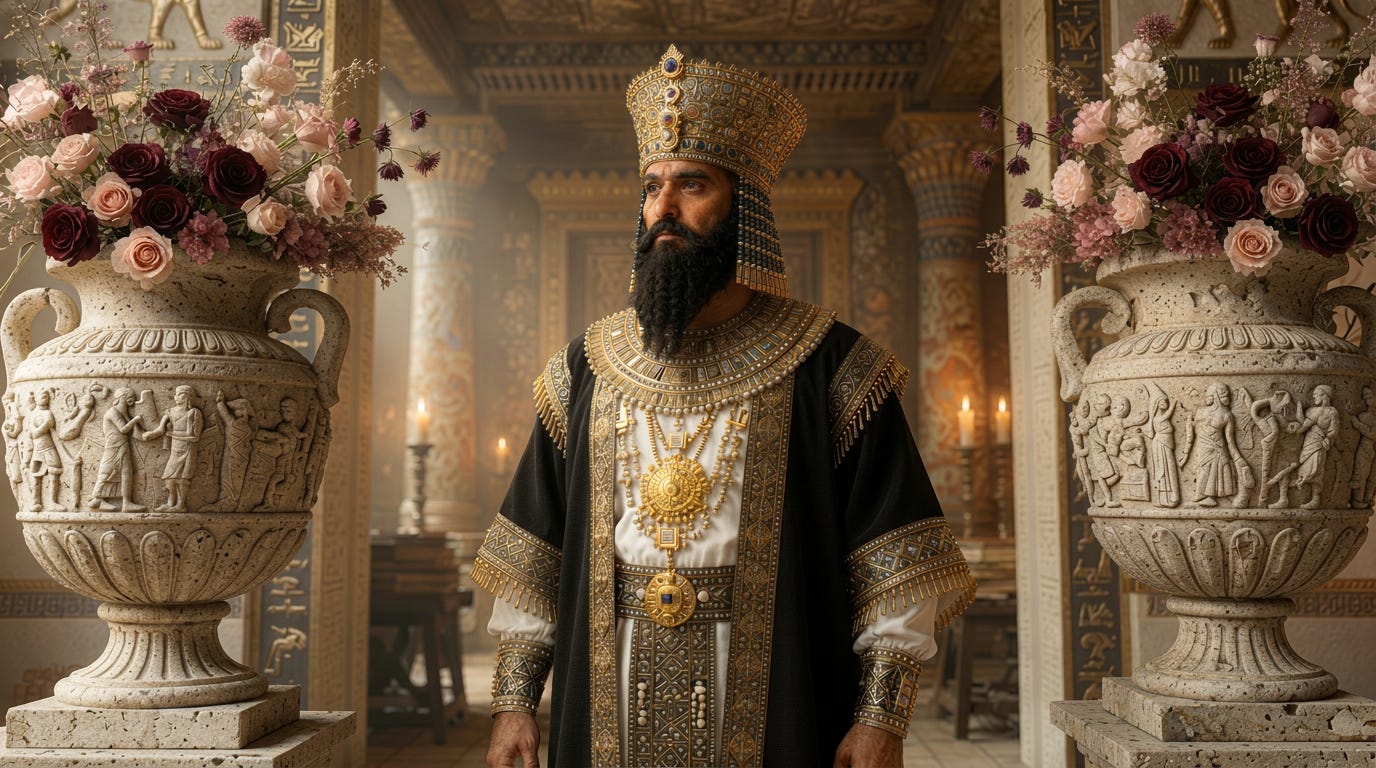
The Eurocentric reductionism at work here is not difficult to diagnose. Modern Europe was forged in war. Its intellectual tradition, from Thucydides to Hobbes to Clausewitz, has treated organized violence as the natural state of humanity, the engine of historical change, the default mechanism by which one people supplants another. The standard model of elite replacement is Hobbes translated into prehistory: a war of all against all, in which the strongest band of brothers inevitably seizes the top of the hierarchy. But this model is not a universal law; it is a cultural assumption, and it has been projected backward onto periods that may have operated by entirely different rules.
The genetic evidence, read without the assumption of conquest, tells a more complex and more interesting story. The Y‑chromosome replacement was not sudden. It was gradual, unfolding over centuries, even millennia. The mothers, meanwhile, remained largely constant; the same mitochondrial lineages—H, U, K, T, X—persisted from the Neolithic through every subsequent transition. This is not the signature of a blitzkrieg. It is the signature of a slow infiltration, a demographic drift, a gradual shift in who was marrying whom and whose sons were surviving to adulthood in greater numbers.
How might such a shift occur without a single dramatic slaughter? Consider the Mexican family that moves north. They do not arrive with a plan to depose the local elite. They arrive with a set of psychological dispositions—a tolerance for dense cohabitation, a willingness to pool income across multiple working adults, an expectation of mutual aid that extends across cousins—that, in the new economic environment, turns out to be an advantage. Six adults sharing a single house can accumulate capital faster than a nuclear family of four drowning in mortgage debt. Over a generation or two, the newcomers move from laborers to contractors, from renters to landlords. No one was killed. No chieftain was dethroned. The old elite simply became less relevant, out‑competed in the quiet, grinding arithmetic of daily survival.
The Pakistani family arrives with a different but equally potent set of dispositions: accumulated wealth from the old country, a network of relatives already established, and a cultural norm that treats the lending of large sums between cousins as an obligation, not a risk. They bypass the entry‑level struggle entirely and move directly into the middle class, opening businesses that employ the children of the older, native‑born families who could not secure the same loan because their own cultural framework treats such lending as reckless, as an overreach, as something shut away in a mental compartment labeled “not how we do things.”
Now transpose these logics onto the ancient Near East. The J‑bearing pastoralist who arrives at a farming village may not come as a raider. He may come as a herder seeking winter pasture, as a trader carrying copper beads from the highlands, as a laborer offering his services for a share of the harvest. But he carries with him psychological dispositions that, in the long run, prove advantageous. His sons marry into the local community, but they do so on terms that favor his lineage. His grandsons own more land, more livestock, more debt obligations from their neighbors. The old paternal lineages do not disappear overnight. They simply dwindle, out‑bred and out‑invested, until, five centuries later, a geneticist excavating the cemetery declares that an elite replacement has occurred—and a historian, steeped in the European tradition, adds the swords and the burning huts that the archaeologist never found.
The elite replacements we see in the genetic record were not merely the result of material advantages—a better plow, a sharper sword. They were also the result of psychological dispositions: a willingness to pool resources that the locals lacked, a tolerance for risk that the locals found reckless, a kinship structure that enabled collective action across wider networks, a readiness to use violence that the locals had culturally suppressed. These dispositions were not epigenetic in the biological sense; they were memetic, inherited through training, story, and ritual, but they were as real as any gene. That is the Eurocentric reductionism at the core of the standard model: the assumption that all human behavior is a rational response to economic incentives, that culture is an epiphenomenon, that the material base determines the superstructure.
None of this is to deny that violence occurred. The Bronze Age had its wars, its sieges, its destructions. The proliferation of weapons hoards is itself a psychological signature: the greater a community’s predisposition toward weaponry, the more it produces, the more it maintains, and—by the sheer arithmetic of abundance—the more likely it is that a cache survives for the archaeologist to find. A single hoard does not prove that everyone was fighting; it proves that someone found fighting important enough to stockpile for, and that is a cultural choice, not a universal condition. The Männerbund was a real institution, and it could be deployed with devastating effect. But violence was a tool, not the tool, and to elevate it to the sole mechanism of elite replacement is to mistake the exception for the rule. The quieter mechanisms—the differential birth rate, the loan that cannot be repaid, the marriage alliance that shifts inheritance patterns, the cultural norm that makes one group save while the other spends—were likely more important in the aggregate. These mechanisms leave no destruction layer. They leave only a shift in the frequency of a few mutations on a Y‑chromosome, a shift so gradual that it would be invisible to anyone living through it, and so unmistakable in retrospect that we cannot help but invent a war to explain it.
The Männerbund, as it appears in the archaeological and ethnographic record, is routinely catalogued alongside the wheel, the chariot, and arsenical bronze as one of the great technological innovations that pastoralist societies exported into the lowlands (maybe/maybe not). It is described as a social technology—a mechanism for organizing young men into cohesive fighting units, severing their natal loyalties, and redirecting their aggression outward. This classification is not wrong, but it is shallow. It treats the institution as a tool, like a sword, something a society picks up and wields. It misses the far more unsettling truth: the Männerbund is not a technology. It is a psychological disposition, a memetic inheritance, a set of deeply ingrained habits of mind that precede the tool and determine whether the tool is sought in the first place.
The distinction matters enormously for how we reconstruct elite replacement. If the Männerbund is a technology, then its spread is a matter of diffusion: one group learns it from another, adopts it, and gains a competitive edge. The story remains one of material advantage—a better organizational chart, a more efficient command structure. But if the Männerbund is a psychological disposition, then it is not something a society learns; it is something a society is. It cannot be adopted without altering the entire fabric of kinship, child‑rearing, identity, and the boundary between the self and the group. And its presence in one population and absence in another is not a matter of technological lag but of a fundamental divergence in what kinds of persons are produced by each culture.
This reframing also forces a reassessment of how elite replacements actually unfolded. The standard narrative assumes that open warfare—battlefield victories, sieges, the clash of arms—was the primary engine of Y‑chromosome turnover. This assumption is, at root, Eurocentric: it projects the warfare‑centric history of Europe onto prehistory. But if we take seriously the psychological dimension of elite replacement, a different calculus emerges. Sabotage, treachery, and the slow, patient exploitation of social trust are not merely supplementary to military conquest; they are, in all likelihood, the dominant mechanisms. They leave no destruction layer, no mass grave, no burned citadel. They leave only a shift in who owns the land and whose sons marry into the chiefly lineage.
Consider the Hyksos in Egypt. The standard account paints them as chariot‑riding conquerors who overwhelmed the Delta by force. But the Egyptian sources themselves, read carefully, suggest a far more gradual infiltration—mercenaries, traders, and migrant laborers who accumulated power over generations, who married into Egyptian families, who learned the language and the customs, and who eventually simply woke up as the ruling class without a single decisive battle. The chariot was there, yes, but the chariot was the final seal on a process that had been underway for a century, driven not by military superiority but by a psychological disposition toward patient accumulation, toward collective action across wide kin networks, toward a long‑term strategy that the local elite, fragmented and competing among themselves, could not match.
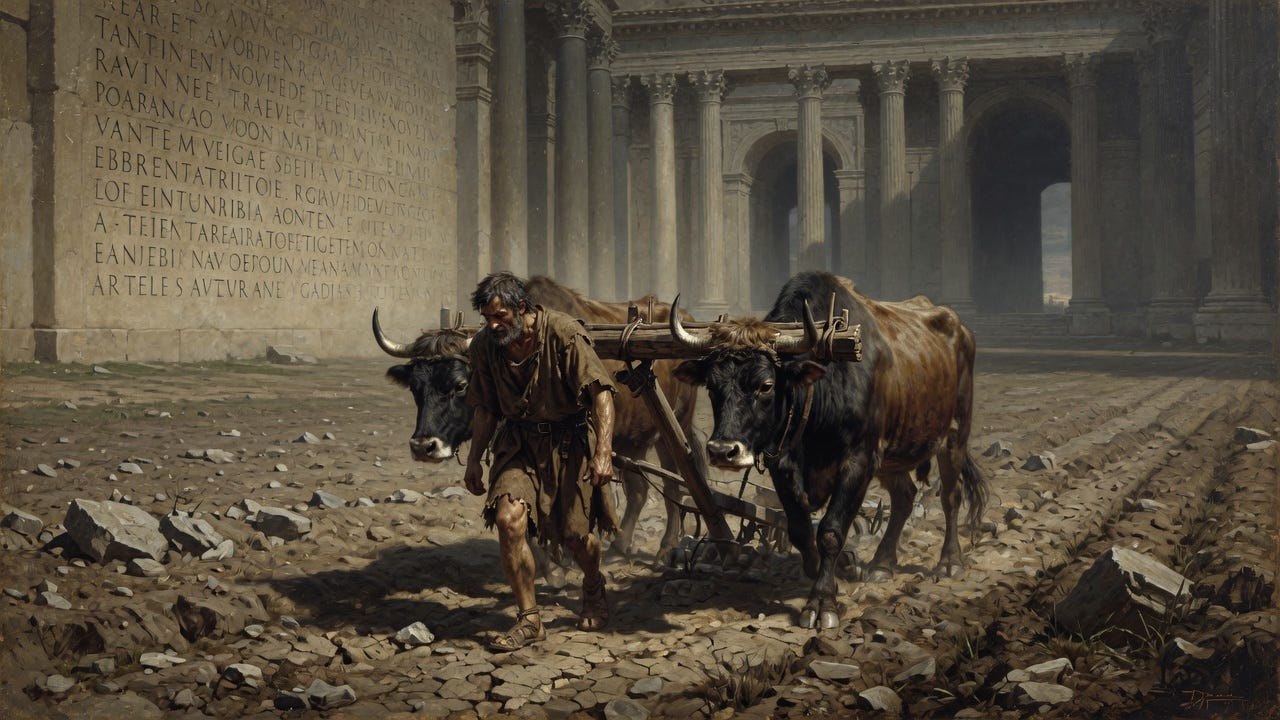
The same pattern appears wherever we look closely. The Dorian takeover of the Peloponnese, if it occurred as a discrete event, left no archaeologically identifiable destruction layer that can be confidently attributed to invaders. What we find instead is a gradual shift in material culture, a slow emergence of new social forms, a creeping Dorianization that looks less like a conquest and more like a cultural and demographic drift. The Dorian ethos—the agoge, the mess, the discipline—was not a military technology brought from the north; it was a psychological package that, once embedded in a community, gave that community a reproductive and economic edge over its neighbors. The edge was not primarily exercised through battle but through the relentless, multi‑generational training of young men to subordinate their individual desires to the survival of the group.
And when we turn to the steppe pastoralists who brought R1b into Europe, the same logic applies. The Yamnaya did not conquer the continent by fighting their way through every Neolithic village. They arrived in small groups, established themselves on the margins, and over centuries, their particular psychological dispositions—a tolerance for mobility, a willingness to use violence when necessary but also a capacity for long‑distance alliance and exchange—allowed them to out‑compete the more sedentary, more localized populations. The violence, when it occurred, was sporadic and opportunistic, not the primary engine of replacement.
Technological innovations—bronze, the horse, the chariot, the wheel—likely accounted for fewer successful elite replacements than did the far less glamorous arts of sabotage, treachery, and the quiet, unspectacular exploitation of trust. The Männerbund was not a technology but the psychological soil in which the decision to hoard weapons, to raid, to betray, and to bide one’s time could grow. It was a disposition toward loyalty and predation in equal measure, and it was that disposition, not the bronze in the hand, that proved decisive. The victors were not always the ones with the sharpest swords. They were, far more often, the ones who knew how to wait, how to pool resources, how to marry well, and when the moment arrived, how to slide the knife between the ribs of a neighbor who never saw it coming. The genetic record is a monument not to battlefield glory but to the patient, ruthless, and deeply psychological art of becoming indispensable before you become dominant.
On the Bronze Weapon as a Decisive Advantage
The bronze weapon has been elevated into a talisman of inevitability. The standard narrative runs that when the first bronze swords appeared on the field, the outcome was as predetermined as a Maxim gun against spears—a technological rupture so profound that the old world simply had no answer. The romance of this image is palpable. It transforms conquest into a kind of natural selection, in which the superior metal confers the superior destiny, and the vanquished are not murdered but merely out‑evolved. This is patriotism dressed as metallurgy.
The reality is far less cinematic. Bronze is an improvement over flint and copper, but it is not an exponential leap. A bronze sword holds an edge longer than a copper one, and it is less brittle. But it is not gunpowder versus an arrow. It is not a cannon against a city wall. It is not a nuclear warhead against a civilian population. It is, in practical terms, a sharper, more durable blade—nothing more. The difference between a bronze spear and a fire‑hardened wooden one, between a bronze axe and a well‑knapped flint blade, is measurable in inches of penetration and hours of sharpening time. It is not the difference between living and dying in every encounter. It is not a weapon system that renders all previous forms of combat obsolete. The societies that fell to bronze‑armed pastoralists had been fighting each other—and the pastoralists themselves—for centuries. They knew what a blade could do. The bronze edge was real, but it was marginal, and margins do not explain the total eclipse of entire paternal lineages.
And then there is the chronology. By the Middle Bronze Age, bronze weapons are everywhere. They are no longer the monopoly of a highland elite; they are being produced, traded, and buried across the entire Near East and Europe. If bronze swords alone could wipe out paternal lineages, we would expect the turnovers to be concentrated at the moment of the weapon’s first appearance.
Oh, The Irony
The irony is that the standard model, for all its pretensions to rigor, is ultimately a romantic fiction. It imagines a past of decisive battles, of strong men who seized their destinies with bronze in their hands, of clean breaks and fresh starts. The reality, as the genetic and archaeological records whisper, was far more mundane: a slow churn of differential success, amplified across centuries, driven as much by psychological dispositions—the culturally inherited habits of mind that govern how people share space, extend credit, raise children, and tolerate risk—as by any material advantage in weaponry or tactics. The past was not a constant war. It was a constant negotiation, and the victors were not always the ones with the sharpest swords.
But yeah, sometimes they just bashed people over the skull with a mace, too. The end.